Thursday, September 8, 2016

Cavalry and Devilry


August 6-7

We stopped in Hardin because it’s close to one of the most famous sites in the Western states, and maybe in the United States, the Little Bighorn Battlefield. It was the subject of a Budweiser print that used to hang in bars all over the country.

Going there, I found, is an experience very much like visiting the Alamo. Errol Flynn, Richard Mulligan, Robert Shaw, and countless other actors died at the Little Bighorn. Just as Fess Parker, Sterling Hayden, John Wayne, and hundreds more died at the Alamo.

It has been fictionalized, rationalized, and lied about so often that I half expected it to be like Stonewall Jackson memorabilia in Virginia.

But the Little Bighorn Battlefield National Monument, like the Alamo, brought this wise-ass up short.

The parking lot and visitor center are next to a National Cemetery. None of the dead from the Little Bighorn battle are buried there. Many of the graves are reburials from cemeteries at frontier forts that were closed. The identities of many of those remains are unknown.


Others are from the Spanish-American, First World, Second World, and later wars.

We saw the grave of someone whose name I know. Marcus Reno was one of Custer’s officers, who was court-martialed, essentially for surviving the Battle of the Little Bighorn, but then exonerated.

Reno led part of Custer’s command in the initial attack on the huge Indian camp. It was a diversion while Custer took a larger, though still inadequate, force to attack another part of the encampment.

Reno’s force was driven back by overwhelming numbers of Indians, who then turned their attention to Custer.

Reno fell back to join another part of Custer’s command, led by an officer named Benteen, who were holding a hill a few miles away. Many of them would die, too, in a siege that lasted about a day. 

Then all the Indians withdrew. They buried their dead and moved away.

The Seventh Cavalry dead, their scouts, and a few civilians who were with the group, are buried in a mass grave under a monument that lists their names on top of Last Stand Hill. 

Years ago, I was driving back from Mexico to Houston and stopped for the night in a small town called Beeville, not far south of San Antonio. 

The next morning, feeling really irreverent, I detoured to the Alamo. I waited outside with a small crowd of people until the place opened. I expected something really tacky, and expected to be amused.

Just outside the door of the mission church I read a sign that changed everything. “You are about to enter the Alamo Shrine. Gentlemen, please remove your hats.”

I choked down the lump in my throat and the last thing that occurred to me then was to make a wisecrack.

I had the same feeling here. After walking through the cemetery, we rested in the visitor center and saw the orientation film that discussed events leading to Great Sioux War of 1876-77 and the Battle of the Little Bighorn.

I favor a theory I’ve read a couple of times about Custer’s motivation that day. 

His name already had high recognition. A victory against the Sioux, even if it was an unarmed village, would make him an even greater national hero.

It would give him a shot at the Republican nomination for the presidential race. The Republican Convention was due to begin in Kansas City about a month after Custer rode down the hill to attack the entire Sioux Nation, most of the Cheyenne, and the Arapaho.

We all know it didn’t go as Custer planned it. Almost 300 American soldiers and civilians, and many Indian scouts died there.


Marble markers all over the battlefield look like the headstones in the cemetery, but these mark where each man’s body was found. There are many on Last Stand Hill, including one in the center with Custer’s name on a black shield.

There is a ravine with many more, where an officer named Calhoun led a contingent that was wiped out.

There are other markers dotted around in the grass in twos and threes.

Many markers simply say “U.S. Soldier.” Their names are etched on a stone monument at the top of the hill, so there is a record of who died there. But private soldiers carried no personal identification so individual bodies couldn’t be identified.

Most of them are in the mass grave. The officers’ remains have been buried elsewhere. Custer’s grave, for instance, is at West Point. 

A second set of markers, dark brown and distinct from the marble, record where Indians fell. 


There is one right on the edge of the National Cemetery, for instance. It says that O Xasehe, or Cut Belly, was a Cheyenne warrior who fell at that spot on June 25, 1876, “while defending the Cheyenne way of life.”

It is estimated that 60 to 100 Indians died in the fighting.

Not far from Last Stand Hill, there is a monument to the Sioux, Cheyenne, and Arapaho who fought here.


It is a very eerie place. Broad and mostly very silent. The markers stand in grass that waves in the wind. 

We didn’t bother with any of the commercial attractions in the area and made it to Gillette shortly after three. 

I did an Internet search for places to eat and found a couple of steak houses. We got the directions to one of them and the route took us past the other one.

We pulled up at the Chophouse. I thought we were early. Joanna thought the place was closed. Joanna was right. The windows were papered up.

That’s how we wound up at the other place, the Prime Rib. It was fun. We shared a dozen snails and sopped up the butter with sourdough bread. That was already a lot of food, so we shared one order of New York strip. 

Here’s how we did it. It came medium rare—way too red inside for Joanna’s taste. I cut it in half and Joanna sent hers back to the kitchen to cook some more.

We shared the salad, potatoes, and string beans that came with the steak and were stuffed before it was gone. Joanna took a few ounces of her steak and some beans away in a box.
We had a California pinot noir with it. It was surprisingly light for pinot. It had a good ending, but not as much flavor up front as I like.

I lost all track of time again. I got up on Saturday morning and found out it was Sunday. I lived all day yesterday thinking it was Friday.

Enough of that. It can make my head hurt,

Sunday, the seventh, we made it to another very interesting place made famous by the movies. 


Devil’s Tower is all it’s cracked up to be. Crossing the passes in the hills, we could see the top of it miles away. 

We stopped at a scenic turnout and met a bunch of bikers in the area for the Sturgis Bike Rally this coming week. 

One of them came up to us and asked to have his picture taken with us. He said he gets his picture taken often with non-bikers. How could he know I was not a biker? The rally is the reason we are not staying in Deadwood, or even in Rapid City, but in a town a few miles south. 


I expect there are plenty of bikes on the highways here all summer long, but August is peak season. Sturgis closes its streets to cars for the bike rally in the second week of August.

According to the Park Service, there is a mass ride to Devil’s Tower on Wednesday of Rally Week. They have to make special arrangements to park all the motorcycles.


I have photo somewhere taken during a rally some years ago. It shows Lorenzo Lamas, who was a motorcycle rider in a TV series called “Renegade,” with Pee-wee Herman, whose connection with motorcycles is dancing in white platform shoes on top of a biker bar. (If you don’t now what I’m talking about, that’s OK. See “Pee-wee’s Big Adventure.”)

I may have lost it, though. Some weeks ago, before I left for this trip, I spilled beer on my other computer. I took it to the Great Apple Graveyard to be recycled.

We met climbers who had scaled the tower and saw several others in the process. Doesn’t it harm the rock, we asked. They showed us a removable piton that clips into a crevice and leaves no trace.

Joanna got the best shot of climbers on the Tower.


Another climber we met is a park climbing ranger. He gets to scale the mountain three or four times a week. The round trip takes about eight hours.

His companion, not a ranger, said he found the experience “terrifyingly awesome.” Now that it was over, he was glad that he did it. He might do it again some time in the future, he said, but he’s not sure about that.

The tower sits on the remains of an eroded hill. It rises more than 800 feet. People climb up through the crevices between the columns of rock. 

I got the best (only) shot of Joanna photographing the climbers.


The tower was formed by magma under the surface of the Earth. As the hot rock cooled, it cracked. At least, that’s what I remember from one of the signs along the trail.

Over millions of years, wind and water eroded the surface and left the tower exposed. You get a similar story at Stone Mountain, Georgia.

I’m more inclined to accept the Kiowa story. Seven girls were chased by a bear. They leapt onto a rock, and one of them prayed to the rock to save them. It started to grow higher. The bear tried to chase them up the rock, but kept slipping, leaving his claw marks in the stone.


My grandson Liam has a birthday later this month, so I sent him a card a little early. Devil’s Tower has its own post office.

What better place can there be to send greetings to a little devil? Especially when they’re coming from a big one.

We found a promising looking Italian retaurant in town and decided to go there for a pasta fix. That was closed, too. Restaurants around here have been really catching hell.

Rather than go back and start another Google search, we went to the one place we know was open in town, the Prime Rib.

Both times we went there, I got to park next to the fire plug and not get a ticket.


Joanna had chicken Parmagiana and I had something called chicken Italiano. The sauce was too sweet, the onions pieces too big, but the Banfi Chianti classico riserva (2012) was terrific.

I am polishing off the last of the bottle now.

And am wrapping this up, too, because it’s already too long.

Love to all and to all a good night.

Harry


Painted Caves, or Writing on the Wall


August 4-5

After I sent the e-mail from Starbucks on Thursday, Joanna and I went back to the Museum of the Rockies. One of the permanent exhibits there is devoted to the history of the Earth and the evolution of life.

When I see these things, I am always reminded why I can’t remember the names of the geological periods. It’s like an extensive filing systems full of code words. Pre-Cambrian, Paleozoic, Mesozoic, Cenozoic. OK.

But each one has several subsets, which is where (I guess) terms like Cretaceous and Jurassic creep in. Then each of those has multiple breakdowns.

On the other hand, the museum runs a recording of how, judging by anatomical features, some of the dinosaurs vocalizations may have sounded. That, and of course all the old bones and fossils of invertebrates, are very interesting.


There is also an exhibit of artifacts from villas in Herculaneum and the surrounding area that were uncovered from the ruins after the great eruption of Vesuvius in the first century A.D.

Not so interesting for Joanna. She has been in Pompeii.

We went back to Main Street in the evening and had dinner at Ted’s Montana Grill. This has no connection with Ted’s Corner Tavern on Third Avenue in New York. This one, we were told, is owned by Ted Turner. 


The bison meat loaf and bison pot roast were both very tasty. The garlic mashed potatoes were very lightly seasoned with garlic, which is a very good thing. Aunt Somebody’s squash casserole contained bread crumbs and black pepper, so it had some flavor, too, and I rarely expect flavor from squash.

I had a Bent Nail IPA, a Montana brew that I had tried before from the bottle, and an amber, much like an English bitter, whose name I forget.

Several blocks were turned into a pedestrian mall for an event called Music on Main, part of the Sweet Pea Festival. We arrived as musicians were packing up, but there were still a lot of people there, including a table set up by the Green Coalition of Gay Loggers for Jesus.


Signs warned people that no alcohol was permitted past a certain point and the open containers were permitted only in the festival area between 6 and 9 p.m. And I had always pictured Montana as a wide-open live-and-let-live state. 

It may have been at one time, but now it is getting as anal retentive as New York.

At nine, we were chased onto the sidewalk and four cop cars with lights flashing came through. I guess they were going to run over anybody with an open container.

Friday, we left Bozeman for Hardin, a small town just off Interstate 90 and about 15 miles from the Crow Agency and the Little Bighorn Battlefield National Monument.

It is a drive of two and a half or three hours. We took a little longer because we saw a sign for Pictograph Cave State Park.

Never heard of that before, so we took the exit and followed the only road till we came to the visitors’ center. For six bucks you get to walk up a sidewalk to a shallow cave that has yielded evidence of occupation for at least 10,000 years. 

It was excavated over a several years beginning in 1937. 


The pictographs are paintings on the cave walls. They have seriously deteriorated since the excavation. You really can’t make much out, but there are reproductions and indications of where the remains are.  

Many were in black. Some, in red pigment, show up better. But at least one of them was drawn very late because it is an image of rifles.

I followed a side trail to another spot called Ghost Cave. Before the excavations in the ’30s and ’40s the park was named for Ghost Cave.

The cave creates strange echoes and amplifies sounds. I heard my feet on the gravel path, but also heard grunts and other sharp noises that were either distortions of wind or complaints by dyspeptic revenants.


It is strangely eroded, too, with large round stone formations on the walls that look like giant emerging heads.
Joanna waited below and took the photo of my hat at Ghost Cave.
We will stop at the Crow Agency on Saturday and then move on to Gillette, Wyoming, near Devil’s Tower.

Be well, all.

Harry


Tuesday, September 6, 2016

Bozeman Trails


August 2-3

It is a short drive from Livingston to Bozeman, mostly on Interstate 90. We are in another plain surrounded by mountains.

Bozeman has about 40,000 people, making it is the biggest town we’ve seen since we left Cheyenne. 

We got into town with plenty of time for mostly boring, but necessary stuff: Blood test, Rx refills, dropping off dry cleaning, taking a nap, running a couple of washer loads at a laundromat.

I had booked us into an independent motel, which is always a craps shoot. Actually many motels are. 

I’ve learned on this trip that you can count on Motel 6, though. It is consistently bad. The towels are like sand paper and the franchise is too cheap to give you a packet of shampoo.

Super 8, another inexpensive brand, is all over the place. Some are run down and literally moldy, but the one in Livingston was very good. It was clean and bright, and even provided a reasonable breakfast. It’s more like what I expect at La Quinta or Hampton Inn.

The Rainbow Motel in Bozeman is near the bottom of the list. Maybe a short step above the Motel 6 in Jackson. The room has a funny smell. The wi-fi is usually unavailable. When it works, it can be too slow to use e-mail. (I’m in Starbucks, right now.)

There was a guy sitting outside not far from our door.

He has stringy hair down to his shoulders and a cowboy walrus moustache. Joanna and I were both wearing light color clothes and straw hats. He said we looked like twins. 

Given the bare-bones simplicity of the property here, when I first saw him sitting stock still on a bench outside his door, I figured this was a welfare hotel and he was on county relief.

Not so, though. He asked where we were going to eat. We said we didn’t know yet. He gave us a couple of suggestions. One was a brewery, and my experience in Livingston taught me that the breweries stop serving at eight and are supposed to close at nine.

So the man shared a recommendation that he got from one of the ladies at the Rainbow office. There is a place called Cat’s Paw not far up the road. 


Dinner was surprisingly hard to find. Cat’s Paw, a block away on North 7th Avenue, was closed. So we tried to find the Club Tavern, farther up the avenue. We had the number of the address, taken from the Yellow Pages directory, but couldn’t find it. Maybe it’s closed or operating under a new name.

We went to a place called Old Chicago. The name suggested a steakhouse to me, but it had no steak. I had a burger. Joanna had a salad with chicken.

The big thing there is pizza, so maybe they make it Chicago style, in a pan with thick crust. 

They did have a good range of craft beer. I had a couple of tasty IPAs with some fragrance.

On the way home, I picked up a six-pack of Big Sky IPA, which is also good. Like most of the IPAs made up here, it is short on hop aroma, but the body and bitterness are both satisfying. 

Wednesday morning we had breakfast with the welfare cowboy.

The motel, as many do, lays out cold cereal, pastry, and coffee each morning. Joanna and I took ours to a picnic table. We saw the cowboy out to get coffee. 

He asked, so I told him about the Cat’s Paw, and then he joined us.

His name is Sonny, and he grew up in Bozeman. He actually had a ranch, and has experience raising cows and horses. I believe he said the ranch was in Wyoming. He lives in Albuquerque now and had driven up for his 50th high school reunion.

He is full of stories, and some of them may be true. His parents sent him to a private school out of state for his senior year of school, to get his grades up so he could go to college.

He was a bronc rider for the Montana State U. rodeo team. When the school told him that he couldn’t just ride broncs and drink, but had to go to classes, too, he quit.

He has caps in the window of his car for the First Cavalry and the Bronze Star. He says he earned three Bronze Stars in Vietnam.

We went to the Museum of the Rockies in the afternoon. We spent an hour or so at the farm exhibit next to the museum building. 

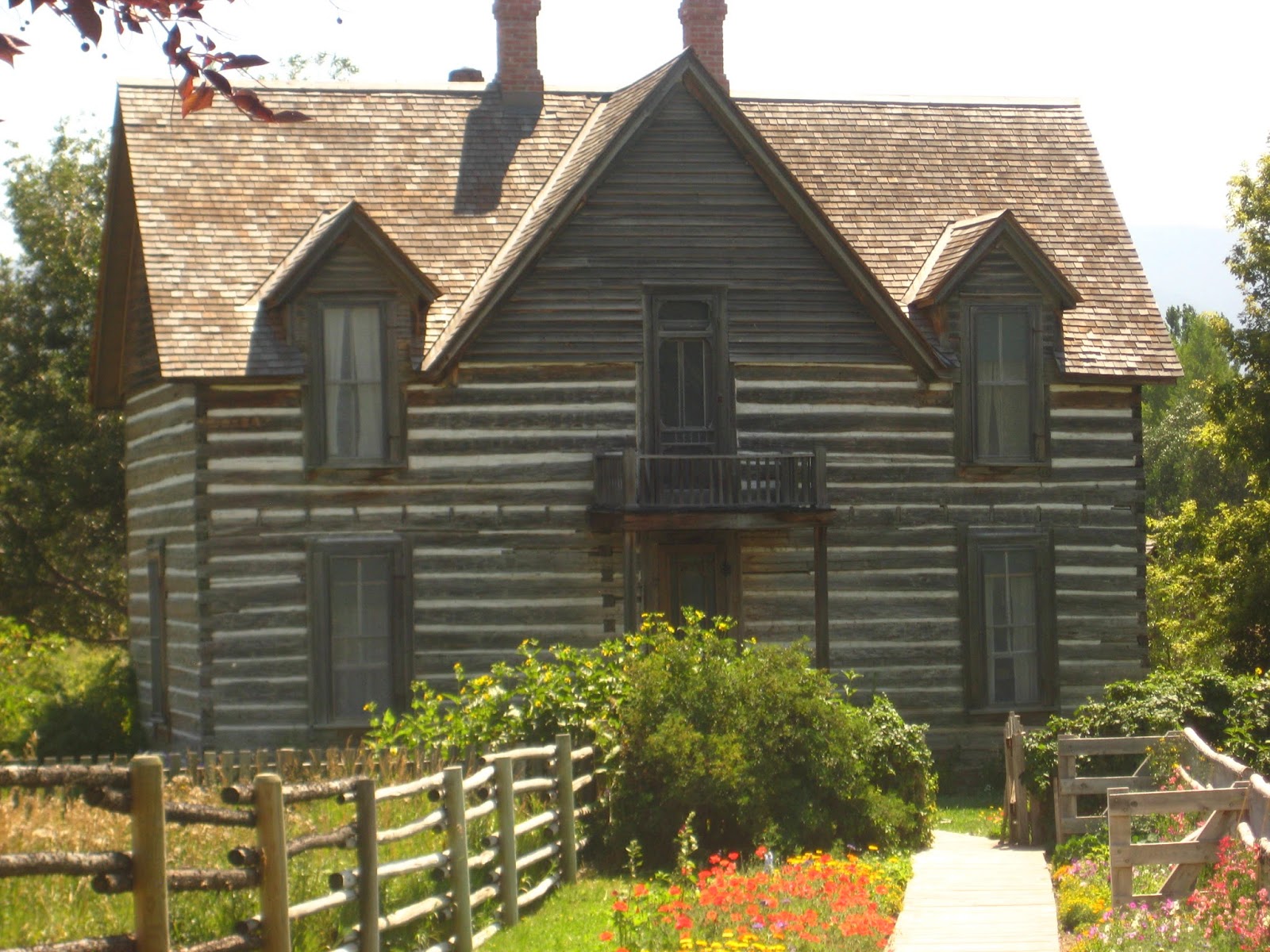
It includes a two-story log house built around 1890. Montana State University, which operates the museum, hauled it in a single piece from its original site about 45 miles away in Willow Creek, Montana.


The interior is furnished in period furniture, but pieces not original to the house. 

A man named Tinsley became a homesteader out here to get away from Missouri during the Civil War. There is a replica of a one-room cabin the family lived in for 20 years. They had eight children.

The farm has a kitchen garden using heirloom seeds for authenticity.

We saw corn growing in the garden. The gardener, who may teach at the university, told us the heirloom corn is hit or miss.

Summers can be too chilly to yield a crop some years. Same is true for the tomatoes. The nights are often too cold for the fruit to form.

He said he tends his own home garden where he grows corn and tomatoes, but they are hybrid strains developed for climates like Montana's. They were unavailable in the 1890s.

For lunch, we went to Bridger Brewing. All they serve there is pizza and great beer. I had a pint of a black IPA called Antilogy. I just discovered that’s a real word, meaning “contradiction in terms.” 

Lots of malt and lots of hops contradicting each other.

We told Sonny we’d see him around four and walk to Main Street. The evening was the start of an annual event called the Sweet Pea Festival and would be devoted to food. 

All along the stroll downtown Sonny reminisced about what used to be where. 

The Rocking R Bar really surprised him. Didn’t look at all as he recalled it.

That, we learned later, is because about seven years ago a gas main leak ignited and blew up the entire block. Sonny said the place used to open at 7 a.m. for the bar-flies. It’s a bit more upscale now.

We sat next to Ralph, who was wearing a collar pin with Rocking R in rhinestones. He has been the owner of the place since 1978. Or maybe that’s ’88. I’m not sure now.

He showed us photos on the wall of the building after it blew up. 

The street was filled with stalls by various groups—local restaurants, Knights of Columbus—all offering samples of food. Joanna saw a man eating a turkey leg and asked where she could get one.

I was still stuffed from pizza for lunch. So I had few bites of turkey, which was very tasty and tender. The dark meat is always the best part of the bird.

I had so many different beers that they sort of run together in my memory. Every one was good, and most were from breweries I hadn’t heard of before.

I guess, all in all, Bozeman is my kind of town.

Be well, all.

Harry


Monday, September 5, 2016

Hell on Wheels


July 31, August 1

Sunday we went from Jackson, Wyoming, to Livingston, Montana, by way of something that may look a little bit like hell. At least, it smokes and smells faintly of sulphur. I don’t know what brimstone smells like.

From town to town is a 4 1/2 hour drive. We made good time and did it in 10.


First, of course, we passed the Grand Tetons again. They are amazing every time we look at them, and this time the air was a little clearer than it was a couple of days earlier: wonderful soaring stones dressed in bits of glacier.

We stopped at a historic site, the J.P. Cunningham cabin, which is on a large piece of prairie in sight of the Grand Teton Range.

It looks like the Pony Express stop in dozens of Western movies. It has two separate log rooms separated by a roofed breezeway. 


The gaps between the logs and the space between the dirt floor and the walls show no evidence of having been chinked with plaster or clay. I have no idea how anyone could have wintered there in Wyoming. Or hell, even in the Carolinas.

But Mr. Cunningham and his wife, we read, lived there for several years while he built a farmhouse.

Like most ranchers, he was originally opposed to the idea of turning a large part of the Tetons into a playground. The hard economics of cattle raising, or persuasion, or something eventually turned him around to being a booster of the idea. 

He not only sold his property to John Rockefeller for the project, but got a lot of other ranchers to go along. Rockefeller put together 33,000 acres, about 50 square miles, to donate the park. 


Resistance was rife in the area. A rancher and several others including, for some reason, the movie actor Wallace Beery, led a herd of cattle across part of the park shortly after it was set aside, I guess to show that they could.

The rancher (whose name escapes me) later became governor of Wyoming. By the time he took office, he had developed an apparent conservationist state of mind. He supposedly once remarked, “Thank the Lord that we lost that fight.”

I came this far west partly to confirm that, yes, Yellowstone is a truly bizarre place.


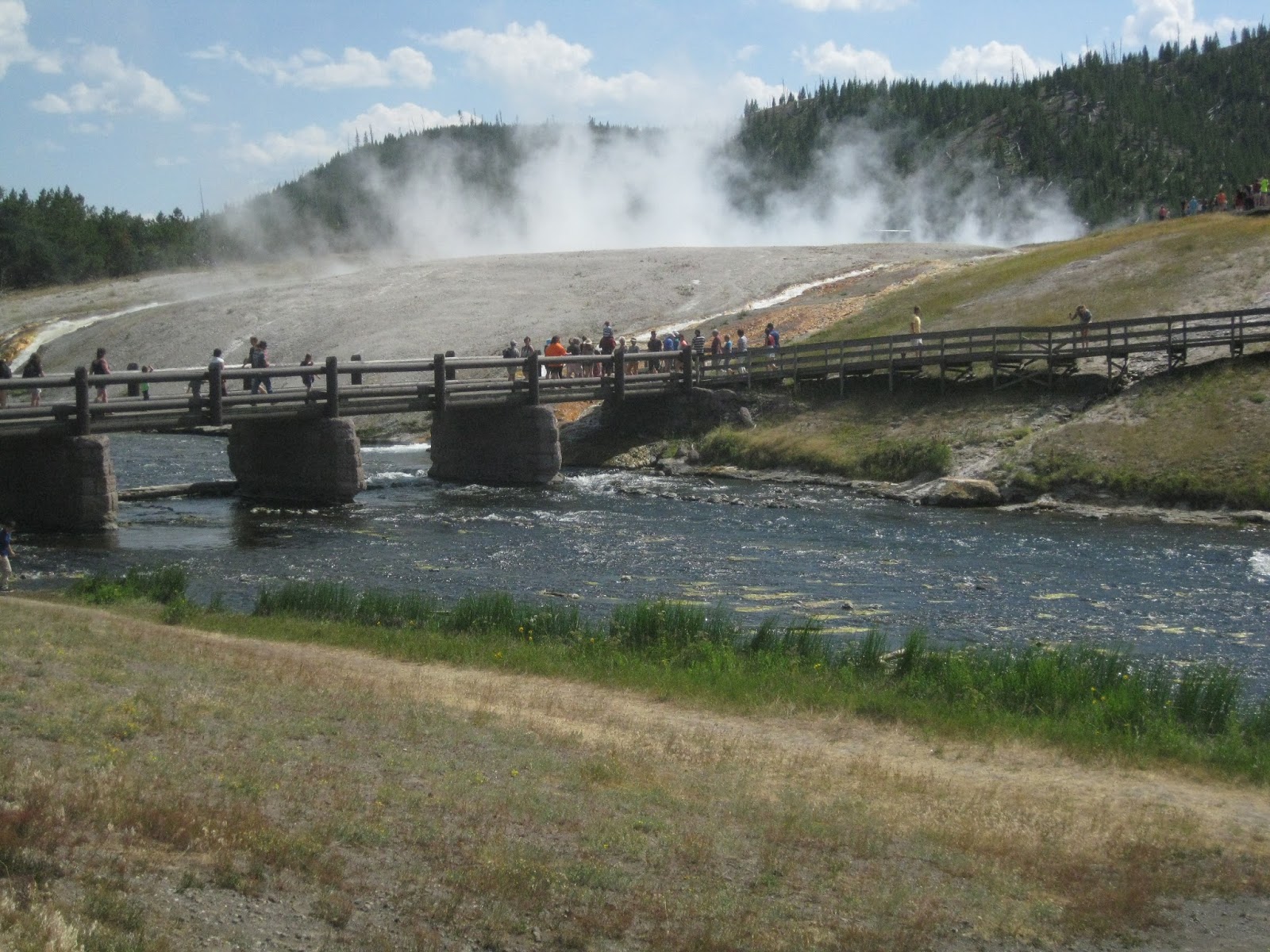
There are active sites with bubbling pools of mud, geysers of boiling water, and plumes of steam. Some of them, like Excelsior Crater and the Artists Paint Pots are very colorful, mineral deposits tinged red, yellow, white, and orange. Often the water in pools is sky blue, or a smoky opal, if the water carries enough dissolved white stone.

A novelty we didn’t expect is Lake Isa, a large pond covered in water lilies that strides the Continental Divide. You cross the Divide often out here because it snakes its way through the Rockies.


One side of Lake Isa drains to the Gulf of Mexico and the other to the Pacific. Don’t ask me how that works, but I saw the lake, and there it is. So if its water hasn’t learned to run uphill, it’s flowing two ways.

Of course, we had to see Old Faithful. It makes you feel like a confirmed tourist. We got to the parking lot, which was extensive and packed. We couldn’t see any useful directions. We followed a drifting crowd instead. 

The geyser erupts at various intervals. The timing of an eruption, they say, can be calculated by the duration of the previous blowout.

The geyser was already spitting a few false starts when we got there. We stood in the shade for maybe 20 minutes and then it took off. As advertised.


We saw steam in the distance from other geysers. They steam and sometimes send up small eruptions of water. For some, that’s all they do. Old Faithful hits the ceiling. 

It’s hard to judge scale, especially at a distance. I’m told the jet of water will reach somewhere between 100 and 200 feet in the air.

We had read something about the Great Prismatic Spring. It is in one of the geyser fields, along with Excelsior Geyser Crater. 

Excelsior is steamy. It bubbles. 


This field is a very popular site and it took almost half an hour, I guess, to inch our way into the parking area to find a space.

You get out and walk a long boardwalk. (There are lots of boardwalks here, not only in parks, but also in Laramie and Jackson, just like board sidewalks in Western movies.)

In Yellowstone, the boardwalks protect the delicate and dangerous ground. 

The Excelsior Crater and Prismatic Spring don’t shoot up water, although the park warns that one fell dormant, then a century later became very active, and then went silent again. 

No telling, it said, when another massive eruption can take off. The subtext is travel at your own risk.

So it was a gamble. It looked calm enough. But if it went off while we were on the boardwalk, then we were parboiled meat.


Grand Prismatic Spring gets its name because of the variety of mineral colors it sheds. Water runs into the Firehole River, which goes somewhere. I keep losing track of which side of the Continental Divide we are on.


Another treat came near the end of the park run. There is a cluster of buildings that look like a village. It consists of hotels, eateries, cabins, park offices, all at a place called Mammoth Springs.

It was raining when we got there, and a herd of several dozen elk had taken over the place. They were on all the lawns and for the most part ignoring everybody (including us) who were staring at them and snapping photos.


There was one group behind a building and we pulled into a parking lot to get a better look. That group included two young bulls. 

One had single-point antlers, and the other had double-point. Both racks still had moss, indicating that they were newly grown.


There may have been several dozen elk, mostly cows and calves, spread through the place. 

We went on to Livingston, where we had dinner at Neptune, a brewery that enouraged us to “drink like a god.”

They served an American pale ale, an amber, and an IPA that were all good work. The amber was a little bit sweet, but not too much. The India pale ale was a little sharper and more bitter than the American.

I’ve noticed that a lot of the IPAs I’ve had out here don’t have the strong floral fragrance of hops. That may be intentional, and a regional preference. I miss it.

The food was hit or miss. Joanna had some boneless fried chicken, and I had a couple of bratwursts. The brats were good. The chicken too dry.

Good thing I went for the beer, not the food. 

The bar wisdom made up for the dry chicken. One sign reminded me, “Beer is the reason I get up every afternoon.” A sticker on the wall made a keen observation: “To err is human, to arr is pirate.”

Another stop well worth the trip.

Monday morning, we covered 50 miles or so to go back to Yellowstone. We took a different loop through the park with fewer steaming things, but other strange sights.

One was a petrified tree. I expected to find rocks lying on the ground. Instead, we saw a bit of trunk standing maybe a dozen feet high. It was covered millennia ago with volcanic ash that buried an entire forest. 


Silica embedded itself in the cells of the tree and preserved it in stone.

Somehow, genetic information was taken from the tree, enough to identify it as similar to the California redwoods. It stands behind a fence because it is the only surviving example of three petrified tree trunks. The other two were destroyed by souvenir hunters chipping off bits of stone.

The route brought us to the Grand Canyon of Yellowstone, dizzyingly deep. We stopped to see Tower Falls, a 120-foot step waterfall that comes down between eroded pillars of natural rock. 


You can follow a path past the grocery and souvenir store to a wooden viewing platform. I grew a little disoriented by looking down.

From the same place, we were able to see another formation across the chasm that looks for all the world like the columns of a temple.


We also saw a corral of horses. Joanna was disappointed the other day because she wasn’t quick enough to grab a photo of horses clustered very near the highway. Not her fault. Speed limit out here is 70.

Most of the horses we see are dots in the distance.

I told her we would see more horses up close. I didn’t know that. I was making it up. 

So when we passed the corral near a cluster of park buildings named for Theodore Roosevelt, we turned around and went back for a closer look. 


Joanna got several shots of horses, including some only of their tails. That’s because, as my father used to say, there are more horses' asses in the world than horses.

We saw the Paint Pots on Monday. A trail climbs the cliff behind them to give an overview of the colors that stain the ground.


One of the most fascinating pots here is not colored at all, but dead white. It is a large pool and two small ones of a substance that looks like pancake batter, but is really dissolved rocks, bubbling and popping. 

The rock gets tossed up at the margins of the pools and, when it hardens, looks like piles of salt.


Most of the Paint Pots walk is a boardwalk tour. According to signs in the park, the surface over the thermal areas is a thin crust. Walking on it, you can fall through and cook to death.

One of the Paint Pots, called Blood Geyser, gets its color from iron oxide, or rust.


We read that one place in the park, the Mineral Springs, I think, has no access trail because the ground is very unstable. Geologists have fallen through the crust there and taken severe burns.

The Mineral Springs are the remnant of a gigantic eruption. A huge valley was formed 600,000 years ago when a massive volcano blew it out and sent volcanic glass as far as Texas. 

The springs are kept hot by slowly mounting pressure of volcanic lava, or something like that, so geologists expect that eventually there will be another volcano. 

Watch out for flying glass, I guess.

We rode up and down mountain roads, and every once in a while, we’d see something smoking. Well, to be more accurate, steaming.

We were getting tired, and headed back toward Livingston. We had to wait for 15 or 20 minutes because of road work in the park, but even so were back before seven.

We went to Montana’s Rib and Chop House for dinner. It’s a chain with locations in several towns out here. Joanna had been craving fish and the place has a catch of the day on the menu, so it’s fresh and not frozen.

It was good. I tried a bite of it. But I was in the mood for brew and red meat. I had an IPA that was exceptionally bitter (a good thing) but oddly not strongly fragrant (a missing thing). I also had an amber ale, hoping that it too would be bitter. It was OK, but not quite as nutty as an English bitter.

Back at the motel, drinking more beer, I am almost out of supply. 

That is nature’s way of telling me it’s time for me to conk out.

What’s more, these are all the tall tales that I can remember to tell.

Good night, all, and all be well.