Sunday, February 3, 2013

Buzzed on Spain, Part 7


Churches, Christian and Otherwise
December 30

It’s Sunday afternoon and I came back to the hotel for a rest, if not a siesta. I still have a bottle of Rioja that Joanna and I bought in Valencia in case there was no place open on Christmas Day. But I’ve told you how great that holiday turned out.

After I packed up at the bar in the Atocha station, there was a train ride for almost three hours to Barcelona. The train was packed because people were traveling for New Year’s Eve. The guy next to me offered me a section of his newspaper, when I told him that I was OK, he asked where I was from. Montclair, New Jersey.

His father had a company called Solthermatic, or something like that, which had a factory years ago in Trenton, New Jersey.

I was born in Trenton, a long time ago.

They ask you not to talk too much in your seats in the coaches, out of consideration for other passengers. So the passenger in 1C, next to me, spent much of the time on his phone in the vestibule.

The track runs through pleasant country. More vines and orchards, hills, towns, villages. I saw a man with a stick and a dog with a flock of sheep. He even had a cloth cap on. I’ve never seen that outside the movies before. 

I am so lucky. Everywhere I turn, there is something cool to see. And what’s more, I have the ability to go and see it. I say thank-you prayers about that from time to time.

The train reached Barcelona a little after three. I took a cab to the hotel and checked in. Then I sent yesterday’s e-mail.

I tried to find a place to get my suit cleaned and some underwear washed, but nothing, not even the hotel laundry, seems to be open. There are some places a few miles away, but I can be more resourceful than to put myself out that far.

I wound up doing some hot-water rinsing in the sink and hanging stuff up to dry. The jacket is still serviceable, although a bit rumpled. I have another suit. I’m good to go.

Speaking of the sink. You pass it coming in from the hall. It’s right next to the door of the room. This is the first time I’ve had a hotel room that you enter through the bathroom.

I went out into the city shortly after five, when it was getting dark. I headed for the Old City, called the Barri Gòtic, the Gothic Barrio.


It’s got the old port, where the statue of Columbus points the way out, and lots of old churches, including Basilica Mare de Déu de la Mercé. I think it’s Catalan and translates literally into English as Mother of God of Favor or maybe Mercy.

In the church the representations of the Virgin Mary were all called Mare de Déu. There was a replica of the black Madonna of Monserrat in the church. You know I dropped a euro to light a candle with her.

Another highlight of the Barri Gòtic is La Cervetica, a brewhouse that sells its own ales and lots of craft beers from all over, including the States. I had two house brews: Tarraco I.P.A., which is darker and smokier than most India pales that I have had, and Fort Amber Ale, sharp and bitter, and at 5.3 percent reasonably “fort.” I had those with a couple of slabs of sardine and slices of black pudding. 

Back at the hotel, I ordered one more beer for the night. Una cerveza, por favor. The barkeep brought two. I wanted one. He told me my Spanish is no good.

He started to put one glass under the bar. No, that’s all right. Está bien. I’ll take them both. One I drank at the bar and the other in the room.

This morning I visited Sagrada Familia, the famous church designed by Antoni Gaudí. He died decades ago, and the church is still under construction. You can see some of its spires and the building cranes from this hotel, through a window near the elevators. 


After reading about it and seeing a few photos, I expected to find one of the ugliest buildings ever, but no, it is so far over the top that it is heroic. If you’re ever in Barcelona and don’t have time to get over to Our Lady of Favor, go see Sagrada Familia.

The photo of the day is a detail of the church, the nativity, which is over the principal doors of the eastward facing facade. I like the donkey head peeking around Mary.


It may be the most famous church in Spain. Certainly it’s up there with the top attractions. It was hard to photograph because the streets around it were so full of people. 


 At first, I wasn’t sure there were any services scheduled in the church. I finally found a schedule. There was a mass in Catalan scheduled for 11:30, and for a brief instant I expected to go listen to it.

Then I saw the line stretching around the block. Judging from the crowd, there was no way that was going to be possible. 

From there I made a meandering bee line toward the Gothic cathedral in Barri Gòtic.

On the way, I passed a strange-looking building and didn't guess at first what it was.


I stopped for a beer, because you shouldn’t go to church without one. Actually, it was to rest my feet and to look at the tourist map without standing in the street.

The cathedral, or seu, of Barcelona is an imposing structure, as all cathedrals are. I don’t know who is on the spire. The figure looks like a bishop, not like Jesus.

The square in front of the cathedral was full of life, not only tourists, but also others come for the street market, and to hear the musicians.


The Chapel of St. Lucy, hard by, is “a place of prayer,” the sign says. And so I knelt and said one of those thank-you prayers for all the luck in my life. To have known so many wonderful people. To love them and be loved back. To be able to spend the New Year, if I choose, buzzed in Spain.

I lit a dozen candles for everybody.

This made me tear up, so I got the hell out.

I may be cathedraled out for a while. I didn’t go into the Gothic cathedral, just took some shots of the square and some old Roman walls nearby. 


There was a cool sign outside that showed a guy in a baseball cap and shorts and a woman in a short skirt next to a STOP sign. Long pants, no hat, and skirt to the knees were a go.

But after all those churches, I decided to give the Old Time Religion some corresponding attention. I found the Carrer de Paradis with the help of a bartender and one of his customers. It snakes up from one corner of the city hall to the back of the cathedral. I was almost there hours earlier but of course had no idea.


I wanted to find it because that’s the where remains of the Temple of Augustus are. Yeah, I know that Augustus is only a few years older than Jesus and he probably was never a god until after Jesus was born, but hey, his religion is a whole lot older.

Some other folks walked in ahead of me, and when they left I started to shoot video. It was one of those incredibly fortuitous moments, like the video of the flower market in Amsterdam. I started the camera and bells began to ring. Maybe the Augustus arranged it from Pagan heaven in the Elysian Fields. 

And just as the bells stopped, so did the camera. Memory card full. I’ve been shooting so much video that I filled an entire 4 gigabyte card in little more than a week.

I dashed out, and that’s when I discovered how close to the cathedral the temple is. I wanted to get to the hotel for one of my backup cards and back to the temple while the light held. Dumb and wasteful plan, sure, but it was the first solution that came to mind. Across the square, past the guy making giant bubbles with a wand and the guy doing great violin karaoke to Bach, was a souvenir store that had a sign reading “Kodak.” 

I don’t know about Kodak, but they had memory cards, and I bought an exact duplicate of the one that was full in my camera. Problem solved. I walked back to the temple and finished shooting. 


Given all the good luck I enjoy, I decided to give my feet a rest and risk the Metro. I had to ask the guard outside a museum near City Hall for directions, and once he pointed the way it was easy to find. 

Then it was four stops to the neighborhood of the hotel, and less than five minutes to get my bearings above ground. I figured I’d walk around in circles till I found Carrer de Pere IV (I don’t have clue how to say that), which would take me in the right direction. 

Even then, luck stayed with me, because I didn't have to circle far. The street lay hidden beyond the corner of a building about 30 degrees around.

So here I am. It’s about 7 p.m. local time. The Rioja bottle is lighter than it was when I started. Restaurants and bars are going to start opening downtown. I'll be stepping out soon to try a few of them.

Everything is fine. I’m one lucky son of a bitch.

Harry


Dec. 30


My own take on Sagrada Familia is that it was probably the number one destination for people dropping acid in the 1960s. The line. "MacArthur Park is melting in the dark" could have been inspired by the original Gaudi facade. Easily the weirdest building I have ever seen. And one of the greatest cities. 


Alan


Dec. 30


What are you doing for the big night? I was in Southern Spain for New Year's 2007/2008—Jerez de la Frontera, to be exact.


I was wandering all over the city, and nothing was open! Bars, restaurants, etc., all closed. I managed to find a mediocre Chinese place for dinner, and continued to wander the streets. Tons of fireworks and firecrackers, but not much of anything else. Until I came upon a big celebration in the central town square. Everyone was there! They were selling cava, there was amplified music and a big projection of a clock ticking off until the new year. I noticed everyone had a bag of grapes. I later learned that this is the tradition in Southern Spain; you eat twelve grapes as the clock strikes 12. I bought myself a bottle of cava and got tanked. Crazy night.

Larry

P.S. A little more wine knowledge tutoring. You mentioned in a previous e-mail you drank a wine from Castilla y Leon and you noticed how it had less body and "stuffing" than the Riojas you were enjoying so much. You postulated that the weather was probably warmer in Rioja, making for riper, more intense wines. Well Riojas are generally much better than wines from Castilla y Leon, but it's not because of the weather. Indeed, Castilla y Leon is one of the hottest growing areas for wine in Spain
—lots of flat land and high yields. 
Rioja is cooler with more hills (and even mountains, if I'm not mistaken). Yields are kept lower, and the struggle of the vines in harsher conditions—cool nights, rockier soils, etc.—make for more interesting, more complete wines. 
Even if the grapes can actually get riper in Castilla y Leon, they don't have the complexity and other characteristics you'll find in Riojas. It's why Rioja is one of the premium wine producing areas in Spain, not far from the Basque country in Northwest to north central Spain. 


Dec. 31

Be well and enjoy, Sensei.

A lot of the restaurants here are offering expensive prix fixe dinners for New Year's Eve. I'll ask about where the big gatherings are. I really enjoyed the one we stumbled into last year by the moat.

It's great to be back in a place where the flowers bloom this time of year.

Thanks for the info on wine. Cava for the New Year sounds just about perfect.

Grasshopper

Thursday, January 31, 2013

My Brain in Spain, 6


Fun With Trains and Beer

I’m starting to write this at the Puerta de Atocha station in Madrid on the morning of the 29th.

It isn’t quite 10:30. Joanna should be in Lisbon now waiting for her plane to Newark Liberty. 

So I’m sitting at a table near the palms trees in the arboretum on a foggy, cold morning in the capital of Spain, enjoying my first beer of the morning, and waiting for my train to Barcelona. 

But let me bring you up to date.

We took another great walk through Valencia the night before we left and another yesterday morning.

All the walks are great there. Night before last, we were on the Plaça de Ajuntament, which is more or less the Catalan name for City Hall Square. The demonstration from the other day was out with horns, whistles, and yellow coats.

 
This time we wound up back at the Central Market. We didn’t see anybody kill an eel, but it was exciting nonetheless. We bought a local orange with the stem and leaves still on it.


The market is full of very earthy things: ranks of hams, bright piles of vegetables everywhere, white corn with kernels bigger than navy beans, unmolested eels, cooked and live shellfish, skinned rabbits with their eyes still in, mesh bags of snails. One had gotten out of the bag and was trying to escape, but unfortunate for his chances, he was moving at a snail’s pace.

The train ride between Madrid and Valencia is OK. It hits 300 kilometers an hour and travels through rolling country with hills in the distance. Then the hills get closer. There are orchards, vineyards, and plowed fields. The biggest town we saw on the way rests in a small valley and up a hillside, in the distance looking very Renaissance-like. 

There are orchards, and vineyards, and hills.


We came into Atocha a little before dark, took a cab to the hotel, and stayed there because there is not a lot to do outside the hotel, which is in a residential neighborhood near the airport. 

We were checking menus at the bars off the lobby, and the bartender at one place came out and tried to persuade us to come in for a drink and some ham and cheese. His prices seemed a little high, so we said, maybe, but we’re just looking right now. 

It wasn’t eight in the evening yet, so most of the places were still closed. So we did go back there for a glass of red.

He didn’t pour from a bottle. Instead he sold me a split, the equivalent of about 8 ounces. It was a Rioja Crianza and, like all the Riojas, very good.

He served it with a plate of the best olives I have tasted and a dish of potato chips, which are very popular wherever we have gone in Spain.

We had one of his tapas plates, pollo Provencale. It consisted of eight chicken wings, a small plate of cracklins, and a basket of bread. His prices weren’t high for tapas. He was serving meals.

After that and another bottle of red, we moved on to the Mediterranean restaurant, which had opened in the meantime. We had cod in a honey ali-oli sauce. (Don’t know what that is. I add this detail only so I’ll remember to look it up when I have an Internet connection.) 

[Editor’s note: Harry learned later that it is a sauce of garlic and olive oil. He should have guessed as much, but we surmise that he had been drinking too much wine to be that lucid.]

Fish and honey sounded too weird to pass up. The sweet was a little strange, but it worked.

Four o’clock came early this morning. But we got out to the airport on the 5:30 hotel shuttle. 

When we were sitting in the lobby waiting for the ride to show up, we heard the distant thump of dance music, muffled a bit but distinct, like the sound track of "Queer Eye for the Straight Guy," a few minutes after five in the morning.

I followed the vibration, down a hall and then down a flight of stairs, to another area with doors. I opened the one labeled "Ghost," because it was the one pulsating. Inside I glimpsed a startled doorman and several people—could be dozens—up and bouncing at 5 in the morning.  Amazing what a few uppers can do for you. 

This was probably my most energetic experience of Spanish time. The the circadian rhythms run different over here.

Joanna checked in with the airline without incident. I tried to take a photo of her heading toward security, but was stopped by a guard. He told me to go around the corner to take a photo. 

Here is a photo of Joanna being deported from Spain.


When it came time to head for the railroad station, I was tired of being soaked by Madrid cab rates. It was 30 euro, including tip, from the rail station to the airport hotel. A 10-minute ride from the air terminal back to the hotel was 15 euros, or about 20 bucks, because there’s an 8.50 euro airport surcharge. 

To hell with that. I decided to take the Metro. I have a reserved seat on a 12:30 train, so I allowed three hours for lots of stops, getting lost, and choosing wrong trains and platforms. As it turned out, the trip took less than an hour, including the walk from the hotel to the subway station.

It was so easy that the only excitement was carrying 30 pounds of luggage up two flight of steps to change lines at Gran Via station, and a moment of uncertainty. I followed the signs to the No. 1 line toward Valdecarros, which would take me to the Atocha Renfe, the stop at the rail station.

I stepped onto a train with confidence feeling after all very worldly. I looked at the station list posted on the carriage wall—just like the ones on the New York Subway that list the stations in order. I wanted to see how many stops until the railroad station.

The list was for the No. 5 train, and Atocha Renfe wasn’t on it. OK, here we go, and on only about four hours’ sleep.

So I pick a random passenger and ask, “Esta tren stop at Atocha Renfe?” Which got me a nice blank stare. Three other people simultaneously said yes and pointed to another station list over the door behind me. Don’t know why there are two lists in the same car. Maybe the train doubles as a No. 1 and a No. 5, and is set up for both.

When I got to Atocha station, I was early. The only way I could get onto an earlier train for Barcelona was if I upgraded to first class. No, not to pick up an hour or two. That gave me three hours to kill.

So I watched the turtles for a time. A rather small one was chasing another for a while by trying to bite its hind feet. Then (I think the same one) it used it forelegs to drum on the nose of a guy who was about twice as big. I expected the big guy to chew the little one’s arms off, but no, he said fuck it and left.

Then it was time to sit down and try to be creative. I found La Barrila, which may mean the Barrel, but I’m not sure because the translating dictionary on my Kindle doesn’t have an entry for that exact word. 

I have discovered that pidgin Spanish, though woefully short of conversational, is helpful. I have a hard time catching the language spoken, but can read a bit. When I think no one’s looking, I check words on my Kindle.

For instance, I have no exact idea of what “realicen” means in the sentence “Se ruega por favor realicen sus pedidos en la barra.” It wasn’t in my vocabulario or the Kindle’s.

But Kindle told me “pedido” means “order.” So I guess the table is self service.

So I knew how to get beer. It is a Pilsener, I believe, and is called Cruzcampo. So far, so good, and nobody can ask for better than that.

Peace and good times to all.

Harry


Tuesday, January 29, 2013

My Brain in Spain, parte cinco


 Grail Legends
December 27

I don’t know which was the bigger event, photographing St. Vincent’s arm or the Holy Grail. I got to do both on Thursday.

Four and a half euros get you a recorded tour of the Valencia cathedral in your favorite language. Each chapel and other architectural highlight has its number and you key that into your player. Since I chose English, I heard a man with a very pleasant Brit accent pointing out details.

The original parts of the church building date back to the 13th century to a dedication, I believe, by Jaime I el Conquistador. Like all big structures, the cathedral added parts as time went by. Now it is a sprawling amoeba even attached by a bridge to the neighboring church, Our Lady of the Forsaken.

There was a major restoration a few years ago, and as always happens with these ancient monuments, they rediscovered stuff. For instance, the restorers uncovered some brilliant early frescoes in the ceiling of the sanctuary. Nobody remembered they were there, and they had been covered by baroque decorations added in the 18th century. I don’t know why, but I find that kind of story fascinating.


It reminds me of the tours you can take through the foundations of the York and Geneva cathedrals. 

Some of the side chapels were restored to their original Gothic bones, others not.

There is a lot of cool stuff in the cathedral.

I knew there were Borgia popes and have been watching the TV mini series about the family on Netflix. That’s how I learned, for instance, that the Borgias were actually Spanish, not Italian. What I didn’t know until my tour is that there is a Borgia saint. Really. 

Francisco Borja (the original Spanish form of the name) was a duke who left home to become a Jesuit. There is a chapel dedicated to him in the cathedral, and it contains two Goyas.

I had read that the St. Vincent’s arm was “behind the altar” at the cathedral, but being an American, I wondered if it was considered an invasion or privacy or otherwise politically incorrect to let people see it. 

Not to worry. It’s in a glass reliquary in front of an altar called the Chapel of the Resurrection, which is in the rotunda directly behind the sanctuary. Number 12 on the tour.


His are not the only body parts. One of the side chapels off the nave is dedicated to St. Thomas of Villanueva, a sainted former archbishop of Valencia. His effigy has a window in the chest where his skull is preserved. A glass box below him has his bones on display.


According to my narrator, what is now the Chapel of the Holy Grail was built as a place to hold the tombs of bishops. It wasn’t attached to the main church until a corridor was built later.

Everything goes by two names here. The Valencian for Holy Grail, I believe, is Sant Calze. Santo Caliz is Spanish. I know this only because there is a street outside the cathedral named for it in Valencian on the map and in Spanish on the road sign.

The tradition of the Grail says that St. Peter brought the chalice to Rome, where it was venerated until a later Pope sent it west to protect it during the persecutions of Valerian in the third century. 

Everything after the Holy Grail is kind of anticlimactic to relate. Still wonderful, of course, because this is Valencia, but hey, it’s not the Holy Grail.

We rested over some squid and Rioja and then climbed the 201 steps (Joanna counted; I didn’t even try.) to the top of the Micalet, the Little Michael bell tower of the church. We were surprised at how many of the buildings we could recognize after only a few days in town. 


 Hey, there’s the market. That was great. Let’s go there next. And so we did, but it was closed. They were through killing eels for the day.

Later on, we ran into the demonstrators again, but this time they were blocking the streets in front of City Hall. 

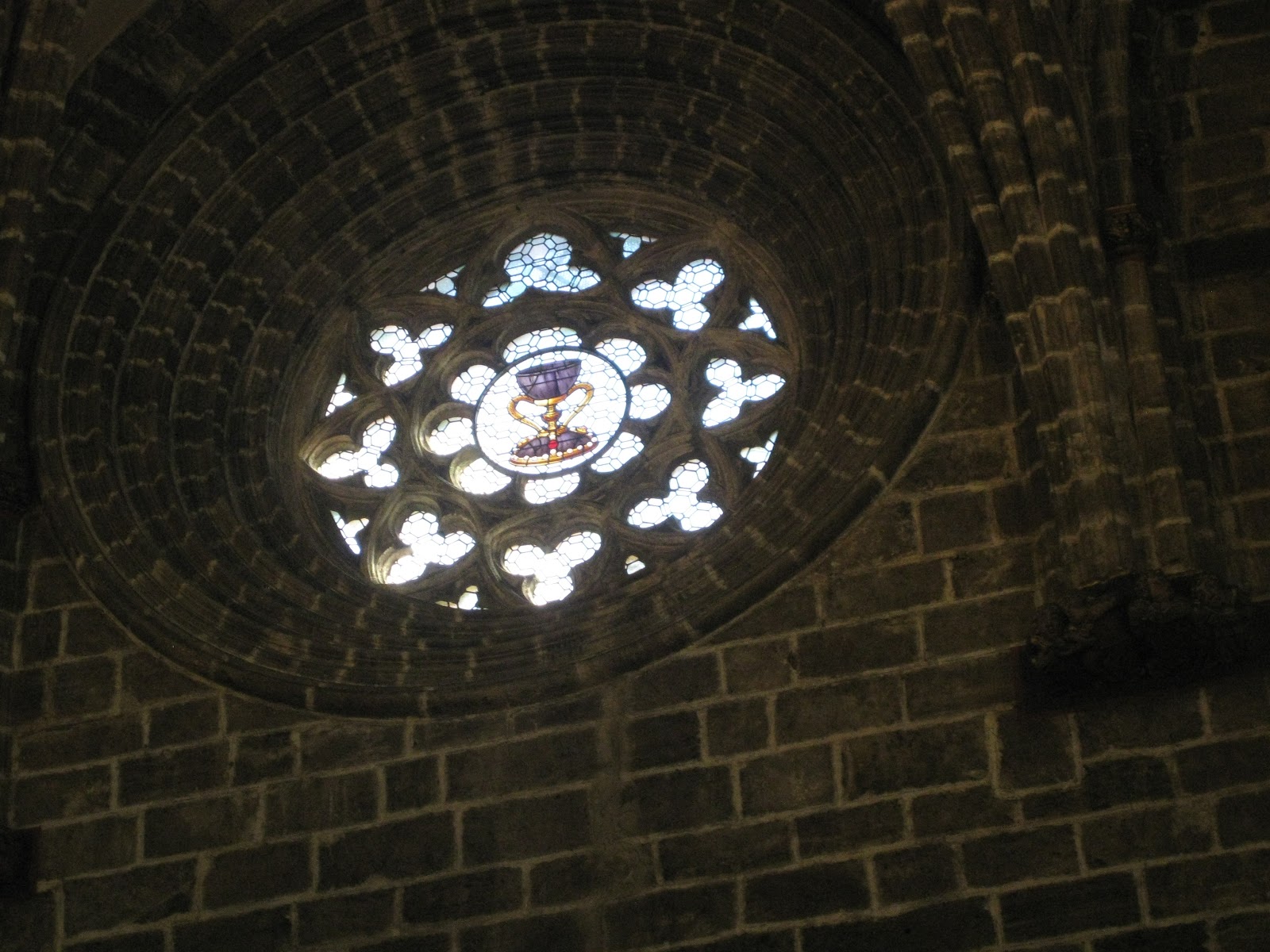
The Grail is hard to see, even though it’s in a lighted glass case. It is high to your left in the altar niche, but there is a large silver screen on the altar. When we were there, two priests were in prayer venerating the transubstantiated Host. At first, I mistook the monstrance for a possible container of the chalice.

I moved to the right side of the chapel and sat on the old stone bench to see what the monks felt. Joanna came over to me and pointed. There, you can see it now.

Photos are permitted in the Chapel of the Holy Grail, and that actually surprised me. 

I rested the camera on the back of a wooden choir bench and used no flash. The fathers, after all, were still praying.

On reflection, I have to say the Holy Grail tops everything else. Grainy though it is, here is the photo of the day.


King Arthur, eat your heart out. I’ve seen the Holy Grail.

Harry


Dec. 28

That can't be the real grail.  Everyone knows it was lost forever when Elsa took it past the seal.

Matt