Sunday, November 24, 2013

Under the Watch of Popes and Sphinxes


October 11
The wine I opened on the train was very good indeed. Of course, it’s hard to beat a smooth, fruity wine sipped from a plastic cup at some improbable speed across the Earth. I don’t know how fast the Train a Grande Vitesse goes, but I did notice that poles near the tracks disappear. An occasional blip of a shadow is all you see.
Riding on a train is always fun. In the States, you see the seediest sides of cities because that’s where the warehouses are.

On this trip, we went through farms and forests. The ground just south of Paris is as flat as East Texas or South Jersey. Then it starts to roll. The farms and villages have terra cotta roofs, maybe made by Rodin. Who knows?

We had bought a sandwich at the station. Sandwiches are very popular and are sold in most places that sell bread. It’s funny, though, because as rich and complex as so much French food is, the sandwiches are simple. This one had one layer of meat and one of cheese, no dressing.
Maybe the filling is considered dressing for the bread. The bread here can be a meal in itself.
The TGV has a station of its own in Avignon. The cab ride is OK. You see the Rhone and some hills. The shapes of the architecture, the cars, and the signs tell you that you’re someplace else. It doesn’t look like home, so it’s kind of fun.
Then you come to the city walls. Wow, now you know that you’re someplace else.
We’re staying on the second floor of the Danieli, a small hotel in the old city. There is no elevator, so carrying the bags up was good exercise. The room is at least twice the size of the one in Paris.

We had been sitting on the train for two and a half hours, so it was time for a walk. We headed toward the Palace of the Popes. It was around four in the afternoon, so we didn’t go inside then.
We did climb up to the attached church, but the entrance was blocked off by a truck and a temporary fence. The church is on a hill overlooking the Rhone. You can see the remnant of the old Pont d’Avignon, on which people dance, according to the song.

The bridge is one of the things I came here to see.
The wind was kicking up and the drizzle sent us back to the old town square, La Place d’Horloge, which is a few hundred meters from the hotel. It’s where the city buildings are and it’s named for a clock that was put there in the 15th century, when a clock was a rare thing.
We sheltered from the rain in a cafe called La Civette. Joanna warmed up with hot chocolate, and I saw white Cotes du Rhone on the menu. Wow, even the luncheonettes down here carry it.
So I had a glass from les vignerons de Roquemaure. The white Cotes du Rhone is hands-down my favorite white wine. I drink some others on occasion—Chardonnay with Thanksgiving turkey, for instance, or Loire Valley whites, which have a mineral aftertaste—but not a lot. I find them light and a little on the sweet side.
White Cotes du Rhone is almost as good as a red. It’s hearty and has enough flavor to fill the mouth.
We wandered down a couple of side streets after the rain let up. We came to a medieval church dedicated to an early Bishop of Avignon, St. Agricol. Parts of the building date back to the 7th or 8th century. Most of it is later, maybe 12th or 13th century.
Outside are remains of the old Roman walls of the city.

We came back to the hotel, which is covered in ornate Belle Epoque grandeur. You enter through an alley that makes an S curve. I like the sphinxes guarding the door. They make me feel secure.
We found a guide book in the lobby and took some notes on restaurants. We had a few candidates and wound up at one with the unlikely name of New Ground.
It specializes in Provencale cooking.
I was going to order the house red, which was 2 euros and change per glass. The waiter showed me the list of bottles. I could get a whole bottle of Cotes du Rhone rouge for less than the cost of three glasses of wine in Paris.
He recommended Les Amariniers, Cotes-du-Rhone Villages, 2012. The village is Signargues. The wine is made from a blend of Grenache and syrah grapes. I know this because the notes on the back label are in French and English.
According to a sticker on the front of the bottle, it took the Medaille d’Or at the 2013 Councours des Vins in Orange.

First course was grilled tuna. It was supposed to come with mashed sweet potatoes. There was a mashed vegetable, but I had never seen green sweet potatoes. There was a kind of ratatouille made of leeks and mushrooms.
We asked the waiter about the green sweet potatoes. So happens, they weren’t sweets at all, but mashed peas. “There was a problem in the kitchen,” the waiter said.
I can only say, give me more problems like that one. This was comfort food right from the start.
That was followed by duck leg with herbed rice and another ratatouille-like dish of sweet peppers, eggplant, and small tomatoes.
The food, along with numerous glasses of a superb red, put a great cap on the day.
I put the remains of the bottle in my raincoat pocket and we set out for a stroll.
I think we stopped at a bar back at La Place d’Horloge, then came back to the Danieli, where I polished off the Signargues.


Oct. 12

Grasshopper,

Enjoying your missives and so glad you know just how lucky you are to be there. One of my favorite parts of the world. Avignon is OK, but the surrounding country is incredible, with the occasional exception of suburban-style blight. I hope you get the chance to return for a longer stay.

Random thoughts:

The ramparts are really cool, yes? And the way they connect into the Palace of the Popes is really something.

Try to get to Les Halles. A modern market where you'll find lots of local products and flavor. 

Most of the restaurants in that big public square are not very good.

And I'm impressed with your white wine crusade. It's exactly what I do when I'm there. Some are really interesting. See if you can find a Vacayras white (the reds can be excellent, as well.) And need I say, if you feel like a splurge, a white Chateauneuf du Pape from the right producer, with a little age, can be a revelation. But proceed gingerly. Lots of bad Chateauneuf du Pape around in those parts. If it seems too cheap, it's probably not even worth what you're paying for it.

Try to eat some lamb. The area is known for it.

Have fun!!!

Larry


Thursday, November 14, 2013

Pont, Pontoise, et La Porte de L’Enfer


October 10
Following up on a couple of recommendations yesterday: Larry recommended the Rodin Museum. After Bill pointed out the error of my working from memory, I reread his original e-mail and Googled Le Petit Pontoise to get the address, 9 Rue de Pontoise.
I had Bill’s e-mail but misremembered the street the night before and had gone to Rue du Petit Pont, and so wound up at Le Petit Pont.
When the computer found Le Petit Pointoise for me—a few blocks away from the Little Bridge, its rue, and its restaurant—I phoned in a reservation just to be sure.
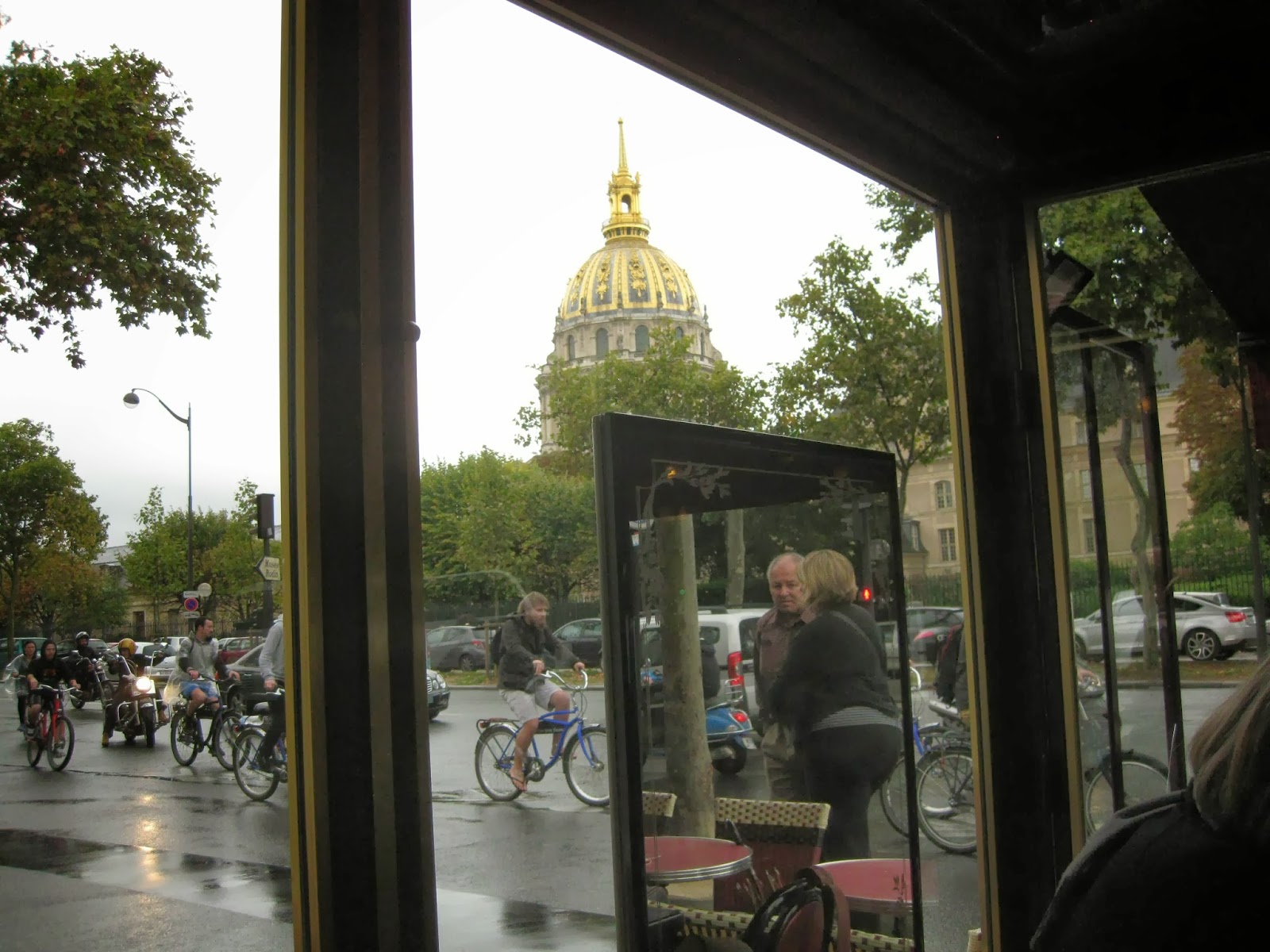
The visit to the Rodin Museum took us back yet again to the neighborhood of Les Invalides. I had heard the name of Les Invalides before I came to Paris but knew nothing about it. I have in the past couple of days learned that it started out as a hospital for disabled veterans. It was commissioned by Louis the Fourteenth, and like the public structures of that era is a spectacle. It’s a hospital with a facade of huge columns and a dome in gold leaf. Nothing like a V.A. hospital today.
I understand that Napoleon is buried somewhere around there. Maybe inside. He was short and wouldn’t take up too much room.
The Rodin Museum is in a mansion called Hotel Biron, where the artist paid rent when he was in Paris. He owned an estate somewhere else.

The German poet Rainer Marie Rilke lived there and recommended it to Rodin, who moved into a couple of rooms. He lived there for something like 20 years. Eventually he was the only tenant.
I’m fuzzy on the details, as usual, but it seems that some of the people may have been evicted because the owner, maybe the French government, wanted to sell the property. It was a pretty serious piece of real estate—big enough to have its own chapel, for instance.
Rodin by that time was in his 70s and famous, but even he was under pressure to move out. That’s when he came up with the idea of donating all his unsold work, studies, papers, etc. to the government to establish a museum, on the condition that he could live in the Hotel Biron for the rest of his life.

The grounds of the museum are formal gardens with Rodin bronzes at intervals. Some of the appeal of Rodin for me is that his work ranges from the realistic to impressionistic, sometimes in the same piece. It is very sensual and the faces are expressive and alive.
The Burghers of Calais are a group of larger-than-life men who strike anguished poses with grieving faces. They have ropes around their necks as they go out to submit to Henry V. Hang us if you must, but spare the city.
The Gates of Hell are covered with a tangle of naked bodies plummeting into chaos.
Balzac is in the garden, and so is The Thinker. The Three Shades from the top of the Gates of Hell appear nearby as a separate group in much larger scale.
Inside the house, are Rodin’s studies for several of his works—early alternative compositions of the Burghers, for instance. Plaster and terra cotta pieces that would become bronzes, several marble works, and some early paintings by Rodin.

Thanks to Larry for pointing that one out.
We stopped at a corner café across from Les Invalides before the hike home. There was a mirror in one window. Very strange. You can see people and cars through the window going in one direction, and people and cars in the mirror headed in the other, but they never crashed. They just passed through each other.

We walked back along the river past the government buildings at Quai d’Orsay. There are some really outlandish looking structures across the river at that point, but we didn’t get to see them today. Maybe when we come back from Avignon.
We took the Boulevard St. Germain to Rue St. Jacques, walked around the Pantheon again, and took some side streets to get back to the hotel, when I made the reservation at Le Petit Pontoise.
Charlie once said to me that he’d follow Larry to a restaurant anywhere. Charlie, take it from me: You can be just as sure if you follow Bill.
As it is in many small restaurants here, the menu at Le Petit Pontoise is short—shorter than the breakfast page at a Jersey diner. But there was still a range of unusual (at least for me) things to choose.
Free-range chicken with mashed potatoes probably would have been better than the way my grandmother used to roast it, but it sounded too tame for me. Veal kidney? Interesting, but generally I like my meat grown up before it is put on the plate.
We decided on two courses, fish first. We shared sea bass in vanilla sauce. Fish and vanilla didn’t sound at all like an intuitive combination, so we guessed that it would have to be good. That sauce went with everything—not just the fish, but the carrots, green beans, zucchini, bread, and pinot noir, too.
Quail with grapes followed that. Three bird legs with more vegetables and roast potatoes. I think it may have had rosemary in it.
Thank you, Bill.
I had a white Cotes du Rhone with the quail. I don’t often drink white wine, even with fowl or fish. But white Cotes du Rhone is hard to get, at least in the States, so when I saw it on the board, I decided to order it.
White wine always tastes a little sweet to my tongue. Wine in general tastes sweeter than my other favorite drinks, black coffee, or IPA and other heavily hopped beers, which are bitter.
The Rhone white has almost as much flavor as a red. It held up pretty well against the rich quail, but I probably would have tasted more of it if I had taken it with a mild cheese and some bread.
Well, we’re on the Train of Great Speed headed for the banks of the Rhone now, so I hope to get plenty of chances to pair the whites and reds of the region with foods over the next few days.
I have a half-bottle of Bordeaux in my book bag. We bought it yesterday at a wine shop across from the hotel. The name of the place is Et Si Bacchus Etait une Femme (And If Bacchus Was a Woman). With a name like that, it was a must-see on my list.
I’m about to open it now. It’s Chateau des Gravieres ’09. Let me see how good it is.
Today's photo, by the way, is Harry Goes to Hell.


October 16
Hi! Greetings from home!
We have checked in on Miss Maggie frequently. She is doing very well. She loved the attention (even from me when I would go over during the day to make sure she was OK). She is so affectionate I did not want to leave her.
We will check in until you return.
Just wanted to let you know she is doing great!
Anna
[Editor’s note: Harry did not at this time keep a mad relative confined to his attic. “Maggie” refers to a 10-year-old cat that has the run of the house.]

Tuesday, November 12, 2013

Charmes et Invalides


October 9
Breakfast yesterday consisted of yogurt, figs, a peach, and plums from a shop next door, croissants from a boulangerie around the bend. Very local, maybe even moderately—dare I suggest it?—French.
Coffee, however, was a large Americano from Starbuck’s on the corner.  It’s the only place I can get coffee to go with a lid.
We decided to visit the Galeries Lafayette store in Montparnasse to buy Joanna a Paris charm for her bracelet. It’s a reasonable distance, and we decided to walk.
From the hotel you go to the fountain by St. Medard’s church (where Life photographed the bride) and take Rue Pascal, which is a charming little alley, to the overpass where Boulevard de Port Royal goes overhead. You climb the narrow steps and then you come out onto the wet pavement of a broad avenue. The city has a truck out to wash the dog turds off the sidewalk.
I’ve been only to a few neighborhoods of Paris, but from what I can tell it is the second-dirtiest city that I have seen. I’m talking world-class cities. Newark doesn’t count.
Paris is not as dirty as New York by any means. The sidewalks here, for instance, are not decorated with the black dots where people have spit out their chewing gum. But even in the Louvre somebody left candy wrappers in front of a bust of Emperor Marcus Aurelius’s wife.
There was a site for a produce market along the boulevard, and vendors had left all kinds of debris behind—spoiled plums, corn husks, empty boxes. If that happened at a neighborhood fair even in New York, let alone the Saturday morning farmer’s market in Montclair, that market would never reopen.
The Blvd. de Port Royal eventually becomes the Boulevard du Montparnasse and we had to walk as far as Blvd. Raspail. The city has lots of boulevards, which is good, because they are hard to miss, even when you are distracted by the scenery. and there is plenty of that.
There are Belle Epoque apartment blocks, and streets lined with plane trees. In some parks, like the one behind the Eiffel Tower, the planes in rows are pruned into cubes, and that is downright fantastic. It is so clever and strange that you want to laugh out loud.

Turns out that right on the point where we wanted to turn lies Le Dome. It used to be a cheap place where hungry writers and artists hung out. So I took Joanna in for a glass of wine at the bar. The bar, we were told, is just a decoration. They serve drinks in a glassed-in patio, which was even better because we got to sit at a table, eat olives, and watch the traffic outside.
Maybe it’s here where you’re supposed to be able to sit and see everybody you ever met. I think I saw my second grade teacher, but I’m not sure.

We shared a glass of a house red listed as “Ballon Bordeaux.” It was tasty enough and went well with the dish of olives that came with it.
From here we walked down Rue Delambre, another narrow street, which had a few adult video stores in the mix. The store we were looking for on Avenue Maine was gone, so we went to Galeries Lafayette, which had what we were looking for.
The lady who sold Joanna the charms was named Tamea. She asked where we were from. We said, “New Jersey.” Where in New Jersey? Montclair.
“My sister opened a bakery in Montclair. It’s called Petit Paris.”
It’s near the library and Joanna had lunch there one day. We’ll stop by when we get back and say hi to Rimi.
Paris shopping malls are surprisingly similar to the ones at home, so we didn’t browse long. There was nothing as interesting as we found in Montreal, for instance, at Hudson’s Bay Co. No canoes, no tomahawks, no fur hats with ear flaps.
From there it is a straight walk to Les Invalides. This time, the gate was still open so we were able to sit in the formal garden. It has flowering plants in circular plots anchored by conical evergreens.
We took a cab back to the hotel because we had walked several miles, our feet hurt, and I have no clue how to use the Metro. Seems that to get to Les Invalides, for example, I take the local metro to one station, leave the system and walk to another station, take a train to a fourth station, get out again and walk to yet another station, where I can get a train to Les Invalides. It’s supposed to take 40 minutes, but I’m not sure I can do that all in one day.
Joanna went up for a nap and I went out for a drink. I had three and read the French papers at Cafe Lea, a couple of blocks from the hotel. There was a discussion of charges that Sarkozy misused public funds, a story about Islamists yielding power in Tunisia, and an essay about the U.S. as policeman of the world.
Of course, these were all in French, so I’m not absolutely sure what they were about.
We went to the St. Medard for dinner. We shared a salad that included gizzards, smoked duck breast, and foie gras. It was wonderful. We had chicken skewers for the entree, because we weren’t in the mood for steak or salmon, which were the other options.
Wine notes: Langue d’Oc merlot van de Pays d’Oc—smooth and easy.
Sud Ouest Gaillac AOC 2010 Chateau des Saurs—sharp and spicy, acidic in a good way.
We had dessert at a small place on Rue Mouffetard, the narrow commercial street above St. Medard. There are lots of cafes and creperies, but also stores that sell fish, meat, and bread. It feels a lot like the old city of Prague. The streets are blocked off part of the time, but not all the time, so pedestrians are everywhere. Many seem to be local people.
We ordered crepe and marrons. The crepe was covered with chocolate syrup, vanilla ice cream, and whipped cream. The marron is a chestnut flavored pudding also served under whipped cream.
I ordered a glass of Bordeaux in French and wound up getting a small bottle, but that was all right. It didn’t go to waste.
I, however, did. And so, wasted again, Harry made it back to Point A and slept the sleep of the just. The just made it, that is.
Actually, it wasn’t all that bad. You can ask Joanna. She will have a better memory of the walk home.
Love to all.

October 9
Harry
You are in Paris and I am on my way to Philadelphia. Life is unfair.
Have a nice glass of wine and don't gloat too much.
Charlie

October 10
What part of Philadelphia?
I was at a Best Western on Chestnut near Liberty Hall. Belgian beer at one bar, craft brews and billiards  at another, the City Tavern around the corner, a short walk to Little Italy. It was a fantastic weekend.
Harry

October 12
I'll say!
I'm hoping to get back to Provence this spring. Want to meet me there, Charlie?
Larry

October 15
Right across from the  new Convention Center, which is either the world's newest, biggest boondoggle or a far-sighted business catalyst for a second-tier city.
Couldn't get out much, but did find a nice restaurant with good food, beer, and wine near Rittenhouse Square neighborhood—Pennsylvania 6. A touch of class in a city that desperately needs it.
Charlie


Sunday, November 10, 2013

That Distant Smile


October 8

Hitting the street around the crack of noon, we were headed for the Louvre.

We stopped for a bite up the street at Cafe Parisien. I was able to order two coffees and a cup of hot water from a waitress who spoke no English. I felt good about that.

The food selection, except for the salads, was kind of heavy for lunch, and we didn’t want just salad for breakfast. We ordered quiche of the day with salad on the side. OK, that should be balanced.

When quiche was a rage in the States at least 30 years ago, there was a book that was a mild sensation for a week or two, “Real Men Don’t Eat Quiche.” It’s where all the “Real Men” this and “Real Women” that came from. I guess it sort of peaked and died when somebody published, “Real Mean Eat Anything They Want.”

So we shared a salmon quiche and green salad. Since we were headed for a museum, I wanted to have a clear head—don’t know why, maybe so I could feel that I was getting my euro’s worth. So anyway, I wimped out and didn’t order wine. And that was approriate enough: after all, I was eating quiche.

I tried to figure out how to use the Metro. After a few minutes trying and failing to find our local station, Censier Daubenton, on the map, I gave up and we took a cab. It was only later that I realized my folding map had diagrams of two different public transit systems and I had been studying the wrong one.

We’ll try the Metro another time.

The Louvre is downright daunting. It has that ugly glass pyramid with the exposed trusswork in the middle of a huge courtyard surrounded by monumental apartment blocks that only kings in high heels could call home.

Imagine having a piece of Laguardia airport stuck onto the Statue of Liberty.

They got us in quick enough. After you get tickets you have to decide which wing you want to try. Joanna wanted to see the Mona Lisa.

So we went to the Renaissance. I like the Renaissance almost as much as I like the Dutch masters. There is a Vermeer, the Lacemaker, somewhere in the museum, and I may get to see it if we get back to the Louvre again. But it is in an entirely different wing, which would put it about a two- or three-mile walk from where we were.

The Mona Lisa has a wall to herself. The painting is small and is kept behind what appears to be bullet-proof glass. It has been stolen at least once before, I believe. If I remember right, it was replaced with a great fake and either nobody knew the real one was gone, or the few who did kept it a secret. The original turned up some time later. Or maybe it is the fake on the wall. Who can tell? You can’t get within 10 feet of it.


And still, the people were packed in there shoving and desperately trying to snap amateur photos of a painting dimly visible under glass. Everywhere you look there was the light of a smart phone, and some people came armed with iPads.

And I mean really shoving. A tiny Asian lady was pushing people out of her way so she could hold her cell phone up. I heard Joanna say, “Wait your turn.” But the lady snapped a shot and was gone.

It may be the most famous picture in the world. Certainly it is one of the top three holdings of the museum. I forget what the other two are. They may be the Winged Victory of Samothrace and the Venus de Milo. Didn’t Art Buchwald once brag that he was so efficient finding his way through the Louvre that he was able to see all three within five minutes?

Maybe that lady was trying to beat Buchwald’s time.

Joanna took the photo of the day. It’s “Harry Visits Mona Lisa.”

I have never been a big fan of Mona Lisa, but everything else was terrific—one after another, all these world treasures. By the time we were half-way through, I got the feeling that I was actually personally acquainted with John the Baptist and Hercules.

We must have covered four galleries at most before we were chased out at 6 p.m.

We strolled back along the river toward Notre Dame. My cousin Bill had written to recommend a restaurant near the cathedral, so we decided to go there.


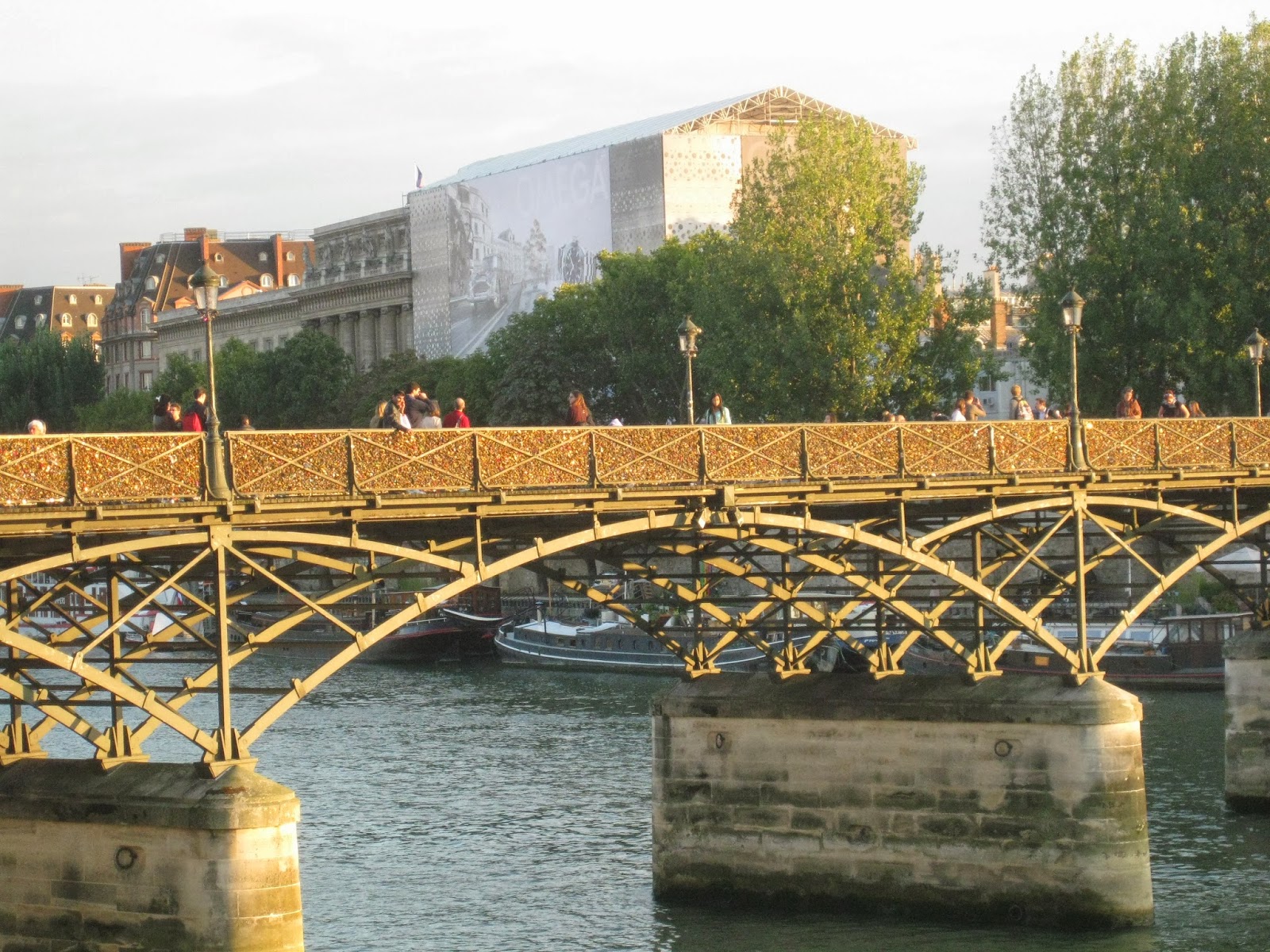
We crossed a wonderful footbridge not far from the Louvre. Couples put padlocks on the fencing of the bridge. Hawkers on the banks sell the locks. Some people clearly bring their own because they are engraved with names and dates, like the couple who became engaged on Sept. 9. When you see it in the distance, the bridge glitters with white and yellow metal.


We strolled on the quay past the houseboats on the left bank and then found ourselves drifting up a ramp toward the street. I don’t know why we chose that ramp, but I was eager to get up to the street. I mean, here I was. Somebody else was doing the driving. The clock was pushing seven—well, over here, nineteen—and I hadn’t had a drink all day.


So we came up to street level and I realized the angels were still watching over me. There was not just a bar on the corner, but a Belle Epoque survival.


The lounge was filled with plush chairs and sofas covered in whorehouse-red velvet. They had wine. Upstairs a hallway was lined with private dining rooms. One of the rooms seemed to have one big table and three waiters. This was the big time in the old-fashioned style—right out of a Victorian porn novel. They even had a special menu of cocktails pour deux.


We sat at the bar where I took a couple of verres of pinot noir. Once I had been properly nourished, I was ready to lead Joanna to the restaurant that Bill mentioned. It is on the Rue Petit Pont and the restaurant is called le Petit Pont.

The Petit Pont itself is the bridge from the Left Bank over the river that takes you to the front of the cathedral. You know, where Charles Laughton swung down on a rope.

Sometime in the 9th century a bunch of aristocrats, now buried in the crypt under the church, fought at the Petit Pont against a group of storming Normans. I read that on a sign somewhere.

We had snails, of course, and fried frogs’ legs, and followed that with duck breast in a pepper sauce with mashed potatoes.

Our server was having troubles, though. We had just sat down when he brought us two glasses of wine, before we had ordered anything. We were pretty sure the drinks weren’t compliments of the house so we suggested they might be for someone else. We were right.

Next he comes out with a tray of desserts decorated with sparklers. He takes those to another wrong table, turns around and promptly launches a parfait onto an empty chair and then to the floor.

I ordered two glasses of different wines. The kid puts them on the table and runs off, not telling me which is which.

Service aside, the food was fantastic—thank you, Bill—and so was the wine, a Bordeaux and something else (I forget).

We passed the Pantheon on the way back to the hotel. The neighborhood is named for it, but I didn’t know the significance. The signs there say it was begun as a church—maybe by the last Louis while he was still king. After the Revolution it was converted into a secular temple honoring prominent citizens. Voltaire, Rousseau, and Victor Hugo are buried there.

We stopped for an apple tart and a white Sancerre at the restaurant called Village Monge, up the street from the hotel.

Then we packed it in.

Be well all. More nonsense to come.

 October 8

It sounds like you are having a wonderful time.

I need to make a slight correction.

I was recommending the "Le Petit Pontoise" not the "Le Petit Pont." I have never been to the latter. If the food was good, which is the most important thing, than no harm, no foul.

Apparently they are both by Notre Dame. Le Petit Pont is on the southwest side and Le Petit Pontoise is on the southeast side.

Bill

October 8

Snails, frogs' legs and duck breast. Now we're talking!

Sancerre with apple tart? Doesn't the wine taste a bit sour with dessert? To each his own.

And you survived the Louvre. I agree, the Mona Lisa is probably the most overrated piece of art I've ever seen. Are you going back?

The Rodin Museum is great and worth checking out if you like modern (as opposed to contemporary) sculpture.

Larry