Tuesday, January 21, 2014

Mounts and Rues of Martyrs


October 14 (Monday)
We thought the neighborhood would cool down a bit on a week day, and it did, but not all the way. The pedestrian mall, which I think is Rue de Steinkerque, was still full of pedestrians in the morning. People were bringing kids to the carousel. We had to wait in line to get into the funicular.
This is a cable car that runs up the most part of the serious climb from Rue Gabrielle to the steps of Basilica of Sacre Coeur. The basilica, especially its dome, is the dominant landmark in this part of the city. From the steps you get an overview of three-quarters of Paris.
It’s fun, but in daylight at least, an overview of Paris is less interesting than looking out over Valencia, New York, or Prague. Paris is kind of beige all over, and most of it has to be seen up close in person to have any flavor. Sort of like a real painting by Van Gogh.
But it was fun to see a few things we could recognize from this distance. Joanna picked out the gold dome of Les Invalides. Once she found that, we knew approximately where to find the Eiffel Tower. We had to move to our left because that part of the view was obscured by some trees on our right.
Notre Dame gets completely lost. We found it only by looking at the crib sheet, a panorama the identifies various landmarks.
We sat inside the nave of Sacre Coeur for the end of a mass and saw the monstrance in the sanctuary that holds the perpetual adoration of the consecrated host.
The church is new by European standards. Construction started in the 1870s and the building was consecrated in 1919. The perpetual adoration began in 1885.
Around the sanctuary there is an inscription: S’mo cordi Jesu Gallia poenitens et devota et grata. My approximate understanding of that is: To the most sacred heart of Jesus France is penitent and devoted and grateful.
St. Therese of Lisieux is also associated with the basilica. I’m not exactly sure of the connection because the explanation was written in more French than I can understand. I believe there was a ceremony here in which her relics were exhibited. I don’t know if there is any other connection.
The neighborhood around the church is a mix of very upscale residential properties and streets full of hawkers. There are guys—one even in a straw hat—who come up to people sitting outside cafes and hound them to have a sketch made. Everywhere I’ve gone, there are large numbers of vendors selling tiny Eiffel Towers. Up here, too.
Joanna’s crepe and my croissant were far in the past, so we ordered moules frites at a small cafe near the church of St. Peter. The waiter brought a huge bowl of steamed mussels and a plate of fries. I can’t remember when I have eaten as many deep-fried potatoes as I have in the past 10 days. No wonder we call them French fries.
The Church of St. Peter dates back to the 1140s (or maybe the 1410s) and was an abbey church until late in the 17th century. It bills itself as the parish church of Montmartre.
In our wanderings we passed another artists’ cafe, Le Consulat. One of the artists who hung out there, in addition to Picasso, was Maurice Utrillo, who was born in Montmartre. I have seen prints of Utrillo paintings of streets in Paris with people going about their lives and the come of Sacre Coeur in the background rising above everything.
The picture of the day is Harry Gets Artsy Again.

This is the view from the street by Le Consulat. Sorry. Couldn’t pass it up.
The capitals of some of the columns have worn in time. That gave it a feeling of kinship with St. Bartholomew the Great by the Smithfield Market in London. If I remember right, that one started in the 1100s too.  There was one curious statue, which looked at first like a bishop with very bad posture, maybe an old one bent with age and a calcium deficiency. When we got up close, I saw what it was.
This part of town is called Montmartre because, according to tradition, St. Denis, the patron of present-day France was beheaded here about the year 250. Diocletian was a boy then, so I don’t know whose persecution this one was.
The bishop of the statue was St. Denis. He was shown standing, with his head held before him in his hands. According to his legend, which I just looked up, after he was beheaded, he picked up his head and walked six miles while preaching a sermon.
On the way down the hill, we ran into a group of guys that Thomas had warned us about. Apparently they put a string on your finger and try to keep you there while they talk to you. About what I don’t care. I don’t do restraints symbolic or otherwise.
Just above the park where the carousel is, an African guy tried to put a colored string on my hand. No.
Why are you afraid?
I’m not afraid. Nothing gets tied to me.
During our late-afternoon rest stop at the hotel, I opened the bottle of Petit Pont. I had expected something rough, maybe a cross between Gallo hearty burgundy and vinegar. But no, it wasn’t bad at all. Not as good as many of the wines I’ve been drinking here, but certainly worth drinking slowly. So I finished the bottle.
We set out to find dinner at a restaurant called Mon Oncle, also on the hotel’s hit list. Much of the route to the place, according to Google Maps, follows Rue des Abbesses. All right, we were there last night. What we hadn’t seen the night before is that there are 2 (deux!) Rues des Abbesses. We took the wrong one and never did find My Uncle.
Instead, on the way back we went up the Rue Des Martyrs to La Cave Gourmand, which was serving boeuf Bourguignon.
We started with bone marrow and rare terrine with Armagnac. The marrow, served with a dish of sea salt and some toast, was in a bone split lengthwise. It was much too big to be human, so it was OK to eat.
I looked up “terrine” the other day in the Collins translating dictionary, and it is translated as “earthenware pot,” which is what I remembered. It can also mean “potted meat,” which is what this was. Think high-class French Spam. It had little chunks of something in it, possibly soft nuts. It was OK.
Joanna and I both preferred the bone marrow, though. It was as good on the bread as on the toast. A sprinkle of sea salt brought out the flavor.
Boeuf Bourguignon is a comfort food. It is made from a cut of beef that probably would break your jaw, and maybe your knife, if it wasn’t simmered for hours in a sauce heavy with wine. But it is cooked that way, and it’s wonderful. It is much like American beef stew, in that it is slow-cooked tough beef with carrots and onions, but I also detect a bitter mixed with the fat and the sweet that not only gives it character, but also makes it a great dish to go with red wine.
We had a couple of Bordeaux: St. Emilion Petit Fourney 2010, and Chateau Latery (I think) ’09.
The owner was covering the tables and assured us that he used local ingredients whenever possible and always as close to home as possible. I think there are fewer cows walking around the Montmartre tonight.
We tried to find that wine shop again, but couldn’t. We walked the length of the Rue des Abbesses and Rue d’Orsel, but it wasn’t there. Now wonder a cheap wine was so good, the store that sold it was supernatural.
And so another day of indulgence ends in the Ile de France.
Happy days, all.
Harry


October 15
Charlie!
Did you read that?
Bone marrow!
And he found it without even looking.
In case you didn't know, Harry, Charles and I are big bone marrow enthusiasts. I spent quite a bit of time and energy looking for it in Budapest. The truth is, however, the best I ever had was in Paris, served as you described. My guess is it was broiled, and looked like a dish Fred Flintstone would eat.
And if you're interested, Harry. There's a place in Singapore that makes a dish from lamb bones. Not broiled, but cooked in a radioactive-looking red hot sauce. You suck out the marrow with straws. Messy but good.
I still prefer the broiled cow bones, myself, but the stewed lamb's bones might be interesting.
Larry

Monday, January 13, 2014

Paris Encore


Oct. 13, 2013
Took the train back to Gare de Lyon and a cab to the Hotel Bellevue. It seems that Sunday is pedestrian mall day and half the side streets are blocked off. The driver tried a few ways to from the boulevard to Rue d’Orsel, and finally bypassed a no-entry sign and ran up the block.
 The hotel is clean. That’s all I can say for it so far. The street in front is ripped up by the electric utility, but that’s not the hotel’s fault.
We arrived a little after one. The room wasn’t ready. We could leave our bags, but not anything containing computers, because the hotel wouldn’t take responsibility for them. We had to sign a waiver and put our bags in the breakfast room along with a dozen others. We had to lug our carry-ons.
We went for a walk. The neighborhood is colorful as hell. We’re a block down from the park at the foot of the Sacre Coeur hill. The funicular is a short stroll from the Bellevue. One of those blocked-off streets was so crowded that I didn’t want to attempt it with the bags.
I asked Joanna what she’d like to do. “I need to eat something right away,” she said.We headed for a couple of cafes up the street. On the way we passed a confusing store with high-heeled shoes and weird-looking toys in the window. Maybe they couldn’t decide what line of business to be in.
We went to L’Anvers du Decor. You can tell it’s a decent cafe because it has an awning. Joanna had soupe l’oignon. I’m really working hard to get that out in French. I had cassolette de pocreau (maybe) chevre. On the English-language menu that’s leek and goat cheese bake. It was a baked omelette with goat cheese and leek. Very good.
The ripped-up street isn’t the hotel’s fault, but the dysfunctional bathroom, on the other hand, is. The hinges on the toilet seat are broken. The seat slides off.
The receptionist tells me that she was unaware of the problem and will call someone on Monday to fix it. There is no guarantee that it can be fixed on Monday. One red flag.
We can change rooms. OK. Let me see if there is a room open.
A half hour later the phone rings. There is no open room today, we can change tomorrow. Two red flags.
We have to be out by noon, so the hotel can have the room free. Six red flags.
I was starting to get suspicious. Maybe the room has been this way for months and they keep giving people the same runaround. You move in; you put up with it or you move the next day. Like they say in “Star Wars,” I have a bad feeling about this, Luke.
We hung around the hotel late in the afternoon. Joanna’s nephew Thomas, who was transferred to Paris by his company two months ago, was planning to meet us at the hotel. So Joanna phoned him to warn about the disrupted traffic and the obstruction at the entrance. She put me on the line to make arrangements because she believes I have a better picture of the area than she does.
Well, I did in fact know the name of the nearest Metro station, Anvers. Thomas knew it too. He said he and Barrett would be at the hotel sometime shortly before six.
I was hoping Thomas might suggest we meet somewhere else because I was mildly embarrassed that I had brought Joanna to this hotel.
I finished the previous e-mail message and sent it, then headed out for an ATM. After that, I decided to look for the Anvers station.
This must be the Anvers neighborhood because everything along Boulevard Rochechouart seems to be called Anvers. The station is on the island in the middle of the boulevard not far from the hotel. We may try a trip underground. It is a straight run to L’Etoile and one transfer to the Louvre, where we hope to go at least once more this trip.
When I got back to the hotel Thomas and Barrett were in the lobby, but hadn’t called Joanna yet.
The hotel has a list of six or seven restaurants that it recommends. We decided to head in the direction of the first one on the list, La Villa des Abbesses, on the Rue Des Abbesses.
But first we went up the tourist street to see the chocolate museum. Not a museum in the conventional sense, it’s a chocolate store with extremely fancy products and some extraordinary specimens under glass, like a chocolate rigged ship and an entire replica of the Cathedral of Notre Dame. I didn’t see a chocolate Quasimodo, but maybe he was grabbing a rope in the other tower.


We passed a display of elaborate chocolate figures, some with a Halloween theme, and also chocolate high-heeled shoes that you could fill with chocolate bon-bons. The window we passed earlier suddenly made sense. If you’re making stuff out of chocolate, you can do any damned thing you want.
We checked menus at this place and that, and actually wound up after all at La Villa des Abbesses. We all had snails and entrecote with frites.
Entrecote is a tough, fatty, and therefore very satisfying cut of beef. Don’t know what part of the beef, but very good.
For some reason—maybe because she doesn’t drink—Joanna never orders wine. So in my usual role of bad influence, I ordered a Saint Emilion for her. I had a decent Bordeaux, followed by a Cotes du Rhone. (Forgot to take notes and so didn’t get the origin.)
Thomas and Barrett are great guys, full of fun, smart, and downright good company. I had met them briefly at their wedding reception in New York summer before last. Joanna and a guest were invited.


We talked about that. I don’t know how many people were there, but like all events of that sort, the hosts didn’t get a chance to do anything but talk to the guests. They fed us, but didn’t get to have any dinner. 
On reflection, I am amazed that Thomas recognized me when I came into the hotel and saw him.
After dinner, when we strolled back to the hotel, I had the sudden urge to buy wine. I ducked into a store that was a real surprise. I bought one bottle that was less than 4 euro: Le Petit Pont, reserve 2012, a Pays D’Oc, “mise en bouteille a F34450 par les domaines Robert Vic - Vias- France.” The other wine is more upscale, about 5.70 euro. The label says Barathym 2012, de la Garrigue d’Aumelas, from Langue d’Oc.
I’m putting all this detail in because I have no idea what it signifies, but if I poison myself, Larry may suggest an antidote.
Bon soir, tout.

Oct. 14
Dear Grasshopper.

The wine sounds safe enough—both are estate bottled and from the Languedoc in southwest France, a mixed bag source of sometimes interesting wines at value prices. My My guess is, unless they are varietal bottlings, they're probably made from local grapes in blends similar to what you were drinking in the Rhone. 

And, just in case you're curious, St. Emilion is also a Bordeaux.

I'm more concerned about what kind of parasites you might pick up at that hotel! Perhaps a haz-mat suit for when you're in the bathroom? Have you put the health department on speed dial yet?

Have fun!
Larry

Oct. 15
To my great relief and unbelief, the hotel is very clean.

The city is going to cut the electricity tomorrow from 8:30 to 12:30, so I'm clearing out early tomorrow. perhaps I'll go back to the Louvre for the day.

Harry

Sunday, December 1, 2013

La Grande Armee


Oct. 12

The French were out in force today.

Not right away, mind you, because it seems Saturday starts out slow here. We went this way, that way on some little streets to get to Les Halles, the city market. The streets at 11 a.m. were pretty empty.

We stopped for breakfast around that time at a place really called Joke & Co., a small cafe with a long list of crepe choices and a dining room upstairs. We had the place to ourselves and sat by a window. Some people walked by, but not many.

Joanna had crepes with a chestnut topping. I had mine with Calvados.

I also finally got to have wine with breakfast, a glass of a white that the proprietors said came from Aix-en-Provence. I had asked for a white Cotes du Rhone, but they didn’t have one. Maybe that was one of the jokes.

No complaints, though. The wine had some flavor and went down reasonably well.


The Les Halles market is newer, smaller, and less gritty than the markets in Valencia and Barcelona, but well worth a stop. There are wine sellers, bars, lots of places that will shuck a plate of oysters for you. We didn’t stop for oysters because Joanna doesn’t eat raw fish, and we had just eaten crepes. But damn, they looked good.


One thing on the fish counter that I had not seen before is aile de raie. It reminded Joanna of shark fin. I think the name refers to the fin of a ray or a skate.

We picked up some very expensive macarons for fun and some very cheap fruit for breakfast because we are going to leave the hotel relatively early Sunday morning to get a 10:14 train back to Paris.

In our wanderings on the way back to the hotel, we found a 13th century synagogue next to Place de Jerusalem in what was during the Middle Ages was the ghetto of Avignon. I believe the synagogue is still used for marriages and possibly for regular sabbath services, but am not sure.

The first big surprise of the day came around our lunch time, which was in the middle of the afternoon. We went to the Place de l’Horloge for some wine and cheese.

There were some tents set up in the square, one with an exhibit about insects, another with a clown show, a couple of others. An acrobat disguised as a giant red bug of some kind had huge stilts that resembled lobster claws on his legs and arms and lumbered around the crowd. At one point, he trapped a lady inside his four limbs.


We sat in the sun in front of one cafe that ignored us. We went next door and got a white Cotes du Rhone and a cheese plate.

This order should be a good bet in France, because there are the three things the French really pride themselves on: wine, cheese, and bread. I think French restaurateurs are transported to the Netherlands, where they have to eat the food for two years, if they fuck up one of those things.

Before we had polished off the cheese, we heard drums. It seems there is a local festival this weekend involving several hundred medieval reenactors. In the States, we have Civil War reenactments, Revolutionary War, and my brother-in-law Mark goes back as far as the French and Indian Wars. I believe some Americans also belong to a Society for Creative Anachronism, but they are largely confined to Renaissance Faires.

But over here, they have knights in mail and yeoman with crossbows.


They had drums and bagpipes, hunting horns, and banners. The guys bringing up the rear were in white with red crosses on their tunics. And they were really into it. I think they were supposed to be the Templars, kind of the Marine Corps of the Crusades. The Templars were scary in real life and these guys had their game faces on to uphold the tradition.

The procession also included camp followers, at least one jester, a couple of bishops, a cardinal, and maybe a pope impersonator.

The whole group marched through the Place of the Clock and went up to the plaza outside the papal palace, where they clowned around for an hour or so. Some were chanting marching songs, or maybe bawdy songs.


We watched a duel between two knights with a third acting as referee. Whenever one tried a low blow or some other infraction of the rules, the ref hit him with the flat of his sword.


A thief grabbed a woman’s pocketbook, and the guards grabbed him, and then they all had a photo taken together. We saw the Wife of Bath using a video camera.


After a while, the reenactors formed up and marched back. Their route took them past the site of the old Templar commandery of the city.

There is a sign there that I found the other day. It’s right across the street from St. Agricol, which is the name of that very old church named for the even older bishop.

We wandered around looking for a restaurant in the evening. For all I know, there is no bad food in Avignon, but we stayed away from the Place d’Horloge, because if there is substandard food, it will be in a tourism navel like that.

Most of the menus offer five or six choices of entree, generally something beef, something salmon, duck, and tartare.

We wound up at a place on Rue Bonneterie called Chez Rippert.

We got a bottle of red Cotes du Rhone called Terres de Galets from a company or person named Gabriel . Meffre (yes, with a point in the middle). It was good, but nowhere near as flavorful as the wine we had last night.

The Galets had a mild fragrance and was reasonably fruity with a little bite going down. After four or five sips it started to grow on me and the aroma seemed to get stronger.

The flavor improved significantly once the snails came. They were plump and garlicky. Escargots is one of the few dishes that I enjoy with a strong garlic scent and flavor.

When we were choosing the main course, I came across one with “pulpeaux.” I couldn’t remember what pulpeaux. Was it a vegetable? Or meat without a backbone? Then I remembered.

I confirmed with the waiter, who spoke some English, that pulpeaux is octopus. With an X on the end, it probably referred to more than one, but I was not being punctilious. As long as it was dead, I would eat it.

The dish turned out to be a brown broth with carrots, potatoes, and little octopuses. It wasn’t exactly the comfort food that we have been eating for days, probably because it wasn’t as fatty. But it was very good.

Back at the hotel, we polished off the bottle from Gabriel . Meffre with some of the macarons we bought at Les Halles.

I arranged a wake-up call for 6:30 to make that 10:14 train without having to rush, and thus assured of my schedule, slept the sleep of the mildly buzzed.

Back in Paris on Sunday afternoon, staying in the Montmartre.

Be well, all.


Oct. 23

Larry,

According to your Grasshopper, my walking Google, the people in Paris are very serious about their wine, cheese, and bread. Whoever screws up those three will be sent to Holland and eat Dutch food for two years.

Fact or did he make that up?

Joanna

Oct. 23

Joanna,

When I saw he wrote that in one of his e-mails, I was quite impressed.

The concept is so excellent, who cares whether it's true or not?

Although I have seen a few lost-looking souls wandering around Amsterdam muttering in French as they scoured the streets for a decent loaf of bread and a drinkable bottle of wine (cheese isn't a problem — while the Netherlands might not have the variety France does, quality is hardly an issue), I don't know if their situation was self-imposed or by judicial directive.

Unfortunately, some of these guys became cooks at some of Amsterdam's most popular restaurants.

Who am I to argue with an older and wiser man whose travel mileage is quickly catching up to mine?

We should discuss this further over a bowl of laksa or hokkien mei in Singapore.

See you then!

Best,
Larry  

Thursday, November 28, 2013

L'On Y Danse


Oct. 12

Another life ambition achieved today: I danced on the bridge, or what’s left of it, at Avignon. To my own extremely poor accompaniment: “Sur le pont d’Avignon” et cetera. OK, so I don’t dance well, but I try to move like a movie gangster when I do it, so nobody will give me a hard time.


From the time more than 40 years ago when I first heard the song and learned what the words meant, I have wanted to come here and see the bridge. Then I learned that most of it had fallen down centuries ago. That’s all right, so did London Bridge, and I crossed the ocean to see that.

If you’re old like me you pay 11 euro for one ticket that gets you onto the bridge and also into the Palace of the Popes. Quelque chose! a bargain.

And it was an all-day trip. We left the hotel around noon and went to the post office because I had a couple of cards to mail to the States.

The post office is right by one of the city gates. The walls run all around Avignon. They are largely intact, but in bad repair. People aren’t allowed to walk on them because some of the stones are loose. You could fall, or knock one down on somebody’s head.


Many of the old stone walls here are made of limestone or sandstone, or maybe chalk and butter. I’m not sure. In the Palace of the Popes, Joanna brushed against a wall when she was trying to take a picture, and there was white dust all over her trenchcoat.

Many walls have deep holes where the stone has dissolved in the wind and the rain. I put my fingers into one stone and some grains came away. It was upsetting. Oh no, I just took six months off the life of somebody’s house.

In fact, the window of my room looks out on some ancient-looking stone walls. You can see where a piece of one of them fell and lodged in the roof of an adjoining building. Now, if that happened in New York, or maybe anywhere in the States, there would be a dozen hungry lawyers trying to find out who owns the roof and how much they can get.


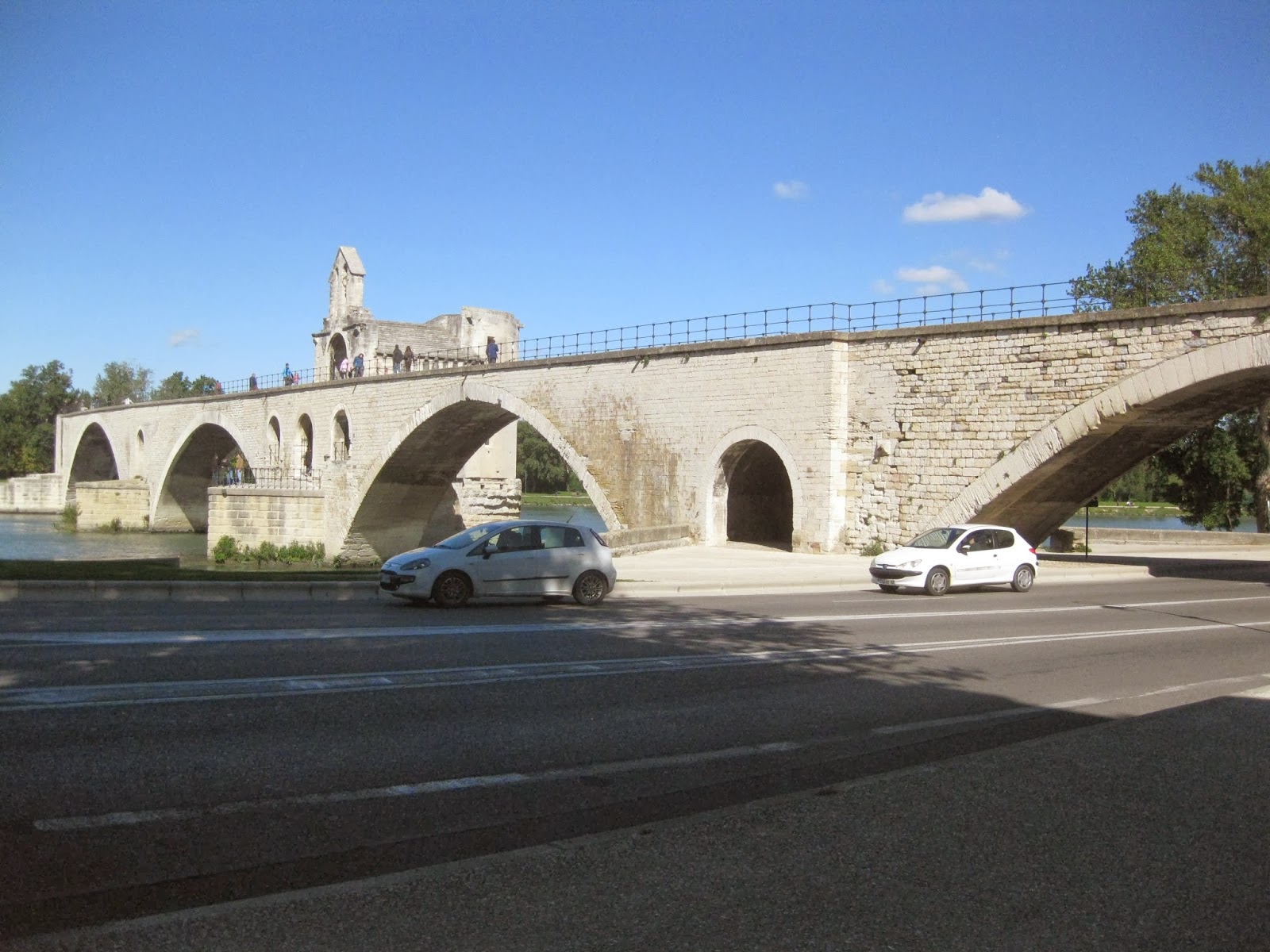
The bridge that stands in the Rhone now consists of four arches. There used to be more than 20. The original bridge was the inspiration of someone named St. Benezet. He raised money in the 12th or 13th century and roused people to build it.


The Rhone at this stage outweighed medieval bridge work by a good measure, so the thing kept falling down. It was abandoned in the 17th century. The last remaining arches were restored in the 19th or 20th century and are now part of the Unesco World Heritage Site at Avignon. The papal palace and a couple of other things are also part of that.


It is made of blocks of stone and is paved with a difficult surface of river stone laid in concrete. Think of round bulbous things poking up to torture you.

Joanna says this kind of surface is recommended for reflexology. If you walk on the surface in your bare feet, it makes you healthy. I walked on that pavement in my long-distance shoes, a pair of rubber-soled Rockports, and those stones took some work.

I have learned on this trip that the Rhone was the border between France and somewhere else. The popes lived on this side and Philip the Fair had the other. the bridge was heavily protected on both sides. There’s something, the tower of Philippe le Bel on the far side of the Rhone. The Avignon side includes a drawbridge.

I suddenly remembered my Monty Python. Imagine a bunch of French guys running across the bridge shaking their swords. The drawbridge goes up. They fall into the river. The pope is on the wall saying, “Aha, you silly French persons, your father is a hamster and your mother smells of elderberries. I fart in your general direction.” Or words to that effect.

I’m sure that Matt, who has the movie memorized, can give me the correct dialogue.

When we came to the end of the current bridgework,  Joanna got a cool shot of our shadows in the water. There we are on the Rhone.


We left the bridge and climbed a tower to see if it led to the palace. It didn't, but that's all right. You can see why.


We backtracked and wandered toward the plaza where they actually let you into the palace. It was 2 o’clock by then and I hadn’t had wine all day. But there is always a cafe when you need one. I was able to order a cheese plate with bread and a glass of white Cotes du Rhone.

There were two soft cheeses and one hard, served with a fig and some tapenade, probably egg plant. This white was very interesting with the cheese. It had several fruity and sometimes even mineral flavors, and they changed depending on the type of cheese I had just eaten. I think Joanna noticed that too.


After lunch, we climbed a steep alley of stairs and came out into the plaza of Le Palais des Papes.

The palace has wings inside wings, and there used to be more. After the Revolution it was adapted to serve as an army barracks and several structures were torn down.

I think the place was planned to be confusing, to control housebreakers and assassins. Unless you were an insider and knew your way around it, you would get lost in there and starve.

We followed the tour circuit because there were signs pointing the way, but I had no idea where we really were at any time inside the palace.


It is fascinating even now with the furnishings gone. Some rooms, like the papal apartment, have period furniture, but the pieces are not original to the house.


Many rooms—and this I found astonishing—are still covered with vivid painting from the 1330s. Chaucer really was a boy then. The pope’s room is decorated with a tracery of vines with birds and small animals hidden in the motif. The recesses for the windows are painted with trellises and trefoil arches so they look like corridors or alleyways.

It’s very amusing stuff, and according to the notes, shows the influence of early Renaissance techniques being developed in Italy at the time.

There is a chapel dedicated to John the Evangelist and John the Baptist that is still very much preserved. In the panel where they bring Salome the head of the Baptist on a charger, there is a puppy standing next to her.

The consistory, where the pope met the cardinals for official business, the chapel, and the dining hall are huge spaces with Gothic vaulted ceilings.


There are displays of fragmentary objects found during excavations on the grounds, often they are bits of stained glass, or small ornaments. There is a pile of round stones in one corner outside. They are bullets thrown by ballistas or trebuchets, or some other kind of early artillery during various times when the palace was under siege.

One display includes fragments of the pope’s artillery. That case also includes a human skull pierced by the quarrel from a crossbow.


The tour lets out on the far side of the palace, and so we wandered for a while through some very narrow, very old streets.

We saw a drawing of the bridge of St. Benezet somewhere in the day’s travels, and it shows the palace, and behind it an open space with what appear to be windmills. They’re not going to fit any windmills in the old city now. There is no room for sidewalks so you have to watch for the cars and get up against the wall when they go by.

We headed back to the hotel for a breather. Joanna took a nap. I opened the other bottle that we bought at Et Si Bacchus Etait une Femme. The label says Les Tetes de Chats, Coteaux du Giennois, 2007. It is bottled by Mathieu Coste, vigneron a Villemoison. I think it’s form the Loire Valley. At least, that’s what the lady at the wine shop told me.

A very interesting drink, it had an almost spicy hot bite. If I remember what Larry told me, the Loire Valley sits on a vast limestone formation that flavors the soil, the grapes, and so the wine. I have sensed a pleasant mineral flavor in other Loire wines, but this was different, and very good in its own way.

Later, for dinner, we retraced our steps from the night before. On the way to New Ground, we had stopped in front of another restaurant to look at the menu. The waiter opened the door for us. We already had a reservation, so we told him “tomorrow.”

This was tomorrow. L’Hermitage is tiny and the menu very short. It bills itself as Provencal.

We started with appetizers. The terrine maison tout cochon was a mixture of onion, other stuff, and maybe pork. It came in two parts, one on a thick slice of lettuce and the other on a cake that may have been foie gras. Les oeufs mollet aux girolle were poached and the yolk still runny, served in a bowl with a creamy sauce.

For dinner we had a filet of beef with real French fries. The meat was not as tender as you’d expect in an American restaurant, probably because the beef was grass fed, but that made it taste even better.

Wine, for my record, was Domaine du Coriancon by Francois Vallot, vigneron a Vinsobres. It was labeled “cru des Cotes du Rhone” and was a blend of Grenache, syrah, and Mourvedre grapes.

Hot damn! Vive la Provence.


Oct. 12 My dear Grasshopper,

"Les oeufs mollet aux girolle were poached and the yolk still runny, served in a bowl with a creamy sauce."

Did you copy the name of that dish correctly? I wasn't sure, so I did a Google translate: "the calf eggs with chanterelles." If I remember my French, folks would use "oeufs l'agneau" — the lamb eggs — as a polite way of saying one of my favorite dishes in Morocco, lamb's testicles. Is it possible your eggs had no yolks at all, but were indeed calf's testicles? Call me curious.

Larry

Oct. 12

Sorry to say, I'm pretty sure these were hen's eggs, Sensei.

Had I the slightest clue that I was eating anything even remotely like prairie oysters, you know I'd be bragging about that.

These were soft white eggs, with a runny yellow yolk. By the shape, I knew they were poached or cooked in a similar way.

Grasshopper

Oct. 12

Hmmm...how did they come up with that name for the dish? I will have to ask my friend Claude the next time I talk to him

Larry

Oct. 13

I have a Collins translating dictionary with me. The assumption that I have miscopied something in French is always a good one.

This time, however, the dictionary says “mollet” as a noun can indeed mean “calf” or “calf leg,” which of course I didn't know until just now when I looked it up. The word's also an adjective that means "softish" and that's where the dish name comes in.

Collins lists a special usage of “oeufs mollets” as “soft-boiled eggs.” So these may have been soft-boiled and taken out of the shell whole. Or maybe poached also counts.

Oct. 13

Mystery solved....nice work.

Larry