Wednesday, November 26, 2014

Crypts, Boas, Trains, and Grapes


    Downtown Beaumes de Venise


October 14

According to Joanna, we’ve been bar-hopping.

You probably haven’t noticed, but I’ve been too busy to write. Also asleep part of the time.

We made the 10 o’clock service Sunday morning at Notre Dame de Paris. Well, the mass was in progress, and then there was the crazy lady who shoved me from behind, and the line we were able to cut. Lots of fun.

We left the hotel at maybe twenty to ten. It was all downhill from there. I’m not sure. We were in a hurry.

We first saw the crazy lady on the corner at the Petit Pont, the bridge that connects the Left Bank to the Île de la Cité, where Notre Dame is. She was intent on kicking broken glass on the sidewalk. A few moments later, as we were walking across the bridge, somebody came up behind me and started shoving to get past me. It was the crazy lady in a hurry. And since she was crazy, I backed off my initial intention of throwing some son of a bitch into the river.

We got to the island and queued up in a long line. Then we noticed the sign that said “messe.” No line there, so that’s where we went. It must have been on the honor system because it immediately merged with the tourist line at the door.

The congregation for the mass was fenced off, so we started to go down a side aisle to find an entrance. Then we tried the back of the nave and found a way in. Joanna, having a knack for this sort of thing, led me forward till we found two seats together about midway through the congregation.

All right. So far, so good.

The ushers handed us programs on the way in, with the liturgy in French and Latin. Also English, German, and Spanish on other pages, we found later. So some of the time, we were able to sing along.

The Roman liturgy is the basis for the Episcopal service, which I know, so I wasn’t completely lost, just mostly.

The homily ran overlong and so did the announcements. We had to press our way out against the incoming tide for the 11:30 service.

After the service, we visited the crypt, which was an excavation of medieval remains of the Île de la Cité from the Middle Ages—maybe Quasimodo’s time. 

The river in those days came closer to the middle of where the island is today. There is an animated film of the old wharf that shows a boat coming in to what are now white rocks under ground. When that’s done, a projection shows where the water used to be—under our feet. Life changes and so do cities.

There are supposed to be the burials of several titled guys who died in a fight against Vikings at the Petit Pont. But we didn’t find them.

At my urging, Joanna had packed a feather boa, a prop from her days as an exotic dancer. No, not really. It was a prop for dancing, though—for a recital when she was taking tango lessons. Feather boa in Paris. That’s got to be a natural, right?

I think it was a hit with the locals. Every once in a while Joanna drew a surreptitious glance from someone passing by. It's pale purple and I think it's fantastic.

Joanna’s idea was to wear it to Pigalle and have her photo taken in front of the Moulin Rouge. We didn’t get to Pigalle this trip, so she had her photo taken in the crypt by Notre Dame.


We had a quick breakfast (i.e. petit dejeuner) and then went back to the hotel and conked out.

When we woke up in the afternoon, we went to a Chinese restaurant next to the hotel for dinner. We had duck and choi sum (a green vegetable). Duck is often a touchstone for authenticity, especially in the States. If you go into a Chinese or a French restaurant and you see duck on the menu, you know it’s likely to be a legitimate Chinese or French restaurant.

In Paris, however, it’s confusing. It could be a French restaurant pretending to be Chinese. I wouldn’t know, but Joanna does. She was happy, so I know the place was indeed Cantonese.

We had a half bottle of Bourdeaux with dinner, and then stopped at a place around the corner for dessert and another glass of Bordeaux. Wow, it was time to call it a night, and so we did.

After about nine or ten hours’ sleep we got up and made it to the train for Avignon.

Train travel in Europe is very cool, much more so than in the U.S. The trains work, for instance. Also, unlike Amtrak, if you take a sandwich and bottle of wine onto the train, nobody gives you a hard time. The conductor, having a little joke, may make like he’s going to take your bottle for himself. No lectures, no threats, no fool telling you that you are competing with the concessions a couple of cars ahead. This is Europe, where free enterprise is respected.

Larry met us at the Avignon Tren a Grand Vitesse station and drove us to the house where we would be staying. It is the 400-year-old wing of a stone place set among an ocean of vineyards. This is where Larry stays with a family in Provence. The family invited us to stay in a wing of their house, the old wing, which is spectacular.


When we got to the house we met Claude, the householder. He grows grapes in vineyards behind the house and also grows them in other fields in the area. He is president of the local wine cooperative in Beaumes-de-Venise.

Once we were settled in, sometime late in the afternoon, after a quick lunch at the house, Larry started our wine-tasting tour of the region.

We went to Domaine la Garrigue in Vacqueyras. Vacqueyras (or Vacqueiras in Provençal) is an appellation. Let’s see if I have this right. Appellation is a government-controlled classification for the wines of a region, town, or whatever.

Vacqueyras is an appellation d’origine protegée (protected name of origin). You make a wine from grapes raised somewhere else and call it Vacqueyras, you’re cheating.

That would be like American champagne, burgundy, or chianti. No, it ain’t.

They are all great wines here. Highlights included a special cuvée called Cantarelle from 2010.

We had dinner outside the house with Claude and his wife, Sophie, who came home around 8:30 or 9 after an exercise class. Larry had put together a veal meal and reheated it, along with a mix of couscous and herbs. After that course came a selection of cheese, some of it really runny and just perfect with bread.

Lots of bread and wine were consumed. Cheese too. This is a good way to live.

I’m writing this now on Tuesday, a day and even more wine later. I’ll tell you about today’s tasting tomorrow. Or whenever I get to it.

As you can guess, I am doing well. Very well. So is Joanna.

I’m loving this, gang.

I hope everybody’s well and, even more important, happy.

Love to all.

Harry


Sunday, November 9, 2014

The Old Neighborhood


October 11

I’m starting to write this on Saturday, back in Cafe le Duc, where I’m having
wine and coffee. Euro coffee comes in short cups and is generally light on the caffeine, so I can drink it several times a day and still not stick to the ceiling. Unlike coffee at home, four or five cups of it doesn’t raise the pitch of my voice by half an octave. 

We got another late start and had breakfast between noon and one in Cafe Luxembourg on Blvd. St. Michel. I had a huge crepe wrapped around melted Emmenthaler; also a glass of Chablis. I was told long ago in Quebec that it’s not good form to drink red wine with breakfast. So remembering that advice, I ordered white.

This was better than American Chablis, and drier. It was a good breakfast wine. 

Joanna, being a great fan of baguettes, had a ham and cheese sandwich.

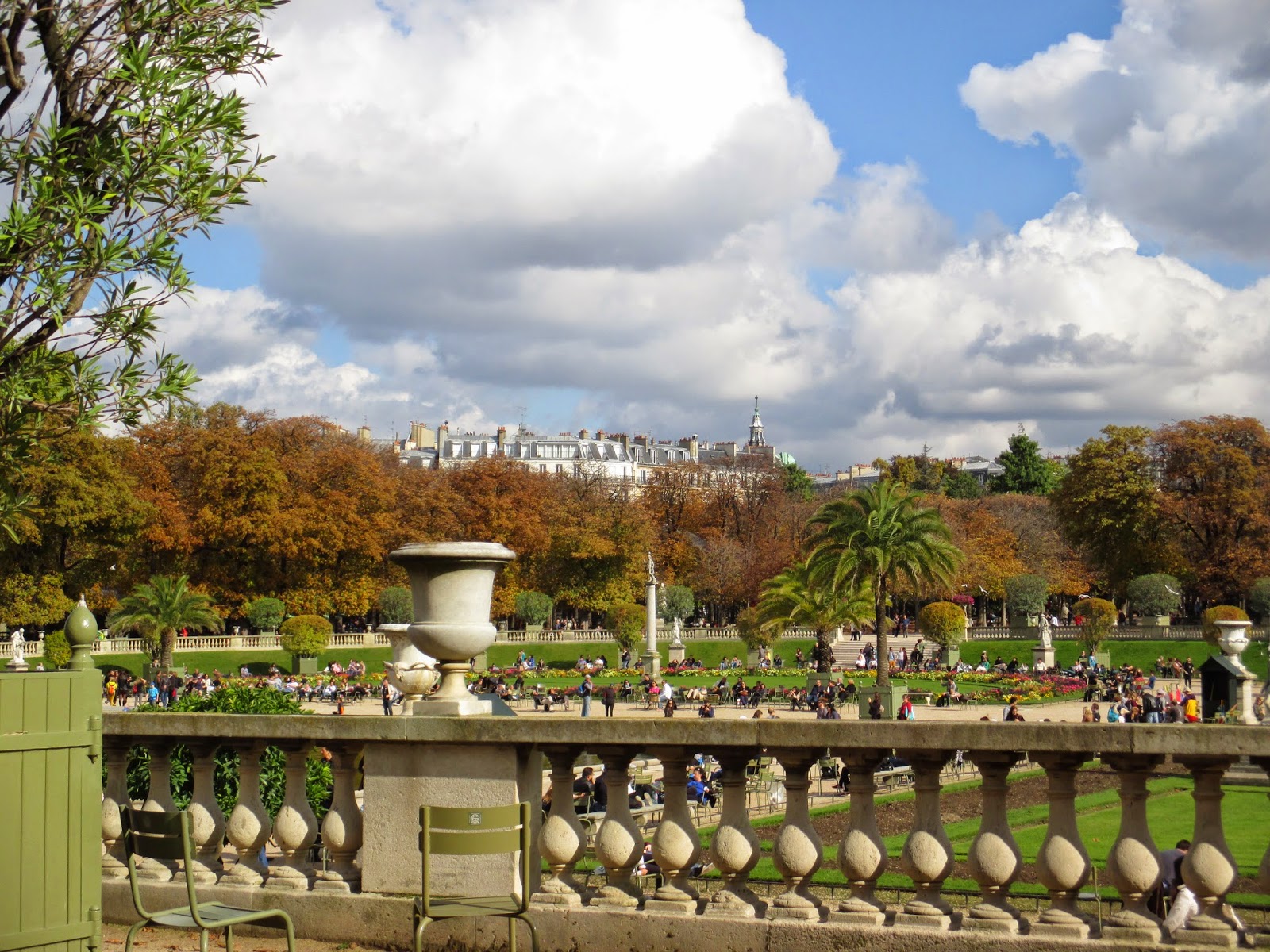
The cafe sits across the street from the Luxembourg Palace and its gardens, which make a large park with everything from statuary and potted citrus trees to tennis courts and pony rides. There were lots of plane trees pruned square, a look the French seem to admire a lot. 


Les jardins de Luxembourg continue along the Rue de la Observatoire. We came to the Jardins de les Grands Explorateurs—specifically, Marco Polo, who went to Asia, and la Salle who went to North America. Joanna recognized the fountain (today’s’ photo),  which shows the four parts of the world holding up the globe. We had seen a study for this group at the Musee D’Orsay. I like the projectile vomiting turtles.

The four parts are personified as women. The Americas wears a feathered bonnet. Africa wears a leg iron and chain.


This route brought us to a familiar corner. I felt like such sophisticated Euro trash. Here I was on a familiar corner in Paris, of all places. It’s where Observatoire crosses Blvd. Montparnasse. The cab came this way the other day.

To the right is the way to Gare Montparnasse, the Dome, a short block with sex shops, a branch of Galeries Lafayette, lots of cool stuff. Wow, I know my way around Paris. Well, a little, anyway.

We turned left and took Montparnasse for a few blocks. This, too, was familiar because we had walked it last year on the way to the Dome. 

We went into a grocery store (forget the name) which sold only frozen food. Ice cream and cake, yes, but also stuff like veal patties and escargot. 

We came to Rue St. Jacques, and Joanna said she knew the way back to the hotel. And so we took it.

On the way we stopped at a church dedicated to St. James. The historical marker outside far exceeded my knowledge of French grammar and vocabulary. But it was great stuff, talking about the Order of Hospitallers, St. Jacques de Haut Pas (don’t ask; I don’t know), and pilgrims to the shrine of St. James of Compostella. For all I know, this was a stop on a pilgrim route, but understand, I’m making that up because it almost sounds right.

The building dates to the early 1600s, but there was a church on the spot for longer than that. It’s all white inside. Very interesting and in sharp contrast to the dark stone interiors that I’ve come to expect.

We stopped for a Bordeaux and salade de fruits at a corner bistro near the Pantheon. All right. I learned another French term. Now we’re set to order fruit salad anywhere in France.

Before we walked to the hotel, Joanna wanted to show me what she had discovered when she was out for a morning walk the other day. And it was a real treasure.

At the end of Rue Cujas and past the Place du Pantheon is Place de Ste. Geneviéve. I think the saint’s name is pronounced “Zhan-vee-ev.” As in the old song, “Geneviéve, douce Geneviéve.”

Anyhow, Joanna took me to a church dedicated to St. Stephen, the first martyr. The history was in English in there. Here goes:

Clovis, the Frankish king who died in 511, established a church on the hilltop here, where the Pantheon is now. He was to be buried there, and so was his wife, St. Clotilde, who died more than 30 years after Clovis. Ste. Geneviéve, the heroine (and later patron saint) of Paris, died in 512 and was buried there too.

Here's the origingal. Somebody who knows French, please let me know how close I came:


The original church was eventually dedicated to Ste. Geneviéve.

The peons were relegated to attending services in the cellar of the church, but there being lots more of them than gentry or anybody else, the congregation outgrew the space, and so St. Etienne du Mont was put up for them, next door. 

So I guess, comes the Revolution, and Ste. Geneviéve’s is no longer a church. Voila, le Pantheon.

So St. Etienne’s church has a shrine to Ste. Geneviéve —a glass coffin holding the stone from her original tomb. Two other people who are now saints stopped in to see it. 

According to a sign only in French, John XXIII in 1962 declared Geneviéve patron of the “Gendarmerie Française” (French police force?) and of the public order. Appropriate enough, I guess. I saw those murals the other day in the Pantheon that show her calming the people of Paris when they were under siege by the Huns.

There’s also a photo of John Paul II praying at the shrine when he visited the church in ’97. 

Thinking about this much tradition makes my head hurt: Three saints, about a millennium and a half apart, all in one place. You can believe all, some, or none of it, but that doesn’t make it less beautiful in some strange way.

A couple of other things. The pigeons here are very tame, or else they’re high. Maybe they drink the wine, too. I almost tripped over a couple of them this afternoon. 

And that reminded me of something I forgot to mention yesterday.

While Joanna and I were waiting to get into the Louvre on Friday, a young couple was standing at a fountain where they were having a photo taken. Each one was holding a live pigeon. Somebody, maybe the guy with the camera, had managed to scoop them up from the ground. Even in New York, the pigeons aren’t that stoned.

Children, do not try this at home, or anywhere. You don’t even leave this to professionals. These kids were amateurs.

From all I’ve heard, handling a city pigeon is about as good for your health as keeping a rat with fleas in your pocket. You may not die, but you could come close. 

Joanna’s nephew, Thomas, joined us for dinner. He has been working in Paris for more than a year on assignment for his U.S.-based company. We went to the Perigord on Rue St. Jacques. Everybody had the snails this time. Thomas and I had different versions of steak frites, along with the house wine, and Joanna had a wonderful piece of roast chicken.


After dinner, we walked with Thomas to his metro station near the Luxembourg Gardens.

Then it was time to call it quits. We have a 7:45 wake-up call because we hope to get to the Gregorian service at Notre Dame in the morning.

Have fun, everyone.


Peeking Through the Louvre


October 10

I finally got us lost on this trip, but don’t know if it counts. We were in the Louvre, where everything is upstairs, downstairs, or both, and nothing’s in a straight line. “Je suis perdu” was the phrase of the day.

It’s hard to remember that this was actually somebody’s home—well, residence, in any event—and everybody, both men and women, walked through it on high-heeled shoes. I was in Rockports and my feet were killing me after three hours.

Of course, it isn’t normal walking when you’re in the Louvre. You creep along, amazed at everything. Then every once in a while you stop dead in front of one of the premier pieces—the stele with the Code of Hammurabi, Cupid and Psyche, any number of Venuses, Dianas, and Herculeses.

I wanted to see the Winged Victory of Samothrace. I’ve seen photos of it, with those frightening back-swept wings and the proud, thrusting boobs. It was out for restoration when I was in the Louvre a year ago.

After a few episodes of being perdu, we found it. It’s not in a room, but on a huge pedestal in a staircase. And it’s standing on a stone platform that looks like the bow of a ship. I was wondering: Why did they put the statue on that? Was it another I.M. Pei idea? After all, that was the architect who put the dumb glass pyramids in the yard.

The museum is so proud of the Wing Victory, however, that they translate the information about it into English. It was found in the 19th century and the figure was standing on the stone boat. 

When we first came on it, we saw the right side lit up by a window behind us so the wing was almost the color of the wall behind it. When we got to the other side, the light was better, and as it turns out, that was OK. The right wing is a plaster restoration. 

When we reached the room housing Venus de Milo there were at least three tours clustered around it. It looked almost like the eternal mob around the Mona Lisa. But we sat to cool off by an open window and in a few minutes the place cleared to no more than a dozen people.

The statue is magnificent, graceful rhythmic curves, a tell-nothing facial expression, the wrinkles and waves in the falling tunic. Goethe, Heine, and other Romantics competed with each other to come up with superlatives to describe it. Besides, in addition to being romantics, they were writers.

Rodin, however, was a sculptor. He was supposedly impressed by the abdomen, which is indeed pretty pretty.

I’m not sure, though, that the Venus is breath-takingly better than dozens of other wonderful pieces here. Right next to Venus de Milo is la Salle des Caryatides. I think most of the pieces there—
Roman copies of lost Greek originals—are equally wonderful. 

Somewhere we stumbled on the Italian Renaissance. Giotto, Botticelli, Fra Angelico: it was like being back in Florence. Among the Botticellis on display were a few frescoes. I’ve always wondered how they get the plaster off the wall in once piece. Very carefully, I’d guess.

We strolled the long gallery to say hello to John the Baptist and many of his friends. This is where we were swept out by the man with the broom at closing time a year ago.

We got a little farther today, but not much. the museum outlasted us again this time. After three hours, we had to call it quits. This was on part of the first floor (1er Etage). I still haven’t seen the Deuxieme Etage.


Walking at a regular pace was easier, so we did that for a while. We took Rue de Rivoli to Boulevard de Sebastopol to Rue Rambuteau and then to Rue Montorgueil. We actually found the street easily enough. It was in the Les Halles district.

We walked up R. Montorgueil looking for a restaurant that Larry recommended—Aux Tonneaux des Halles. We came near the end of the street. I checked the address, No. 28. We had come four or five blocks and across the street was No. 17. But a few steps farther, we saw that the street name had changed. 

We walked back. I felt so bad for Joanna. Her feet must be hurting. She must be exhausted. I’m taking her on a wild-goose chase. And not one word of complaint or reproach. “It’s part of the adventure,” she says.

We got back on Montorgueil and stopped across from No. 27. The restaurant name on the awning was “Escargot.” Could they have changed the name of the place since Larry was here a week ago? Hey, this is their country; they can do what they want. But no. It was No. 38. It’s straight across the street from 27. But as I just remarked, this is their country.

The waiters claimed never to have heard of Aux Tonneaux des Halles. They said people often stop when they’re looking for 28 and then come back because this is the place they actually wanted.

We strolled back and found the one we actually wanted, No. 28. The name is on the wall, but the place gets lost because it has no awning. It’s maybe 100 feet from 38 and those guys had never heard of the place. Yeah, that’s likely. Anyway, stay away from 38 Rue Montorgueil. They tell lies, so the food is probably from a can.

We walked in and the bartender told us the kitchen was closed. What? After all that searching, they only serve lunch? 

Then he explained, it would open in an hour. 

So we sat at a table near the door to drink wine. Unfortunately the table was too close to the open door and cigarette smoke was blowing into our faces. We moved to the back room. 

Most of the tables there were for four people. After a couple of changes more, we wound up in the back corner, away from the door to the toilets and out of traffic. We had the room to ourselves. 

Larry had recommended entrecote Tonneaux. But the bartender had handed us English menus. I ordered the rump steak Tonneaux and learned a new French word. Joanna had a filet. 

Mine came with a bone full of marrow and both plates came with fries, or frites.

I had a Gaillot and a Taurine (I think those are the names). Both were red. The first was the stronger flavored of the two and very good to kill time with while we waited for the kitchen to open.

The list also had a Cotes du Provence and Cote de Pont du Gard. But they are southern wines, and we will be in the south in a few days. I’m waiting till we get there before I try those.

We cabbed back to the hotel and slept the clock around.


The photo of the day was taken in front of the Fontaine de St. Michel, about a block from the Petit Pont and Notre Dame. The musicians were playing a blues riff and the guy behind them felt a little upstaged, but had good humor.

It was a good day in Paris. I hope it’s always a good day where you are.
Harry