Friday, November 28, 2014

Wine and Horses


October 15 (or 16?)

We stayed local this morning. We went to the other side of the village and stopped at the Beaumes-de-Venise wine co-op.

We got there, and Larry asked for a tasting. He had helped out as a volunteer in the tasting room before, so they told him, “You do it.” 


One of the things the co-op does is to separate the grapes into three groups, based on the characteristics of the type of soil where they are grown. One, called Ferisien, is grown in soil rich with grey marl that surfaced during the Upper Jurassic. Another, Bel Air, is from chalky limestone soil that’s a younger formation. The third, Trias, grows in the oldest soil, formed maybe 250 million years ago, that is rich in limestone and dolomite. Ferisien and Trias are both made from a blend of grenache, syrah, and mourvedre grapes. Bel Air is grenache, syrah, and cinsault.


The idea is to keep them as much alike as practical and let the flavor of the land show through. They are all wonderful, but if we had to choose just one, Larry and I both prefer the Trias. That comes in two versions, one aged in oak and one not.

Larry doesn’t like the oak aging. He says it tastes too much like vanilla. I like it and believe it’s the smoky flavor that I enjoy in many Bordeaux wines.

Claude actually cut time out of his schedule to take us on a tour of the place. I’m not going to recap it all, because I’m not sure my memory would be accurate anyhow. 

The co-op makes about 2 million bottles of wine a year. It is best known for a sweet muscat wine. When the wine reaches a certain point of fermentation, they dose it with almost pure neutral grape alcohol. This immediately raises the alcohol level to about 15 percent and kills the yeast to stop fermentation. That’s why it’s called a fortified wine and that’s why it’s fortified.


Wine ferments for a relatively short time, measured in weeks. The fermentation time varies according to things like sugar content of the grapes. Lots of other things, too. But I’m not a winemaker. I’m the guy walking through a winery for the first time.


The wine ages after fermentation has stopped. The co-op ages some wines in concrete tanks, others in stainless steel, and some in oak barrels, depending on the result it wants.

Joanna took a shot of some of the stainless vats, and it turned into a kind of inadvertent selfie.


The remains of the grapes were piled up outside for processing. There is still enough alcohol in them (you can smell it in the air) to make it worthwhile to extract it and sell it as industrial alcohol. Seeds become a source of grape seed oil, which is used for cooking. I think there are some other uses for the grape mulch, too. What remains goes back to the vineyard as fertilizer.


From the co-op we went back to the house for lunch. Larry heated up some rabbit cacciatore with linguine.

I got a little writing done, and then Wheels Leventhal had us on the road again.


We rode for a while on charming mountain roads, past a farm here, a village there, and then Larry put the car into a hard right. “I’ve been trying to get into this place. Let’s see if she’s here.”

I caught a glimpse of a sign with the word “cheval” on it. OK, so Larry has developed an interest in horses. 

But no, it was better than that. We drove up a stone road to a low house on the top of the hill. The house looked out over sloping grape vines and a granite bluff on the far side of the valley—well, canyon, really.


The tasting room was open, and we went in. Larry said something in French, and the lady behind the desk answered him in English. It turns out, Claude would tell us later, she comes from Germany.

Larry asked if we could taste some of her wines or if he should make an appointment for later. She shrugged. “I’m here now.” Hell, Joanna and I were game, but we were just along for the ride. Larry couldn’t believe his luck.

The lady’s name is Corinna, and she runs Martinelle, a small-scale artisanal winery in the village of Lafare.

There is a photo in the tasting room that was clearly taken just outside the door.

A man is working at the top of the vineyard, and you can see the rock face in the background. He is cutting weeds from between the vines using a device pulled by a horse. According to Corinna, he speaks to the horse in old Provençal.

Most of the vines are in the Ventoux growing area. A minority are in Beaumes-de-Venise. Some of her wine is a mix of the two. That violates government rules on appellations, so she has to call it wine of France, and isn’t permitted to put a vintage year on the label. 

She gives the wine a new name each year. We sampled a bit of Deuxieme, or 12th.  I wonder what year those grapes are from? The same mix from the year before is Onzieme, or 11th.

We had some other wines from ’11 and ’12, and Larry was remarking how one of the wines had aged quickly. Corinna looked up and said something’s wrong. I thought it was great, but what do I know?

According to Corinna, the cork had let oxygen into the bottle and aged it too quickly. She opened another bottle of the same wine and asked us to pour out what was left in our glasses. She set the cork aside to study it later.

This is where it got over my head. Larry showed me. You hold your glass at an angle over a white surface, and if the edge of the wine is dark, that’s a sign of immaturity. A lighter rim color is a sign of aging. I think I saw it, but can’t be sure.

I don’t know that my palate is sensitive enough to pick up much difference between those two bottles. It was all great wine, so Larry bought one of each bottle she had for sale, five in all.

He put the box, clearly marked "Martinelle," on the dinner table so Claude would see them when he came in. He saw them, all right, and his reaction was clear.

I can’t be sure that he actually said “ou-la-la,” but that’s what came across.

The photo of the day is Joanna and Larry collaborating on dinner, which was lamb shoulder. It went well with the 2010 Cantarelle and a 2008 Chateauneuf du Pape that we bought, in all places, at the local supermarket. 


I have to go drink wine now, so I’m signing off.

Love to all.

Harry


Oct. 16

Hi folks,

Perhaps I shouldn't be such a "budinsky," as my mother would have said, but sometimes I just can't help myself.

Let me first say, both Harry and Joanna are making quite an impression on our most gracious hosts. They are almost as excited as I am to have them here. Not only have they proven to be excellent company, but their enthusiastic reactions to almost everything is infectious.

I should also point out, just to clarify, that the "terroir series" (Bel Air, Farisien, and Trias) I poured for Harry at the co-op's high-style tasting room and retail space are actually dry red wines. Beaumes de Venise is best known for sweet wine, but also has an official appellation classification for its very nice reds.

And the trip to visit Corinna was very exciting for me. I've been hearing about her and her wines for months, but never got a chance to visit. Harry and Joanna were very patient with me and my wine obsession. I fell in love with both the wine and the woman (too bad for me she's married).

And in the photo, Joanna is actually helping me make the daube, a traditional Provençal beef stew, which won't be served until Sunday night. It's best when cooked and re-heated several times.

More importantly, our hosts are most excited that Joanna will be cooking a Chinese dinner for us tomorrow (Friday) night. My guess is it will soon be the talk of Beaumes de Venise!

I hope you all are lucky enough to visit this beautiful place someday!

Best wishes to all!

Harry's (and now Joanna's) humble sherpa,

Larry


Thursday, November 27, 2014

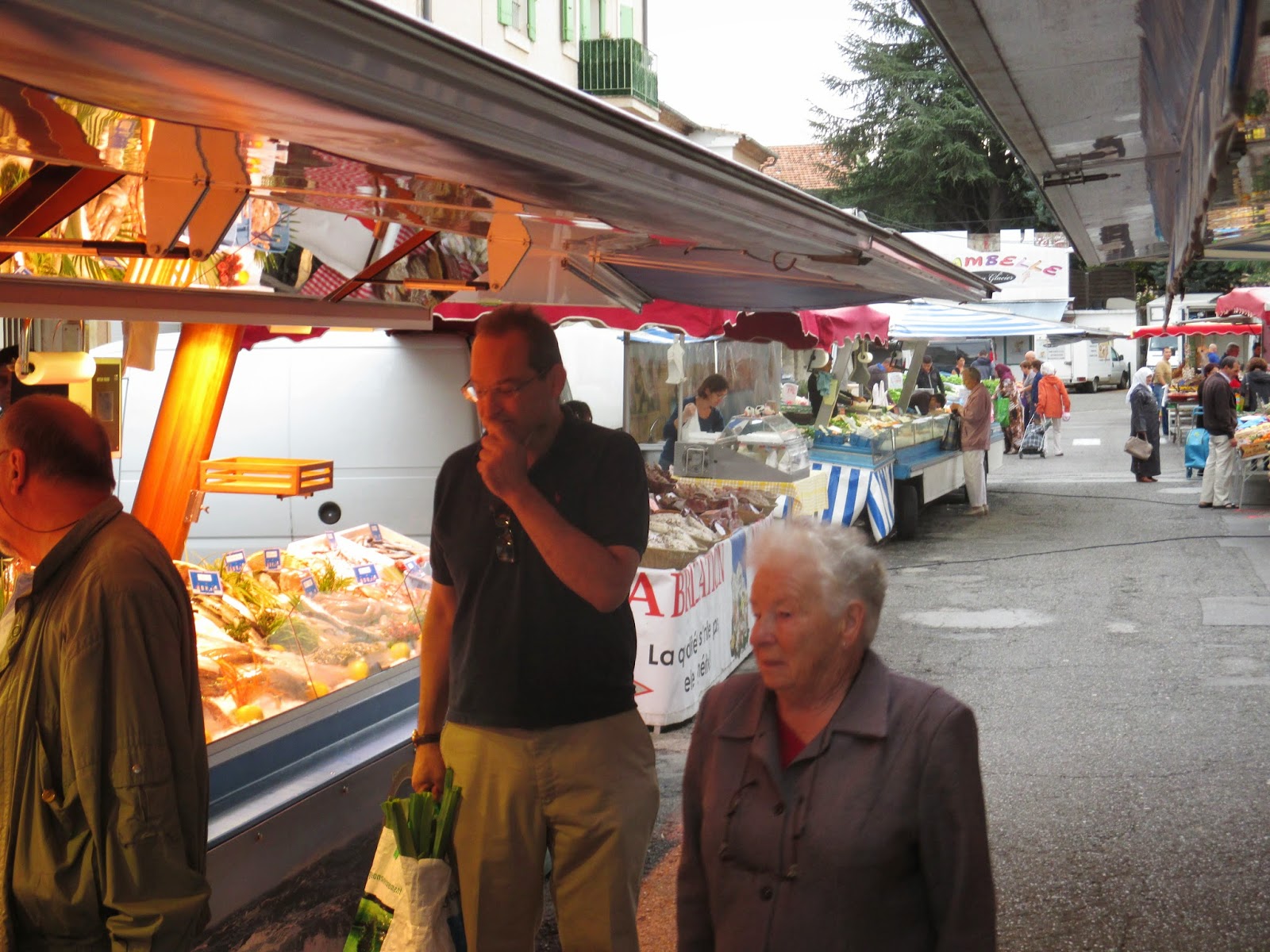
Marché a Vaison-la-Romaine


October 15

That’s “Mar-shay ah Veh-sohn la Ro-mehn.” Well, almost. 

That’s where we started the day, at the weekly market in Vaison-la-Romaine, a fantastic small town that used to be an even bigger Roman municipality, maybe 2000 years ago. 

We got up around 7:30 and were out of the house by 8 or so. That’s because, although the market’s open until half-past twelve, the parking spaces aren’t. We got into Vaison a little after 9, and Larry pulled into one of the few spaces left in the municipal lot. Parking on the street was already filled up.


We bought vegetables first at an extensive table filled with all kinds of produce and old ladies. Of course, they could be hiring the ladies to hang around the place. Think of it: You see them and say, “This has to be where the good stuff is. Look at the old ladies. They have to know,” etc.

We also stopped at the butcher’s stall, where they know Larry. He bought several cuts for meals this week. Joanna and I also heard him ask for meat for the dogs.

Claude and Sophie keep two dogs that are just a little smaller than the ponies in the Luxembourg Gardens. Very friendly, very affectionate, very playful. One of them, the mother, comes up and smacks me with her paw whenever she wants attention. 

So, OK, big slabs of beef seem a little generous for dogs, but I can see somebody going overboard for fun now and then.

Larry’s getting recommendations from the lady standing next to him. Is she a dog lover too?

But no. He didn’t say “dog.” He said “daube,” a kind of Provençal beef stew. The lady suggested a different cut from the butcher’s choice and was adding some tips on how to cook it.

During Larry’s exchange with the lady, the butcher had to ask a question. So he called Larry: “Chef. Chef.” Talk about making Larry’s day, right?

Larry picked out a dourade sauvage (a type of wild bass) for dinner. It was whole, which is the best way to cook and serve fish. Joanna and Larry especially like the meat from the head.


Several stalls sold rotisserie chicken. This cooks slowly on a spit as the fat drips onto vegetables in the bottom of the rack. Joanna has wanted to try it ever since we first saw it cooking that way on the sidewalks in Paris a year ago. So we got half a chicken to take home for lunch.

The lady at the stall lifted a spit with four chickens off the fire and let the birds slide off. The sight was almost Chaucerian for its earthiness.

Then she picked one up and cut it in half for us. She put it and some of the potatoes into a bag, and we were ready to go.


Actually, we put the stuff into the car.  Back at the lot some drivers had to improvise to park.


Then we walked back into town to see the excavated (and perhaps partly reconstructed) Roman ruins. There’s a complete arch, several standing columns and the extensive outlines of the stone walls of buildings. There are even a couple of statues that are largely intact.

We met a couple from the States. They heard us talking and seemed surprised to run into Americans. Larry chatted with them while I made a video of the ruins. He said he hadbrought us along to view the sights. I think it was to help lug the groceries.


 The remains of the foundations are far more extensive than those at Rome. This was all uncovered in an archeological dig. Maybe the archeologists found rubble and replaced the stones, or maybe this is what they found when they dug into this place sometime in the last century. I don’t know.

You pass the ruins, which are several feet below the current street level, on the way up the hill to the street with cafes and bars. We had coffee and a croissant, my first food of the day. Joanna’s, too, I think.

I don’t think we bought many herbs because you get thyme, rosemary, and fennel too when they’re in season by foraging on the roadside here. We went thyme-picking, for instance, the other day.

The bank by the side of the road was covered with grass that had tiny white flowers.


But the flowers disappear when you get up close.


Flowers? No. Snails. Not even big enough to eat.

Claude was at the house, so he joined us for lunch, something he doesn’t often make time for, Larry said. Maybe he smelled the chicken. We had it with a little wine, of course, and with a couple of side dishes we bought at Vaison. One was a zucchini filled with a puree of squash, and the other a sweet red pepper with sausage.

After lunch we went to Gigondas, for wine tasting. First stop was Domaine de St. Gayan. This is where it got confusing for a while. The domaine is in Gigondas, which is a protected appellation of its own. Christian, who met us in the yard, led us into the caveau, or tasting room, and among the selections we tried was a white called Sablet.

Sablet is not part of the Gigondas appellation, but instead is the name of a village that is part of the appellation called Côtes du Rhone Villages (which, I think, is a different designation from straight Côtes du Rhone). 

It turns out that the domaine has vineyards in Sablet as well as in Gigondas. The two places are side by side, or just about, so for all I know, the farm may straddle the border between the two places. 

In any event, the Sablet is a white from the Rhone Valley, so we picked up a couple of bottles. We also bought a Gigondas red.

The white has a kind of mineral flavor and lots of it, which is what I enjoy in Rhone whites and is what makes them exceptional mates with flavorful food. There’s no losing the wine.

I forget which cave had this sign.


We stopped at Domaine Mavette, which had a tiny tasting room, where a lady was pouring. In the adjacent room, I could see an old arch with some of the plaster removed to show the brick work under it. I stepped inside for a better look. I heard the lady call out, and Larry translated. I wasn’t supposed to go wandering in the building.

I felt like a gauche Yankee.

At a tasting, you get an ounce or less in the bottom of a glass. You’re supposed to swirl it to release the aroma, sip a bit and roll it in your mouth, and then spit it out. Sometimes you dump out the last little bit from your glass to get ready for the next sample. I have a hard time bringing myself to do that. It’s just too good, and on top of that, I keep remembering how much work and experience go into wine. 

By the time we got through the second tasting, I had a little bit of a buzz on.

We also visited the caveau at a wine maker called Notre Dame de Pellieres. When we got there, a sheep dog came up to us and dropped a tennis ball at our feet, so I started tossing the ball. The dog was good. Half the time he caught the ball dropping out of its arc or at least after the first bounce.

We stood among the barrels and tasted wine. The dog came up behind me and dropped the ball again. I told him, “Sorry. I can’t throw the ball in here. I’ll break a bottle.”

He looked so disappointed that Joanna picked up the ball and took the dog outside.

We sampled a red wine from an appellation called Restau. Larry told me that Sophie loves the stuff. We bought two bottles.

Sometime during our travels we stopped at a store in Gigondas representing dozens—hell, hundreds. No, at least thousands. Yeah, that’s it—thousands of local wine makers. We may have tried something there, but I’m not sure. I was pretty dull-witted by then. 


But we did come home with a bottle of Gigondas red from a domaine called Moulin de la Gardette. We may drink that with the daube or a lamb shoulder later this week.

Dinner was the dourade roasted whole in the oven and served with rice pilaf. We had the St. Gayan Sablet with the fish and then switched to the Rasteau for the cheese course.

After several wine tastings, and wine with both lunch and dinner, I stood up around 10 and realized I had had it. 

I got to bed somehow and stayed there till 8 or 9 Wednesday morning.

I hope you sleep well, too, whether it’s with or without chemical assistance.

Harry


Wednesday, November 26, 2014

Crypts, Boas, Trains, and Grapes


    Downtown Beaumes de Venise


October 14

According to Joanna, we’ve been bar-hopping.

You probably haven’t noticed, but I’ve been too busy to write. Also asleep part of the time.

We made the 10 o’clock service Sunday morning at Notre Dame de Paris. Well, the mass was in progress, and then there was the crazy lady who shoved me from behind, and the line we were able to cut. Lots of fun.

We left the hotel at maybe twenty to ten. It was all downhill from there. I’m not sure. We were in a hurry.

We first saw the crazy lady on the corner at the Petit Pont, the bridge that connects the Left Bank to the Île de la Cité, where Notre Dame is. She was intent on kicking broken glass on the sidewalk. A few moments later, as we were walking across the bridge, somebody came up behind me and started shoving to get past me. It was the crazy lady in a hurry. And since she was crazy, I backed off my initial intention of throwing some son of a bitch into the river.

We got to the island and queued up in a long line. Then we noticed the sign that said “messe.” No line there, so that’s where we went. It must have been on the honor system because it immediately merged with the tourist line at the door.

The congregation for the mass was fenced off, so we started to go down a side aisle to find an entrance. Then we tried the back of the nave and found a way in. Joanna, having a knack for this sort of thing, led me forward till we found two seats together about midway through the congregation.

All right. So far, so good.

The ushers handed us programs on the way in, with the liturgy in French and Latin. Also English, German, and Spanish on other pages, we found later. So some of the time, we were able to sing along.

The Roman liturgy is the basis for the Episcopal service, which I know, so I wasn’t completely lost, just mostly.

The homily ran overlong and so did the announcements. We had to press our way out against the incoming tide for the 11:30 service.

After the service, we visited the crypt, which was an excavation of medieval remains of the Île de la Cité from the Middle Ages—maybe Quasimodo’s time. 

The river in those days came closer to the middle of where the island is today. There is an animated film of the old wharf that shows a boat coming in to what are now white rocks under ground. When that’s done, a projection shows where the water used to be—under our feet. Life changes and so do cities.

There are supposed to be the burials of several titled guys who died in a fight against Vikings at the Petit Pont. But we didn’t find them.

At my urging, Joanna had packed a feather boa, a prop from her days as an exotic dancer. No, not really. It was a prop for dancing, though—for a recital when she was taking tango lessons. Feather boa in Paris. That’s got to be a natural, right?

I think it was a hit with the locals. Every once in a while Joanna drew a surreptitious glance from someone passing by. It's pale purple and I think it's fantastic.

Joanna’s idea was to wear it to Pigalle and have her photo taken in front of the Moulin Rouge. We didn’t get to Pigalle this trip, so she had her photo taken in the crypt by Notre Dame.


We had a quick breakfast (i.e. petit dejeuner) and then went back to the hotel and conked out.

When we woke up in the afternoon, we went to a Chinese restaurant next to the hotel for dinner. We had duck and choi sum (a green vegetable). Duck is often a touchstone for authenticity, especially in the States. If you go into a Chinese or a French restaurant and you see duck on the menu, you know it’s likely to be a legitimate Chinese or French restaurant.

In Paris, however, it’s confusing. It could be a French restaurant pretending to be Chinese. I wouldn’t know, but Joanna does. She was happy, so I know the place was indeed Cantonese.

We had a half bottle of Bourdeaux with dinner, and then stopped at a place around the corner for dessert and another glass of Bordeaux. Wow, it was time to call it a night, and so we did.

After about nine or ten hours’ sleep we got up and made it to the train for Avignon.

Train travel in Europe is very cool, much more so than in the U.S. The trains work, for instance. Also, unlike Amtrak, if you take a sandwich and bottle of wine onto the train, nobody gives you a hard time. The conductor, having a little joke, may make like he’s going to take your bottle for himself. No lectures, no threats, no fool telling you that you are competing with the concessions a couple of cars ahead. This is Europe, where free enterprise is respected.

Larry met us at the Avignon Tren a Grand Vitesse station and drove us to the house where we would be staying. It is the 400-year-old wing of a stone place set among an ocean of vineyards. This is where Larry stays with a family in Provence. The family invited us to stay in a wing of their house, the old wing, which is spectacular.


When we got to the house we met Claude, the householder. He grows grapes in vineyards behind the house and also grows them in other fields in the area. He is president of the local wine cooperative in Beaumes-de-Venise.

Once we were settled in, sometime late in the afternoon, after a quick lunch at the house, Larry started our wine-tasting tour of the region.

We went to Domaine la Garrigue in Vacqueyras. Vacqueyras (or Vacqueiras in Provençal) is an appellation. Let’s see if I have this right. Appellation is a government-controlled classification for the wines of a region, town, or whatever.

Vacqueyras is an appellation d’origine protegée (protected name of origin). You make a wine from grapes raised somewhere else and call it Vacqueyras, you’re cheating.

That would be like American champagne, burgundy, or chianti. No, it ain’t.

They are all great wines here. Highlights included a special cuvée called Cantarelle from 2010.

We had dinner outside the house with Claude and his wife, Sophie, who came home around 8:30 or 9 after an exercise class. Larry had put together a veal meal and reheated it, along with a mix of couscous and herbs. After that course came a selection of cheese, some of it really runny and just perfect with bread.

Lots of bread and wine were consumed. Cheese too. This is a good way to live.

I’m writing this now on Tuesday, a day and even more wine later. I’ll tell you about today’s tasting tomorrow. Or whenever I get to it.

As you can guess, I am doing well. Very well. So is Joanna.

I’m loving this, gang.

I hope everybody’s well and, even more important, happy.

Love to all.

Harry