Saturday, December 6, 2014

Orange and Limon


October 20

“Oranges and lemons, say the bells of St. Clement’s.” Well, yesterday we visited the place that gave all the Oranges in New Jersey their name.

It’s less than an hour from Beaumes de Venise, and it has a reasonably good pizza shop, where we had lunch, and the best-preserved Roman theater in Europe. I believe the only other one in as good a condition is in Asia Minor.


The pizza was OK, the flavors not as strong as I would want, but tasty enough. I haven’t had pizza in weeks. This one was called Diavola, and had pepperoni on it. There was some heat, but not as much as I’m used to. This may have been a traditional Continental style, but for my taste the tomato sauce needed more oregano and basil.

The flavor gained a great deal, though, because we were sitting outside, under an awning, by a street named for the Princes of Nassau, the family that eventually became the rulers of the Netherlands. They also held title to the city and territory of Orange, which didn’t become a part of France until maybe the 18th century.

One of the Nassaus became William III (just like me, almost) as the king of England. It was to kiss his ass, I imagine, that all those Oranges in New Jersey got named.

The theater in Orange is a semicircle of stone bleachers facing a huge wall. 

It would be impressive to see by itself, but the addition of the audio guide makes it fascinating. The city began as a Roman colony, created by veterans of Julius Caesar’s army. The theater was neglected, then burned by marauding barbarians, and has been partly reconstructed. The place is still used for performances. 

Seating was arranged by class. The top few levels of seats were reserved for slaves, prostitutes, other fringe groups, including foreigners. So that’s where I’d have to be, and it sounds like great place to hang out.

Historians believe there were relatively few traditional Classical tragedies played here. The crowds tended to favor comedies, and there were several kinds of those. I’m not sure what the evidence for that is.

Some farces had stock characters, identified by their costumes as a glutton, an old man, and so forth. Blond hair signified a simpleton. Dumb blond jokes go back that far.

Most of the female roles were played by boys, but at least one genre of mime had women taking roles. These were very popular because the women wore little clothing to begin with, and the crowds would encourage them to take that off too.

Then the Christians took over and shut it all down.

A hundred or so years later, the Visigoths plundered the city and set fire to everything that would burn, including the wooden parts of the old theater, mainly the stage and roof beams. 

The stage has been rebuilt and the seats may have been, too. There is an etching from the 18th century that shows the theater in detail. The seats, which are now made of stone or conctete and go up in steps, appear to have broken down into a bank of rubble, like much of the Roman Colosseum today.

The structure of the wall behind the stage is largely complete, although almost all of the elaborate decoration is gone. An imperial statue in a large niche was recovered in a dig and reassembled. Portions of original columns also were unearthed and put into place.


About three-quarters of the way up the rows of seats, you come to the entrances to an enclosed gallery. Off the gallery are smaller areas that look like caves. The theater is built against a hill, so for all I can tell, these may have been developed from natural caves or maybe they were built to look that way.

In some of the rooms are short films combining conventional video and holographic projections, so sometimes transparent people step out of the screen. I don’t know how the Romans did that.

One showed what one of the Roman farces might have been like behind the scenes and on stage. Larry and I were a little disappointed in that one because the girls kept their clothes on.

Another was a collection of brief excerpts from opera performances at the theater.

We went across the street to the museum, where we saw a few more fragments recovered from excavations at the theater. And many etchings of Nassaus, generally not a handsome bunch, but there was one of a princess with frizzy hair that kind of gave her the swagger of an affluent hooker.

We stopped at the cave of the Beaumes de Venise co-op on the way back. I bought two bottles of the Trias wine, one aged in oak and one not. 

Joanna wanted a bottle of the sweet muscat to take home. There were several types, and she couldn’t remember which one she preferred. So she tasted a few. I took a sip frome a couple of her samples.

So far on this trip, it has been the other way around. I was tasting wine to see which one to buy, and Joanna would take a small sip from my glass now and then. Here, Joanna was the taster and I was the sipper.

Dinner was a kind of a surprise. Remember the dog food? Larry bought beef at the Vaison market on Tuesday morning. We thought he said “dog” but actually he said “daube,” a traditional Provençal dish.

Following Claude’s advice, Larry made the stew on Wednesday and then reheated it for a couple of hours every day until Sunday. Everybody knew it was coming, but I think Larry was a little nervous. This was something that Claude and Sophie had grown up with. Their mothers and grandmothers made it for them from native recipes.

I forget all that went into it except for the olives and dog food. There was a multitude of other ingredients besides. Maybe mushrooms, leeks, garlic, or onions. We had it with plain boiled potatoes on the side, and a bottle of the Eddie Feraud red Chateauneuf du Pape. Then Larry came out with the big surprise, the 2001 Beaucastel. 

When Larry tasted it, he said “leather.” And yeah, once he said it, I could see how you could get that illusion, but I tasted soil and minerals, as well as a certain kind of perserved-fruit flavor that I associate with Chateauneuf du Pape, especially.

One of the remarkable things about the wine—besides its being 13 years old—is that it contains a high percentage of mourvedre grapes, which are difficult to grow in the area. It’s apparently important that the grapes have a hard time. Larry told me that the tougher it is to grow the grapes, the better the wine will be.

The rules say you can blend 13 grape varieties in Chateauneuf du Pape. Most of them don’t use all the grapes, but I think some do, including the Beaucastel. 

Grenache and syrah are the two most common grapes the regional wines we’ve been tasting. It may be different in the northern end of the Rhone Valley, but we didn’t go there and I don’t know.

Because mourvedre is more difficult to grow, it is often 5 percent or less of the finished wine. The Trias that I bought at the co-op consists grenache, syrah, and mourvedre, which is the minority member of the trio.

The Beaucastel may contain 30 percent mourvedre.

Later, Sophie and Joanna were talking about the house, and Sophie brought out a photo album. This wasn’t the first big house that the family had renovated. 

They had bought one years ago in Paris, in a blind auction, placing bids on a property that none of the bidders had seen. The house was unoccupied, and so the doors had been filled with cinderblocks to keep squatters out. One of the photos shows Claude’s mother entering the house for the first time, after Claude and Sophie won the auction. 

A couple of courses of block had been removed and she was climbing through the space onto a step ladder. 

Even so, some squatters had gotten in. One of them, Bozo, had left a message on the wall that Claude preserved in a photograph. Bozo complained about his neighbors who were leaving shit all over the place. “This is my squat.”

The current house had also been officially unoccupied for a long time. It wasn’t actually unoccupied, though, because squatters had moved in. Unlike Bozo’s housemates, the people here were a little more hygienic. They shat into plastic bags that they tossed out of the window.

There were before and after photos. The kitchen roof had been raised about three feet or more. Some windows were turned into doors and I believe some windows were cut into the walls.

When the wine was almost finished, Sophie brought out the bottle of limoncello. They pour it into little egg-shaped cups from a bottle that once held mineral water. That’s because it’s bootleg, made by a friend of the family. I think it consists of neutral spirits infused with lemon zest. 

Anyhow, a good time was had by all. No stew or wine went to waste. Considering all the wine I had, it was a surprise that Harry didn’t even get wasted.

The photo of the day is a selfie by Larry that shows the three of us in front of Claude and Sophie's backyard vineyard.

Bon journee, mes amis.

Harry

October 20
Hey Grasshopper,

How did your voyage to the hotel go today? How are your digs? What's the area around the hotel like?

I've been catching up: laundry, computer set-up (great machine! Thanks again for schlepping for me), moving back into the apartment, etc. I even cooked veal for Weds.

So correct about mouverdre. Yes, the Beaucastel is indeed 30 percent mourvedre. It's one big reason the wine lasts so long and ages so well. And you're correct when you report that very few, if any, producers use all 13 grape varieties. Except, you guessed it, Beaucastel. There might be one or two others, but I don't know them.

It was great having you here. I look forward to our next meet-up, who knows where. But I guess that's the fun of it.

Have a good flight back to the States.

Best,

Larry

P.S. My daube had no mushrooms.


Tuesday, December 2, 2014

Moveable Feast


October 18

When we visited the Beaumes de Venise co-op the other day, we saw a short film about the area and its grapes. For instance, the co-op was started in the ’40s, but the tradition of wine-growing in the this country goes back at least 2,000 years.

The film also mentions that once a year the co-op sponsors an off-road journey to various vineyards and farm houses for special pairings of Beaumes de Venise wines and dishes designed to go with them. Of all the weekends in all the year that we could be here, this is the one. They call it La Semaine du Gout, which may best translate as The Week of Flavor.

We got to the co-op parking lot at half past nine Saturday morning. We were in the first group, which was to start at ten. A second group would start out on the same route about 45 minutes later, and a third about 45 minutes after that one. There will be more on Sunday and maybe even Monday and Tuesday. I’m not sure.

We were in Claude’s truck, which led a convoy of six four-wheel drive vehicles. 

To get to the first stop, we left the road and climbed a steep, unpaved lane to an orange building on a terrace that may have been built a thousand years ago. The vineyards stretched in all directions.


Here we had the first course, three small appetizers and four wines. One appetizer may have been made with crab and butternut squash. The first wine was a sweet muscat. Then they poured a dry muscat. There were also two rosés.


We drove for, I dunno, half an hour, two days, whatever, over loose stone lanes between vineyards on one side and sheer drops into the abyss on the other. There were hairpin turns that took two tries, and every once in a while, Claude would talk to someone on the cell phone and then stop, counting the cars as they caught up with us. Four. Five. Six. All right.


We came to the second course. This consisted of three dishes, one of guinea hen (“pintade” in French), a second of quail, and a third with veal and mushrooms in a rich wine sauce over a puree of celery root. This was my first time trying guinea fowl, which was wonderfully gamy, almost like duck. 

The quail was dark meat, and very tasty. If I ever had quail before, I don’t remember it. It doesn’t taste like chicken. 


Either the pintade or the quail was served with a wild cereal, maybe barley.

The veal dish was very rich and delicious. The wine reduction for the sauce was almost bitter. 

The wines with these courses were the Terroir series that Larry poured at the cave the other day. The pintade went with Trias, the quail with Bel Air, and the veal with Ferisiens.

The cheese course was a soft sheep cheese, a sample of a strong Swiss style cheese, and a blue cheese. The wines were another sweet muscat de Beaumes de Venise and a sweet rosé.
.

The real treat of this stop was the view. We were on a hillside overlooking a valley. The vineyards lay in rows everywhere, along with pockets of trees and small hills with villages. There was even a castle.


Claude parked the truck near a structure that looked like a stone beehive maybe nine feet high. It was at the corner of a low stone wall with a fence on top. We could see through the fence that the beehive was hollow.

A man heard us talking about it. Was it a shrine? A tool shed? A novelty?

He told us it was a shelter for shepherds. In the old days they would be here with flocks, and if it rained, they could take shelter in a place like this one.

We went back to the co-op for the dessert course—four little pastries, a lemon tart, a pastry shell with dark chocolate, a little cake iced with honey and almond slivers, and a macaron with raspberry filling. These were paired with more versions of the Beaumes de Venise sweet muscat, including Paparotier, which is made of grapes from a vineyard owned by Claude’s family. 

Joanna drank most of the wine they poured for her, so she was ready for a nap when we got back to the house. Larry and I went to Gigondas to taste more wine.

Most of the independent caves are closed on Saturday afternoon, but Montvac was open. We were met and served by a lady whom Larry had met at a wine tasting in New York several years ago when he was working in the wine business. 

We bought two bottles there. One, called Arabesque, I enjoyed right away. It had no burn or bite, but still had plenty of flavor and I could still taste the rocks in the soil after I swallowed it. The other, Adage, was a little sharper. 

Oddly enough, the one that Larry expected Sophie to like better was Arabesque, which she tasted at dinner and said was too light. So Larry and I had to finish it.

We stopped at a cave in the village of Gigondas.


Let me stop here and stress that you’re supposed to act spoiled and snooty when you taste wine. Otherwise you will go broke buying two of everything. There are no bad wines in this country. At least none of the several dozen wines I’ve sampled in the past week has been anything but good.

Some are milder or sharper than others. And so far, there isn’t a red here that won’t go great with a steak or pasta, pintade or whatever.

So you’re looking for reasons to pick one good wine over another one.

The reds at this place were not as much fun as those we’ve been drinking all week. A white, Cairanne, was very good, so we bought that.

The town has a store where you can taste the wines from most of the local producers. They pour the samples from small decanters, shaped like miniature wine bottles. I think we tried three, and it was a close race. We wound up going for a 2010 from Domaine le Peage that is mostly grenache grapes.

Dinner was roast pork with fennel, and some other dishes of vegetables because Sandrine was going to join us and she is in training for the New York Marathon.

Sandrine is Sophie’s former step-daughter. Sophie was Sandrine’s father’s second wife. Sandrine is a delightful woman who smiles a lot, but also has an intense side.

This is a lady who, several years ago, went diving for the first time and came home to announce that she wanted to become a diving instructor. And she did.

She took lessons, got a certificate, and landed a job teaching diving for a while at a Club Med somewhere.

A few years ago, she decided that she wanted to lose weight and get into better shape. So of course she became a competitive marathon runner.

We had a bottle of white, either the Sablet or the Cairanne, or maybe both, with the pork. Rhone Valley whites can hold up to meats that usually cry out for reds. I might not try it with a steak, but with “the other white meat” the Rhone white works fine.

Dinner just about did me in. It must have been the fennel.

Good night, all.

Harry

Saturday, November 29, 2014

Coals to the New Castle


October 17

Today we visited the ville of Chateauneuf du Pape. That’s the new castle of the pope, maybe his summer home away from Avignon. It’s also a super-prestigious wine appellation in the Rhone Valley. 

So here we were in the south of France. Larry’s turf. And today, for a big change, maybe the only time it’ll happen, I got Larry’s ass unlost. 

But first we hit the road early to go to the Friday morning market in Carpentras, a few kilometers from Beaumes de Venise.

We parked on the edge of town and entered by the Orange Gate, a remnant of the old city walls. There were vendors set up everywhere in the narrow, medieval streets.

I had been talking one night at dinner about Joanna’s skill at cooking, especially fish, and somehow she was put on the spot to prepare a fish dinner Friday night. She found bonita and bought two. 

The seller cut them into steaks. The meat was red. Sort of like Roussillon ocher or the aged steaks of La Maison Gouin.

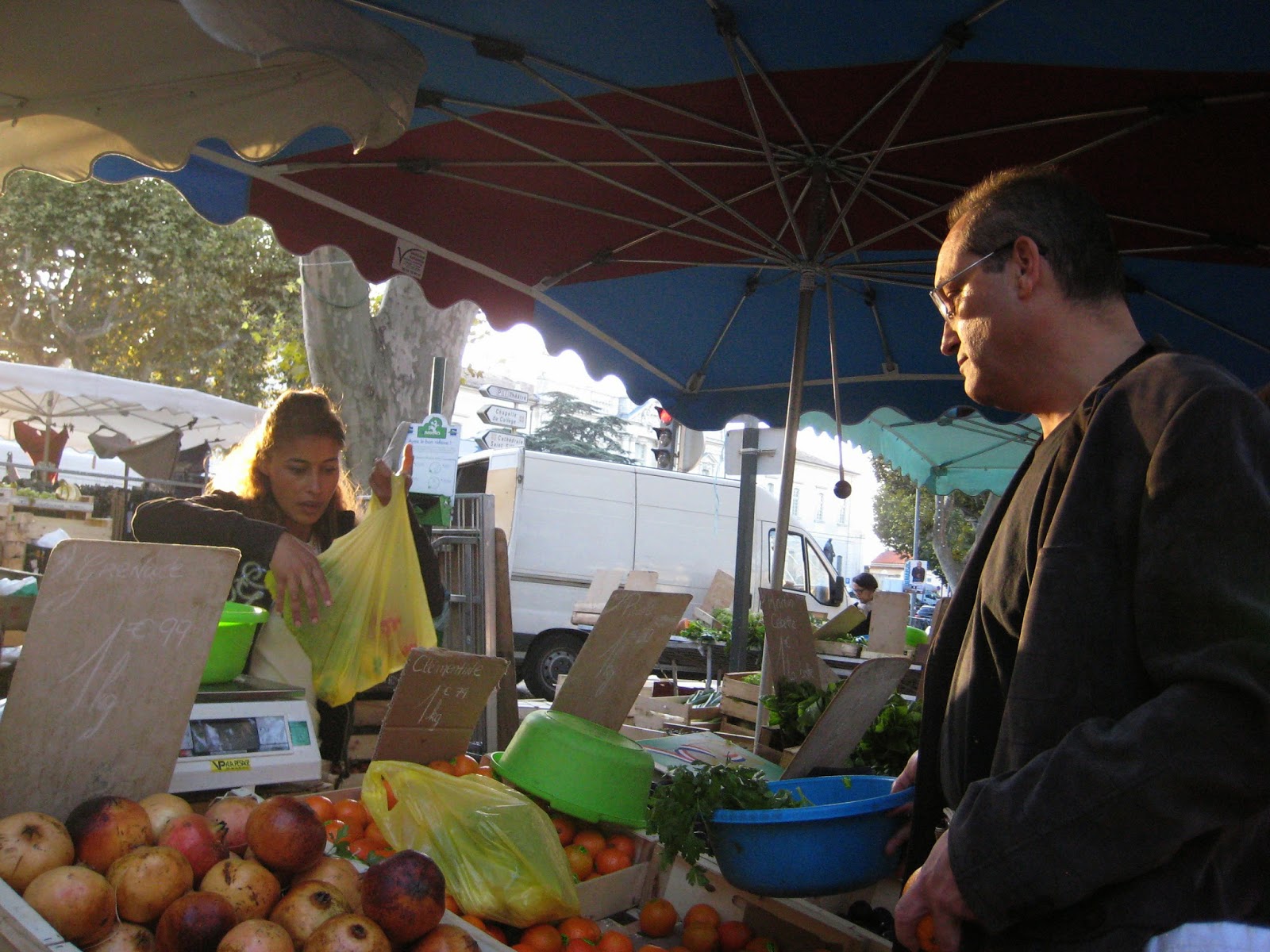
We also made a stop a large produce stand because Larry thinks one of the girls who works there is gorgeous. Joanna got a shot of Larry buying vegetables from her.


There were also vegetables and fruit. There has been a running gag here about pears. Joanna bought three of them at the market in Vaison the other day. Larry said we should buy more. I said three’s enough, a half for everybody. They’ll go bad. I eat half a pear a month on average.

Turns out, everybody here loves pears. So at Carpentras we bought two dozen. I think we picked up some more at the Carrefour supermarket on the way home.


We got back to put everything away, and set out for Chateauneuf du Pape sometime around 11, I guess. The Google map started us out on the same route we tried for Roussillon, sending us to roads that either don’t exist or aren’t marked. We had one false start and then realized we needed to head to a town called Courthezon, which is about two-thirds of the way there. 

The rest was easy. Actually, it was all easy for me because I sat there like a gangster while Wheels did the driving.

So we got to Chateauneuf du Pape a little after noon. The town is built on a hill, with the new castle on top. The actual chateauneuf isn’t so neuf anymore and all that’s left of it seems to be a tower and part of a wall.

That wasn’t what we came for anyhow. Larry called ahead and reserved a table for 13 o’clock at a cafe called Le Pistou. 


Le Pistou is up a hill. Most places are up hills here. This was a narrow street with a 20 percent grade. Maybe even straight up. But we got there. 

One of the specials of the day was coq au vin. I can’t remember the last time I had rooster in wine. This was going to be comfort food.

And it probably would have been, too, except that Le Pistou had run out of it by 10 to one. I was unhappy about that, but went back to the menu and ordered the next best thing, pork cheek in mustard sauce. Joanna had tripe sausage with the same sauce.

Because this is Chateauneuf du Pape, le Pistou served the local wine by the glass. Larry tells me that some of the producers of Chateauneuf du Pape are not turning out great quality wine. I don’t know. Any of the stuff I’ve ever tasted has been great.

Anyhow, I had a glass of red and another of white. The pork cheek overwhelmed the white, but the red was full of fun and held up just fine. It was also good with the bite I took of Joanna’s sausage. The pork cheek was very tasty, but the sausage was even more so. 

After lunch we strolled down to the tourist office for directions to some of the wine caves that Larry had picked out for us. They were all within walking distance. 

We stopped first at the Famille de Perrin store. This family has a range of wines, including a white that I buy at home under the name Vielle Ferme, or Old Farm. It’s made in the Cote du Ventoux section of the Rhone Valley. It isn’t officially a white Cotes du Rhone, but has the strong flavor I like, so I often have a couple of bottles in the fridge. It costs less than 10 bucks a bottle.


The company has other wine operations that climb the price ladder to the top of the line, a Chateauneuf du Pape called Chateau de Beaucastel. They had reds from 2012, 2005, and 2001 that ranged in price from 60 to 90 euros.

After sipping those, we walked over to another cave, Domaine Pegau.


Pegau is a clay wine pitcher, from which, we were told, the pope was served his wine. I don’t know if the wine was called Chateauneuf du Pape back then or not. The cave had a pegau on a shelf.


Pegau had a great, tasty white, which we wound up buying.  

Then we went to my favorite place, Eddie Feraud & Fils. There is a puppet with a big red nose outside the door. I had noticed it earlier when we drove into town looking for the parking lot.


Joanna took the picture of the day, a study in noses. All right, so the puppet wins this one, but at least I was a contender.

The bar was overseen by a laughing Provencal lady, and the wine-maker himself strolled in and offered us a taste of a reserve of some kind. We wound up buying a  bottle of 2012 white and one of 2011 red. Both cost less than 20 euros.

The wine was terrific. We wound up getting a couple of bottles here. I would have done that even if the lady hadn’t let me go down into the cellar.


It was great down there, dark, lined with oak casks, smelling of ancient mold and cobwebs.


Then Larry, consulting the map from the tourist office, led us up a hill and we started down a street full of wine caves, but not the one belonging to Jerome Gradassi, the guy we were looking for.

We backtracked, and Larry showed me the map. Here’s the Rue des Consuls and the street we want goes uphill opposite that.


I look at the map and lead everyone back. We don’t want to head this way, but off to the left. Look. There’s a sign. I can’t make it out exactly from this distance, but it could say Gradassi. And it did. 

Larry said, “This is going to make your blog.” I said, “It’s going to be the lead.”

Gradassi wasn’t there, but had posted a phone number. A man and his mother were standing outside with us, and he phoned.

Gradassi came to the door a few minutes later and let us in. We walked past more casks and cobwebs, but he had only one wine for tasting, and it was too young.


We backtracked to Eddie Feraud and Pegau, and that’s when we bought the bottles. Then came the big one. We went to Perrin. Larry tried the '05 and '01 again. We opted for the '01 as a gift to the family for having let us stay in their house. We’re going to spring it as a surprise with the daube on Sunday night.

We were getting tired, and Joanna was on the hook for making dinner, so we came back to the house. Joanna fried the bonita in grape seed oil with ginger, scallions, leeks in a sauce of wine and oyster sauce. That went with broccoli and white rice.

Went with? Hell, it was all superb.

We had that with lots of local wine, a Sablet white and Gigondas red, for instance.

This is really la plus belle Provence.

Be well, all.

Harry