Tuesday, July 24, 2018

Up the River


June 18-20

After a brief stop at the post office, which we found Sunday night while we were looking for Le Maison du Magret, we climbed the hill to the cathedral, La Basilique Notre Dame de Montreal.


This is a very pretty place with a long history, going back almost to the start of the city in 1642. The cathedral is of course much newer, and dates to the late 19th century.

We had a brief tour, but most of it I couldn’t hear because of background noise and my bad ears. It was mostly about the history of construction. I had hoped instead to get information about the windows and some of the other furnishings.


When we came out of the church, I told Joanna that I remembered a place where we ate dinner last time in town. We were on the sidewalk when a cloudburst hit. Along with everybody else, we ran inside carrying drinks and dinners. It was a lot of fun.

I thought it was right around the corner from the cathedral.


Joanna’s memory proved better. We went down a couple of blocks more toward the old town to St. Paul St. East and turned left. A few blocks away it turns into a walking street.

It’s where Joanna saw the three bronze ladies gossiping.
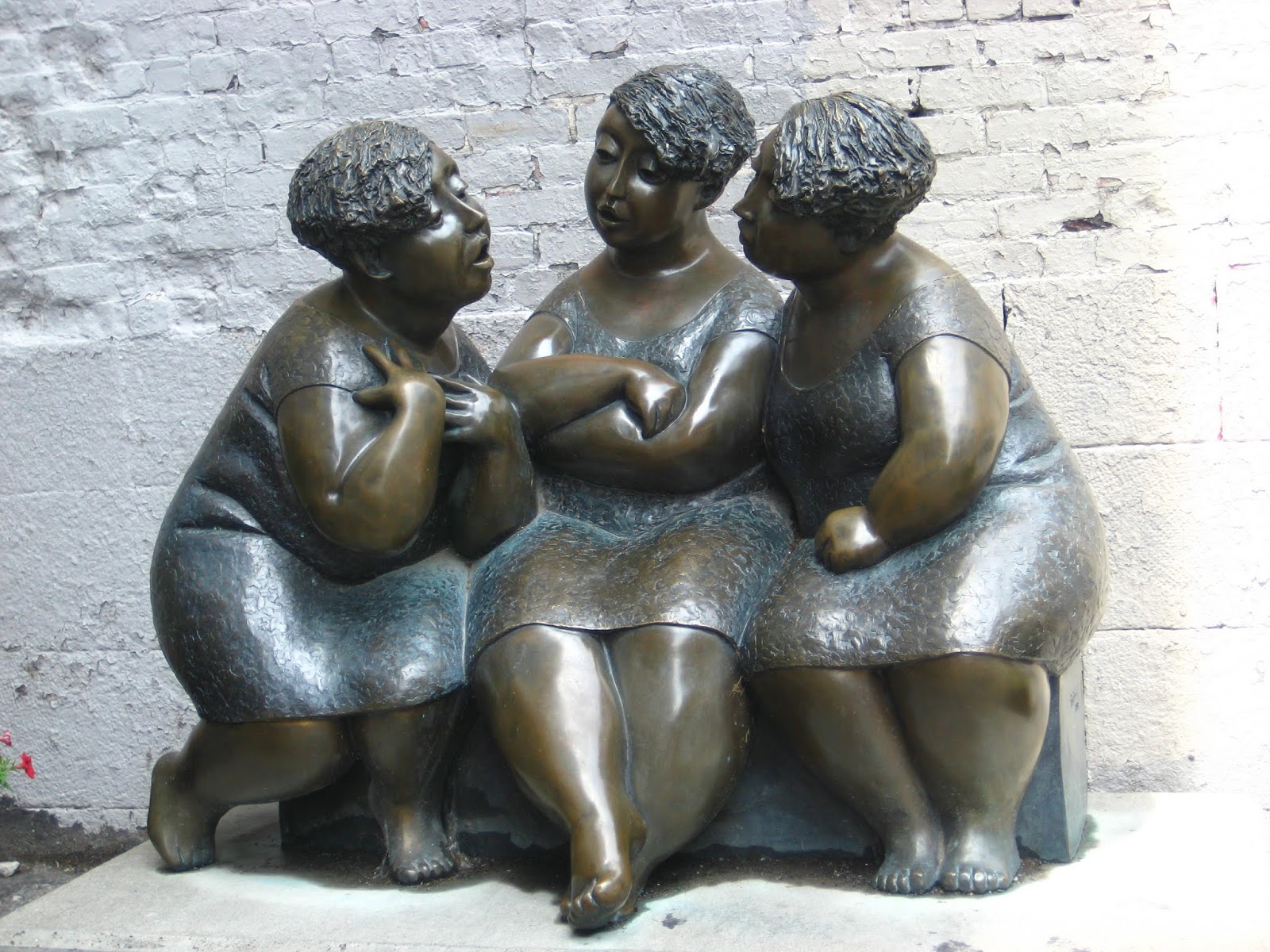

The place I remembered is called the Keg, but it was still closed when we got there. It doesn’t open till 3.

There’s no shortage of other bars to try, so we went to the Vieux-Port Steakhouse. We shared a caprese salad with surprisingly full-flavored tomatoes. Fresh tomatoes this far north are usually hothouse-grown or shipped in. In either case, they usually lose flavor. But these were good.


They were not covered with fresh basil but with something else, two small oblong leaves on a red stem. 

We also had escargot. These snails were cooked in a garlic sauce and then baked under a covering of cheese. It still holds true: Never meet a snail I didn’t like.


A short distance from there Rue St. Paul comes to Place Jacques Cartier, which has a park topped by a column celebrating Lord Nelson. It was put up in 1809, four years after he was killed at the Battle of Trafalgar. This neighborhood is where city hall and the courthouses are.


The Place is lined with shops and restaurants. We stopped in at Galerie le Chariot, which specializes in Inuit art. 

Most of the works on display are carvings of jade-like stone ranging from green to black. The pieces were variations, I guess, on traditional motifs: seals, owls, and polar bears, oh my. There was one carving of a shaman who was also a hunter, and others of ordinary men and women. 

The forms were generally rounded giving the figures a sense of plumpness, or of insulation from the cold. The store also had narwhal tusks, in case you should need one, with certificates testifying to responsible harvesting.

Dinner was at a Cantonese restaurant, Keung Kee, on the second floor of a building around the corner from the hotel. We didn’t want to travel far because the sky was threatening rain.


We had ordered and were waiting for the food to come when a squall started to blow rain around in sheets. This time we were under a roof and behind a window.

Had we tried to walk to Old Town we would have been caught right in it, and soaked through. It would have been an uncomfortably damp meal indeed at La Gargote or the Keg.

So here we were, high, dry, and feeling lucky, enjoying a hot pot with fish and tofu and Cantonese chow mein.

The chow mein nest of fried noodles was covered by a mix of random vegetables, meat, and shrimp. It had a clear sauce that looked like something you buy in the supermarket frozen meal section. 

But appearances deceive. It didn’t look promising but it delivered nonetheless, a rich and savory flavor that sank right into the noodles.  

The pieces of fish in the hot pot required some care because they were loaded with bones of various sizes. But the meat was tasty. The tofu was fried before it went into the pot, and that’s perfect with fish. 

Tuesday morning we set out for Trois Rivieres, about half-way between Montreal and Quebec City. We have a week and a half before we are expected in Coventry, so we don’t have to push it.

We were following Google directions and so got lost in the eastern outskirts of Montreal. We were trying to reach Autoroute 40 and followed directions successfully till we were on one of Montreal’s several roads named Notre Dame.

There was a signpost up ahead. Not the Twilight Zone, but a red, white, and blue sign telling us to go left for highway 40. Also the same way to Autoroute 25 north and south.

OK. I took the sign at its word.

We drove perhaps a kilometer and saw signs clearly directing us to the right for 25 south and left for 25 north. Nothing about 40, though, so I took the third option, which deposited us on a potholed local street.

After a little bit of that, I turned left and left again to backtrack. This was a bigger street, complete with gas stations, so we stopped at one to fill the tank and ask directions.

The man behind the counter said all I had to do was continue a short way until I came to the intersection with a Shell station. I was to make a right turn there. I would see signs pointing the way.

The intersection did have a sign, but it was for 25 north, not 40. I went that way and, sure enough, 25 north led to 40 east.

The country in southern Quebec is largely a plain, much like the shore area and the Pine Barrens in New Jersey.

You can see for miles and the sky is huge. In some places forest has grown back.

You see a few small towns and maybe there are bigger ones out of sight. There are also huge farms lining the road. 

Highway 40 took us almost to the hotel, which is a few hundred yards—oops!—meters from the St. Lawrence River.

The town gets its name because two large islands divide the St. Maurice River into three streams that join the St. Lawrence.

We arrived at the Hotel Gouverneur a little before two. Our room wasn’t ready, so we parked in a municipal lot across the street, next to the local museum. 

On the way to the lot, we passed the museum’s backyard, which was filled with small log cabins and other historical replicas. It looked entertaining enough that we tried to get in.

People were working there, setting up for an event that evening, and the museum was closed.

We saw the spire of the cathedral a block or so away, and made for it. It wasn’t by any means a steeple-chase, but we found our way there.

The Cathedral of the Assumption in Trois Rivieres is neo-Gothic, like Notre Dame in Montreal, but smaller.


The feature that I found most interesting is that the windows are painted glass with very fine detail. They were the work of an Italian-born Canadian named Guido Nicheri. Most of them are dedicated to various attributes of the Virgin Mary: Mother of the Savior, Ivory Tower, Consolatrix of the Afflicted, Queen of Heaven, Mystic Rose, and many others.

The church was dedicated in 1858, 27 years before Nicheri was born, so he windows must have been a later addition.

There’s a social program that I found touching. The Chapel of the Sacred Heart, which is attached to the cathedral, has been reduced by half to make room for a gathering spot open to anyone who wants to drop in for coffee and a little company.

We checked back at the Gouverneur and still no room at the inn. Nominal check-in time is 1600 hours, 4 p.m.

But that’s all right. I had been to church, so it was time for a drink.

Anywhere else in the French-speaking world, there is a bar next to a church and it’s usually named for the same saint. Not here, though. 

So I asked the lady at the hotel desk if there was a bar nearby. She laughed. There are plenty.

We were to follow the street outside, Rue Hart, three blocks to the other end and turn right or left. My kind of directions: fail-proof.

The street we wanted is called Des Forges. Both directions, both sides of the street, steakhouses, bars, coffee shops, grills, and even a vegan joint that sells craft beer.

We stopped in at Le Pot for a plate of cheese and cold cuts and a couple of glasses of Rioja. 

The plate had salami, goat cheese, duck sausage made in-house, blue cheese, and I forget what all. Maybe I was very hungry, or everything really was superior. Even the olives tasted a cut above.

We finally got room keys, tucked the car into the hotel garage, and took a rest.

It was after seven that we went out again, this time to find the river. 

The town sits on a bluff overlooking the St. Lawrence. There are several levels of a promenade with bars and benches. 

One of the unexpected things about Trois Rivieres is a program that posts bits quotations of poetry on plaques through the town—on shop fronts, for instance, and on the wall of the stairwell of the promenade, too.


Many are French, but perhaps half or more are poets composing in other languages, spoken on continents and islands around the world.

The port is still very active. A freighter of Liberian registry was moored at one of the docks.

The Laviolette bridge is a short distance downriver. It is the only bridge across the St. Lawrence on the stretch between Montreal and Quebec.

The photo of the day is Joanna on the promenade.


We explored the area and then walked up Des Forges to a place called simply Le Grill or something like that.

After the big tapas plate at Le Pot, we weren’t ready for a dinner. Instead, we shared an appetizer of coquilles St. Jacques. This is a traditional French pie usually made, in the States anyway, with scallops in a creamy wine sauce topped with a crust of mashed potatoes. 

I love it and have not seen it on a menu for at least 20 years. This version had pollock and shrimp besides the scallops and was served with baked cheese on top. It may have been the same kind of cheese that was on the escargot. Don’t know, but it was damned good.

I tried three different wines—A California Syrah called Seaside, Chateau l’Escart Bordeaux Superieur, and a Shiraz-Cabernet Sauvignon blend from Jacob’s Creek in Australia.

Seaside was the cheapest of the lot, but held up well against the others. 

The Bordeaux was also very good, but wasn’t best I’ve had. I look for a smoky edge in a Bordeaux that wasn’t there.

The Shiraz kept the Cab Sauvignon from taking over the Jacob’s Creek wine, and I liked that.

We woke up Wednesday to the sound of car horns and people chanting. About two dozen people had gathered across the street in front of the museum.


Many were carrying banners for the Syndicat des Metallos. That, I discovered later, is the French name for the Quebec branch of the United Steel Workers.

When we went out later, we talked to their leader, who said they worked for an aluminum company in the area and had been locked out for some time. Non-union workers had been hired by the company to do a job at the museum. They were there to protest it.


We took breakfast at a luncheonette called Binerie Chik, across from the cathedral.

The place is a shrine to Marilyn Monroe, with nods to Elvis Presley, James Dean, Fonzi, and Rita Hayworth. It has an actual juke box that was playing 45s.


I had fun with a yogurt parfait, fresh fruit, a little bread, and a bottomless cup of coffee.

Joanna had fresh fruit and, for the first time in more than a year, crepes. The last time she had them was in Paris.

It’s getting near dinner time and I am a mite peckish.

The strongest thing to drink I’ve had all day is coffee and that was hours ago.

Good night, all. The beer-drinking is about to commence.

Harry


Monday, July 23, 2018

Tunnel Vision


June 15-17

After a big lunch on Thursday, we weren’t ready for a full dinner, so we went to the old part of Brockville to the Keystorm Pub to have a couple of appetizers.

Joanna started with French onion soup with Swiss, not bad but not French onion, either. That needs Gruyere, baked over the side of the bowl.

I suggested the baked Brie, which came with candied walnuts, cranberry chutney, and garlic bread. I could have done without the garlic, but otherwise it was perfect.

The draft selection was OK, but not great.

I had three pints: 

MacKinnon Brothers Cross Cut blonde ale contains 5.2% alcohol but tastes stronger. The flavor has a hint of sweet and is a bit light. It’s not outstanding, but still OK.

Molson Stock Ale, a Canadian mainstream commercial product, tastes much like a lager but avoids the lager aftertaste. It’s made by Molson Coors in Ontario. This isn’t like making love in a canoe, maybe a rowboat instead. It’s not quite as close to water as other Coors products.

Lagunitas is not one of my top IPAs, but it's a solid option nonetheless. Sometimes it hits me as having too much citrus, possibly from citra hops rather than from added fruit. According to Lagunitas, it’s brewed “with 43 different hops and 65 various malts.” I don’t know if they’re serious about that.


Friday, we started our meandering in Courthouse Square. There’s a cross street behind the courthouse called Jail Street. 


There are also a few interesting churches besides the 19th century courthouse.


The figure of Justice on top of the courthouse is a replica of the original, which was carved of cedar. Somehow Justitia in Brockville has picked up the nickname “Sally Grant.” Nobody seems to know why.


For lunch, just for the hell of it, we stopped at Cosies English Tea Room. It serves scones and sandwiches that I guess are associated with English high tea. I had one with cheese and Branston pickle. 

The pickle is not cucumber cured in brine, but pickle more in the sense of chutney or relish. It is a sweet-and-savory mix of fruit and other things. It was fun to try, but like chicken feet, not something I’m going to do very often.

Joanna had a tuna and cheese toastie, an open sandwich with cheese melted in an oven. 

The shop is decorated in old furniture bought from the Habitat for Humanity thrift store. Maybe the ladies’ room too.


Near the east edge of town is Fulford Place, an imposing stone mansion built by a Canadian senator named Fulford. He was also a druggist who marketed “pink pills for pale people.”


The house overlooks the St. Lawrence River from a terraced lawn punctuated by venerable maples. The grounds were designed by the Olmstead firm.


A small formal garden has marbles of Adam and Eve. When we were there, the poppies and peonies were out in force.


And bees were in the roses.


Next we backtracked to a riverside park that used to be a railroad depot. It is at the south end of what Brockville claims is Canada’s first rail tunnel, built in the mid 19th century.

The tracks have been paved with a concrete walkway. On either side of the path are strings of colored lights. Every once in a while, a stretch of red light zooms down the tunnel to the sound of a locomotive whistle.

Sometimes the walls are green, sometimes blue. You get the idea.

It’s where Joanna caught the shot of the day.

Water is constantly dripping, by design. If the tunnel didn’t leak, the buildup of ground water would collapse it.

The drips leave streaks on the walls much like those in a cavern, but for some reason, the deposits build up faster in the tunnel than they do in a natural cave, about a millimeter a year, the sign said.


Walls are streaked with red and green from trace minerals, mainly iron and copper. At some places along the tunnel, the walls are covered with cascades of deposits, maybe calcium, that look like icing.


Dinner was an experimental burger at the Union Jack, an English-style pub that got my attention partly because it has signs for Old Speckled Hen and Hobgoblin in the windows. And also because the front is painted flag blue.

The burger was made of brisket and served with some kind of sweet-sour chutney. It was different, but I won’t do that again. Joanna opted for some surprisingly good grilled salmon.

The Hen was good, as always, and the Goblin even better.

I led Joanna across the street to the Georgian Dragon where I had a pint of White Water IPA for dessert. It’s a very fragrant ale, with good hops and some malt on the end.

Next morning it was time to go to Montreal.

Somehow Google gave me directions that included a highway under construction so I couldn’t get there from here.

Just about the time I was sure that I was on the wrong road, orange signs started showing up with arrows for the Rue Sherbrooke detour. 

That was convenient. I actually know something about Rue Sherbrooke and how it fits into downtown Montreal. We went there last year to the art museum.

Once we got out of the bumper-to-bumper traffic and were on Sherbrooke, I spent a few minutes parked by the curb to compare the tourist map of the city with the Google printout. 

Once I figured it out, we drove quite a way on Sherbrooke to turn right on Rue Peel. A few blocks downhill, we turned left onto Boulevard Rene Levesque. Hotel Travelodge was maybe a half kilometer from there.

I would have preferred to put us up at the Holiday Inn, where we stayed last time. Its feng shui, after all, was assured by an expert consultant. Can’t beat that.

But when I tried a couple of weeks in advance, the hotel was already full.


The Travelodge is a block away, still on the edge of Chinatown and near the Old City. The room’s tiny but otherwise it’s OK. Holiday Inn Centre-Ville is still my first choice for Montreal.

A Google search for French restaurants in Montreal turned up fewer in midtown than I expected. There is one we have visited a couple of times, La Gargote, on Place d’Youville in the Old City. 

There was also one that looked very promising, La Maison du Magret, three blocks away from the hotel. It specializes in duck. 

We sat at a table near a mirror runs the length of one wall. On it is a passage from a La Fontaine fable. The letters looked like they were written in lipstick and stretch too far to be read easily when you’re sitting up close. 

I did make out one bit, about a stork who marched on his long red legs and spoke Egyptian.

Actually, that bit read: “la cigogne marchait sur ses longues jambes rouges et parlait egyptien … .” It wasn’t till I looked it up that I learned that a cigogne isn’t a swan but a stork. The fable is “The Ugly Duckling.”

After we ordered, the waitress brought a complimentary plate of foie gras with coarse and wonderful bread.

Joanna’s duck confit was excellent. The skin was crisp. She shared some with me and ate some of teh skin herself—almost unheard-of for Joanna.

I had the magret, for which the place is named. It consisted of thin medallions of rare duck breast. It was terrific. So were the fried potatoes and grilled vegetables.

Both dishes, Joanna’s and mine, came with a mild foie gras sauce.

If you’re near downtown Montreal, you don’t want to miss this place. If you’re a vegan, you may want to take the day off. This was tear-jerkingly good food.

I had two glasses of a Pays d’Oc cabernet de cabernet. Never heard of that before. I don’t think it was a typo for sauvignon because I heard the waitress say the name and it tasted nothing like cabernet sauvignon.

It was slightly acidic, fragrant, and fairly full bodied.

She brought a merlot-cabernet blend for Joanna that had less bite than mine, but still carried plenty of flavor.

Next morning at breakfast, we ran into the Iranian robotics team. We saw other teams during the day in the hotel and on the streets in the neighborhood.

There seems to be some kind of gathering, probably a competition. I think they're in town for RoboCup, a competition of soccer-playing robots, which is being held at the Palais de Congres, across the street from the Holiday Inn.

That may explain why Holiday Inn was booked solid. It could be filled with nerds in team jerseys. 

Nerds always have more fun.

After breakfast, we tried something new. We took the Metro to the Pie-IX station to see the botanical gardens, which are near the Olympic Park, which dates back to the 1970s.


Pie IX is the name of a boulevard northeast of us. Google says the name refers to Pope Pius IX.

We got there easily with the help of the lady at the Metro ticket booth.


Most of the Montreal botanical garden is a formal layout. The bit we saw is heavy on annuals, different arrangements planted each year.

We didn’t feel like paying $20 each to see another formal garden, no matter how big. We walked around the plantings outside the fence, and that was enough.


This is the Great White North, but even so, temperatures were in the high 80s. It was time to duck out of the sun. So we made for the bar to have a muffin and a beer.

One of the taps was labeled Juke Box. When I heard it was an IPA, that settled it.

I’ve looked it up and am not sure but believe that it is brewed by a Montreal company called Oshlag. Two other taps at the gardens bar were labeled “Oshlag.”

Juke Box is spectacular. It has a rich bitter flavor, and the fragrance from the hops is downright floral.

I wouldn’t drive all the way to Montreal just to get it, but the next time I see it, I’ll buy a pint.

We got back to the hotel in one piece and took a break.

Then we set out on a journey around the corner for dinner in Chinatown. We walked up and down. There are a lot of shops that are heavy on dumplings and noodles—which are good, but not what we were in the mood to eat.

I had wanted snake soup, but Joanna said it is a winter dish and probably not available. We didn’t see any signs advertising it.

We wound up at a spot on the very edge of Chinatown on Rue Gauchetiere. It’s called Mon Nin, Cantonese for 10,000 Years.

They brought us soup with pork and dried bok choy as a starter. It was pretty tasty.

Then came my dish. It was described as snails in black bean sauce. In French it was “escargots.”

But this is a lot of work. The snails are much smaller than the ones cooked in escargots Bourguignon. 

They’re sauteed in black bean sauce, as advertised, but also in the shell. So to get at the meat, you have to hold each slippery shell in your fingers and pick the snail out with a small wooden skewer.

I’ve never met a snail I didn’t like. So this was very tasty. But it took so long to get a dozen or so snails out of the shell, that by the time I was halfway through them, they were cold.


Joanna had a dish of salty pork with preserved egg. It was delicious over rice. It had added appeal because it didn’t come stuck inside a shell.

I had a Tsingtao with dinner, and then we went for a walk.

It was getting late and we were getting tired, so we didn’t wander far.

I managed to pick up a couple of pints at an IGA near the hotel. They were a red ale and a session IPA from a Montreal brewer called St. Ambroise. 

Both were very good. The red was rich and malty without being sweet. The IPA had the fine pine flavor and some perfume, although less than this afternoon’s Juke Box.

I came back and worked on this report before I conked out. I’m finishing it up on Monday morning.

We move on to Trois Rivieres on Tuesday and will stay there a couple of days before we go to Quebec City.

Be well, all, and when you’re in a tunnel, don’t forget to duck.

Harry


June 17

That’s a really really great photo, Harry!

Tell Joanna it’s better than I could do!

On my bucket list is one more road trip with you!

Best

Art


The Other Syracuse


June 10-14

Joanna and I set out on Sunday for three weeks on the road. 

Joanna had received a call from her best friend, Pat, earlier in the week. Pat said she was making a visit to New Jersey and wanted to know if Joanna would be home. 

We were already planning the trip, which would put us somewhere in Quebec Province around the time Pat would be in Jersey. It was easier for us to leave a few days earlier to visit Pat and her husband, Bob, near Syracuse.

So that’s how the front end of the trip got started.

Joanna and I left Montclair on Sunday and took I-80 West. The first stop was in a place called Clark’s Summit, a few miles north of Scranton, so we had plenty of time to stop along the way.

It started to rain, though, just about the time we left in the morning—one of those spring rains ranging from drizzle to downpour and back again. Sometimes visibility was so bad we had to hang back and go slow. At other times, the wipers were doing fine set at that now-and-then swipe across the windshield.

It was still raining when we entered the Delaware Water Gap. We parked near a trail head and saw the forest was soaked. So we decided not to get out for a walk, but to stay in the car and have a snack for lunch.

We shared a smoothie we had made that contained fruit, yogurt, flax meal, soy (or maybe almond) milk, and maybe some things I forget. We also had some unsalted cashews and dried cranberries. 

In other words, it was disgustingly healthy-sounding food for a road trip, and I was determined not to do too much of that.

We sat watching the steam rise through the trees on the Pennsylvania bank. Smoky mountains majesty. It was gloriously spooky.


About an hour later we stopped at Archbald Pothole, east of Scranton on old U.S. 6. The pothole is a result of glacial activity in the last Ice Age. 

The theory is that a hole formed in the glacier and water, mixed with grit and stones, bored a wide hole about 40 feet into the ground.

The space filled with gravel and nobody knew it was there until the 1880s. Coal miners touched off a blast that broke through to the hole. When all that gravel and water started to flow into the mine, they thought they were goners.

There’s a platform built at the edge so you can look straight down into it. The walls aren’t smooth, but instead look almost helical. Imagine a giant corkscrew gouging out the rocks and dirt.


We stayed at a Comfort Inn on U.S. 11 in Clark’s Summit. It was easy to find—one of the first things we saw as we came from Interstate 81.

About a tenth of a mile up the highway is a bar and grill called Tully’s Good Times, part of a regional chain. The rain had quit, so we tried to walk. 

But it isn’t easy. We were waiting at the light to cross the highway when we saw a sign right across from us, a walking man in a red circle with a bar through it. That means “no walking here” or “no stick figures.”

So to be safe we took the car to a place we could see from the hotel parking lot.

Tully’s has an OK list of craft and imported brews on tap. None was new to me, but many—like Neshaminy Creek County Line IPA and New Belgium Fat Tire—are old stand-bys.

We were able to get surf and turf (steak and shrimp, that is) without the Cajun rub, or whatever it was supposed to be treated with, and so we stayed.

Monday we headed north on I-81 to Baldwinsville, near Syracuse.

We traveled over more hills, past more farms and forests. We paused at the New York State Welcome Center near Binghamton.


We missed a turn near the end of the ride, but stopped for directions at a Red Apple convenience store.

We made it on the second try. Joanna saw Pat and Bob on their balcony when we arrived shortly after one.

When we got out of the car, Pat came up to me and asked, “Do you remember me?”


I surely did. “You’re the star of one of my favorite travel stories.”

In the autumn of 2011, Joanna and Pat took a river tour through eastern Europe.

They would spend a couple of days in Prague at the start of the tour, so I decided to  fly over so I could take Joanna to dinner.

I was wandering around the city because I had a few hours to kill before I met Joanna at her hotel. I was crossing the crowded Charles Bridge, when I heard somebody call my name. 

That’s not unusual. With tinnitus and a shaky conscience, I hear that all the time, and nobody’s usually talking to me.

But this time it kept up. I turned and saw under the sun Pat and Joanna.

Pat had seen a guy in a suit and a pony tail and asked Joanna if it could be Harry.

We took it easy at the house for the rest of the day and set off the next morning, Tuesday, for Alexandria Bay, a town on the New York side of the  St. Lawrence River at the Thousand Islands.


Of course, the thing to do here is to ride on a boat for a couple of hours looking at the islands large and small and the structures large and small on them.


We took a two-hour boat tour through the islands, in the area called Millionaire’s Row. Some of these imposing castles are real Gilded Age veterans that have sat on their islands for more than a hundred years.


We also passed  the statue of St. Lawrence on a bluff overlooking his river. The Thousand Islands is also the site of the world’s shortest international bridge, which links two small islands, one in the U.S. and the other in Canada.


We stopped to share a few appetizers at Riley’s by the River, a bar across the street from the pier where our boat came in.

One of the selections on tap was an Empire Brewing pale ale. It was bitter and fragrant enough to qualify as an IPA, and probably would have been perfect with bread pudding.

Wednesday’s plans ran into rain. Instead of going to Cooperstown, we detoured to the local history museum and the Eberson art museum in Syracuse.

The history museum was filled with curious artifacts and stories. Smith-Corona typewriters made in Syracuse accounted for something like 40 percent (or was it 60 percent) of the world’s typewriters at one point.

There were salt mines nearby at the shore of Lake Onandaga. 

Champlain led an expedition against the Iroquois near the lake. He had maybe 2,000 men, and there was one battle which the French won decisively. After that, the Indians withdrew as the army advanced, and the French mostly destroyed villages and crops. 

According to one account, Champlain was nearly 70 and had to be carried in a chair.

The art museum is fun. Most of them are. A local artist named 
Darryl Hughto is the subject of the major exhibition right now. 

His work is a little abstract for my taste, but still fun. Early paintings use the diamond as a recurring theme. Then there are later abstractions of sailboats, which continue the angles and hard lines of the diamond paintings.

There is also a gallery showing some of his portraits. 

We stopped for lunch between museum visits at Dinosaur BBQ in downtown Syracuse. I had some very good pulled pork with a side of collards. I sampled a bit of Bob’s rack of ribs and Joanna’s Dixie-fried catfish. 

It was like being back in the Carolinas. Maybe better. I was able to have all this with a Saranac root beer, one of the best.

Thursday we traced the route to Alexandria Bay, but bypassed that and continued across the international bridge to Brockville, Ontario.


We went to the historic district for a walk. I showed Joanna the courthouse and the monument to Gen. Isaac Brock, “the Savior of Canada,” for whom the town is named. 

Brock had successfully driven off U.S. invaders during the War of 1812 and was trying to drive off more at a place called Queenstown. He was “targeted by a sharpshooter stationed among the enemy.” 

Brock has a marble monument in St. Paul’s London. It is distinguished because in addition to the dying Brock being comforted by a British officer, the group includes an American Indian, whom I have heard may be Tecumseh.

Joanna and I saw that monument in London only a matter of a week or two before my first visit to Brockville during Memorial Day weekend in 2012.

We stopped for some OK Chinese at a place in Brockville called the New York Cafe.

Mine was a mild Singapore mei fun and Joanna had beef with bok choi. She has been missing vegetables because they are hard to get when you’re on the road.

The plates were huge but we polished everything off. That was lunch and dinner combined.

Right now we are in Days Inn just outside Brockville. Joanna has just woken up from a nap, and so we are going to a bar where we will have dessert.

I had four beers Sunday night, none Monday, and only one on Tuesday afternoon. I think the beer-drinking is about to commence.

Good night, gang. May you keep your whistle wet and your feet dry. Be well. 

Harry


June 15

Dear Harry,

Fast backward: When Bob first took me to Syracuse to meet his family—this was shortly after we’d married—he instructed me that when his mother asked if I’d seen the statue of the family patriot in downtown Syracuse I was to say yes. 

Otherwise we’d have to spend the whole day on it. I followed Bob’s order. The upshot is that I’ve never seen it.

It’s a statue of David Williams, who captured Major Andre thus averting West Point’s falling into British hands.

You might well see it on your Syracuse excursion. If you do, please let me know.

Beatrice