Sunday, April 21, 2019

Memorials and Hijinks


Jan. 24-26

Joanna was curious about the World of Coca-Cola, but it’s my fault that we didn’t go in. I just don’t want to pay an admission fee to watch somebody’s commercial.


We did see the statue of Pemberton, the inventor of Coca-Cola, on the plaza near the ticket booth.

Besides, the place has a distinct Walt Disney vibe, and I’ve had enough of that in this life.

So we went straight to lunch.

Joanna was craving vegetables, and I was experiencing a bit of nostalgia for them myself. We had noticed when we were there last night that Ted’s Montana Grill offers a vegetable plate, made up of four sides.

The car was tucked into the lot and we walked the few blocks uphill to the restaurant. It was chilly—downright cold for Atlanta—and windy, but we managed to make it without too much windburn.


This is the South, so the vegetables were exceptionally good because they are cooked soft and gently enhanced by seasoning and shortening. The green beans, generally not my favorite, were delicious. So were the carrots. 

I ordered a chicken tortilla soup, bits of chicken and chopped vegetables in a thick broth flavored with chili powder. Not bad, not great. 

I wouldn’t cross the street to have it again, but if that was the only soup on the menu, I could take it without complaining.


We are staying at a pleasant La Quinta hotel about eight miles from Downtown. And Downtown is where all the action is. 

Google sent us to Interstate 85 to reach Downtown. Then on the way back, we found that it’s much more fun to take the slow ride up Peachtree Street to the Buford Highway and back to home base. 


We had eaten a much bigger lunch than usual and so went out for a late dinner. 

First I had to do some searching for a destination in our neck of town. Google turned up the name Eataliano. 

We had seen the place earlier, the night we wound up at Grub Burger Bar. But a joint called Eataliano sounds right down there with Sbarro, the terrible New York pizza and pasta chain, so I passed right by it.

This time, I read some reviews. They even have wine. It sounded better than terrible. Joanna was game, but then, she’s never tried Sbarro. But anyway, we took a flyer. 

Much to my surprise, they served a surprisingly good pizza. It had a great crust with just the right amount of char. The topping was a savory fennel sausage. The sauce was fine, nothing overdone, and definitely not sweet, which is always a danger with unknown red sauce.

Joanna had eggplant Parmagiana with penne. Again, the sauce had been judiciously made.

I started with a cheap Chianti, which I found too sharp. I followed it with a better one.

After our visit the other night to the war zone, I looked up another place to buy packaged goods. This store was less heavily armored, although the clerk was still behind bullet-proof windows.

I found a bottle of Montepulciano d’Abruzzo for $11 or $12. The label says Masciarelli 2013. It’s not the best, a little acidic, but it’s still Montepulciano d’Abruzzo, and that means good. 


Friday we went to the High Museum of Art. It’s not big, but it’s worth a few hours of browsing. 

There are several large sculptural pieces surrounding the building. 

A striking figure is a casting of Rodin’s Shade. It stands on a pedestal in a pose of despair with its head below one arm. Surrounding it is a ring of black marble plaques with the names of 122 members of the museum who died in a 1962 plane crash at Orly. 

My favorite is an installation by Roy Lichtenstein. It’s a cutout painted to look like a house with slightly exaggerated perspective. As you walk around it, you sense that it is moving and also changing proportions. 

It’s an illusion in more ways than one. The corner of the two walls protrudes toward the viewer. You don’t question that. Not until you get far enough around to look at the piece edgewise.


From the front you see the roof tilt back, so distinctly in fact that you may think the surface is bent that way. But the roof doesn’t tilt back at all. It tilts forward.

What you saw as a convex figure is in fact concave.

It’s an ingenious fool-the-eye joke, an affirmation of life a few yards away from the Shade.


On the far side of the building is World Events, a large aluminum sculpture by a British artist named Tony Cragg. At a distance, you see trusswork that outlines a man holding a globe. 

Close up you see that the trusswork is made up of stick figures balancing on each other.

The painting galleries have works from the late 14th to the 21st century.


My favorite piece inside the museum is a statue of Rachel when she first meets Jacob. It’s a graceful figure made more so by the drape of her clothes. 

You can see her face clearly even though it is covered by a marble veil.


How does somebody conceive of that, let alone execute it in stone?

It’s hard to describe because it’s a sight gag, so I’m sending a closeup as the picture of the day.

Dinner was bar food at one of my other favorite places in Atlanta, the Vortex. You have to be 21 to go inside. You have to behave when they let you in: “No Minors. No Whiners.”

Joanna and I both tried the Alpine Steak Burger—Swiss cheese, mushrooms, sauteed onions, and steak sauce on a half-pound patty. 


I tried something new to me, Abita IPA. I’ve had the company’s Turbo Dog and its Purple Haze, which tend to be on the sweet side. 

When they say IPA, though, they mean it. It wasn’t just very good; it was a complex blend of flavors. At least on draft, it’s among the best India pale ales that I’ve tried.

Saturday we left Georgia and drove to Montgomery, Ala. 


We were originally going to Birmingham, but Joanna read about a civil rights monument by Maya Lin, the same sculptor who did the Vietnam Veterans Memorial in Washington. 

Lin was a kid barely out of school when she won the competition for that earlier commission. Joanna and I saw it in D.C. a few years ago. 

Joanna wanted to see the civil rights monument in Montgomery, too.

It’s in front of the Southern Poverty Law Center, nor far from the Alabama State Capitol. All the government workers were gone on Saturday, so the streets were empty. That made visiting easy.

We parked across from the monument.


It’s a circular black granite fountain. There is quotation on the wall, from a speech by Martin Luther King: “We will not be satisfied until justice rolls down like waters and righteousness like a mighty stream.”

The granite face of the fountain is inscribed with a timeline recording the civil rights struggle, the murders of activists, the passing of landmark legislation, the Selma police riot, Rosa Parks’s refusal to move.

It’s quiet, and the content makes it stunning.


Down the street is Jim Crow’s legacy.

A huge Confederate soldiers’ and sailors’ monument occupies a place of distinction in front of the Alabama State Capitol. According to its inscription, the cornerstone was placed by Jefferson Davis, “president of the CSA,” in April 1886.


There are doggerel declarations on the sides of the base. One reads: “Knightliest of the knightly race / who since the days of old / have kept the lamp of chivalry / alight in hearts of gold.”

I can’t hear “chivalry” in connection with the Old South without remembering Mark Twain. He talked about that too. He blamed the Civil War on too much reading of Sir Walter Scott.


The obelisk must be a couple of stories high. Plaques at each corner describe four versions of Rebel flags. The flags, though, and even their poles are gone.

We saw them, the same designs if not the identical flags, across Washington Street from the Capitol, at the The First Confederate White House.


Montgomery was the Confederate capital for a few months, before the government moved to Richmond. The house is where Jefferson Davis lived and carried out the business of being the Rebel president.

It was originally in a different location, but was moved to its present lot, maybe so the legislators could always keep it close.

The Alabama archive and museum is next door. 

An entertaining feature outside is a bronze map placing significant events in the state’s history and heritage—“Damn the Torpedoes,” the founding of Mobile, the 1965 Voting Rights March, catfish farming. 

A man came out to offer us brochures with more information about the map and also to invite us inside.

We spent about an hour there, reading about the original inhabitants, the Creek Indians. De Soto came looking for gold but didn’t establish a settlement. That was left to the French. Then the British took over, and finally the Americans.

We had to stop and leave at closing time.

Most of the restaurants that looked promising are on the far side of town from the Comfort Suites where we were staying. I just didn’t feel like getting back onto the Interstate and driving eight or nine miles each way.


I found a Longhorn Steakhouse three miles down the highway that runs right outside our door. I usually avoid chains, but this was the closest place I could find that looked like something for grownups. 

It was another happy surprise. This is cattle-raising country, so maybe the filet mignon was locally grown. All I know is that it was one of the tenderest and tastiest in my memory. Even the fries were crisp and the broccoli well seasoned.

A tuna steak passed muster with Joanna. and so did a baked sweet potato.

I don’t know if any other Longhorn Steakhouses are this good,  but I may try one somewhere else just to see.

Even the unnamed pinot noir they poured was a treat.

We’re in Meridian, Miss., right now and heading for Vicksburg tomorrow. We’ll stay there two nights. 

Vicksburg may get 1 to 3 inches of snow Monday night, so just as well that we don’t leave till Wednesday.

I am trying to dodge winter and it’s following me. Ouch.

Love to all and to all a good night.

Harry


Tuesday, April 16, 2019

Underwater Atlanta


Jan. 20-23

On Sunday, our last full day in Savannah, we made it to the Latin mass at the Cathedral of St. John. 

The service begins at one in the afternoon. 

Not knowing how long the trip would take—particularly the part about finding a parking place— we left early. We zipped along, parked a block away and arrived before the previous service had finished. 


It was too chilly to enjoy a stroll, so we sat out that service at the back. The music was fantastic. 

I didn’t get to see the choir for the service that was ending. Joanna and I were at the back under the choir loft.

We moved forward for the Latin service, which was largely sung. There was a small choir, four or five chanters, whose voices filled the space.


I’ve heard the Latin service a few times, but am not familiar with much of it. I know a few responses and can start the Pater Noster. I had a booklet with much of the text, and when I didn’t get lost, was able to follow along with the choir.

It was around two when the service let out, and a long time since our light breakfast. So we stopped at a luncheonette called Clary’s, which we passed on Abercorn St. on the way back to the car.

They have Reuben as big as your head, that was calling my name. But I opted instead for yet another Confederate breakfast, grits, biscuit, and eggs. I’d save the calories for beer later.

On the wall is an illustration that looks like a stained-glass window of the Bird Girl.


We went to Orleans Square for a look at a particularly striking fountain which had been used as a cover photo for the Savannah visitor guide at the hotel.

We couldn’t get a photo even close to the one on the book, because it was already late winter afternoon and the shadow of one of the live oaks was on half the fountain. 


Had it been all in shade or all in sun, the camera would have been able to get a more detailed shot. 

Forsyth Park, a few blocks south, is a large park. It has two buildings that were originally built as mock forts for military training during World War I.


One of the attractions is the Forsyth Fountain, a large marble fountain with water spouting from fish and from sea gods’ trumpets. There are herons in reeds near the top.

The park also has an obelisk commemorating the Confederate dead, erected by some ladies’ group in the 1870s. It originally was to be surmounted by two mourning women, but maybe that idea was considered too emo, so now there’s a Confederate soldier on top with a floppy hat.


The monument was made in Canada of Canadian limestone. It was transported by ship to Savannah so it would not touch northern soil.

There are also two busts of prominent citizens who were Confederate officers.

We had dinner at a place called 5 Spot for burgers with a side of collards.

It was good food. The place bills itself as the “neighborhood kitchen and bar. Like a lot of neighborhood bars, the beer selection was mediocre. Sam Adams IPA is OK but not the best; Brown Bear (Catawba NC) brown ale is slightly sweet; Goose Island is always good, can or tap.

On our way out of town Monday, we took a detour to see the Mercer-Williams House. The house was built for Hugh Mercer, the Confederate general, not the apothecary in Washington’s army. 


This Hugh never got to live in the house. The Civil War started before he moved in. By the time he got back from the war, someone else had taken over the property.

It was eventually abandoned until a prominent local antiques dealer, Jim Williams, bought and restored the building.

Williams later shot and killed a male prostitute in the house. The story is the basis of  “Midnight in the Garden of Good and Evil.” 

Williams was acquitted after four trials, and then died unexpectedly inside the house a few years later. The place is now owned by his sister, who operates it as a museum.


The house faces Monterey Square, which is the site of a monument to Count Pulaski, the Revolutionary War hero who was killed in action near Savannah. He is the eponym of the Pulaski Skyway in New Jersey.

We stopped on the way to Atlanta at a Huddle House. It’s almost identical in layout to Waffle House, but neater. I kind of missed the blackened pans and the spattered waffle batter.

Joanna had one of her favorite breakfasts, pancakes and bacon. Instead of grits, this time I had a waffle with my eggs and sausage.

The coffee was a little weak, but that was just as well. The hour was far past noon, and for me that’s late in the day for coffee.

I learned to be careful with that stuff. I used to drink so much coffee—at least a half gallon a day, literally—that I couldn’t get to sleep till midnight or one. 

I cut that out years ago, and now usually limit myself to a couple or three cups in the morning. 

We finished our drive in the suburbs of Atlanta, a section called Druid Hills. Judging by the franchises on the roadside, these Druids eat a lot of tacos.

I later read in a local alternative paper, “Creative Loafing,” that the neighborhood is heavily Mexican. Maybe because the Consulado General de Mexico is here, overlooking the highway near the hotel.

But it is a smiling Korean lady who runs the laundry up the road at the Sun Tan strip mall.

She gave us a lot of help. Using the machines there is slightly different from the ones at my usual laundromat in New Jersey, but it’s similar enough to be confusing.

Between the two of us, Joanna and I had collected quite a bag of socks and whatnot in the past week and a half. But we finished in record time.

Still, it was after five when we left, so we were feeling the pangs of hunger. Rather than drive to downtown, where all the good restaurants are, we just rode around Druid Hills looking for a place to eat.

The landscape was full of franchises selling tacos and fast food, which is how we wound up at the Grub Burger Bar.

Joanna had a salad of salmon (or maybe tuna; I don’t remember) over things like corn and black beans. It was served cold. I tried a taste and maybe it would be better hot. 

My burger was all right.

The only ale on tap was Hopsecutioner, which I’ve had a few times before. It’s made by Terrapin Brewing in Athens, Ga. Mildly fragrant but full of flavor, it’s a drink-worthy IPA.

Tuesday we went to a novelty of the city, Underground Atlanta, which we found closed. A security guard told us many of the surface buildings will be replaced by. high-rise apartment houses and the underground mall will be redesigned.


The underground part is a couple of city blocks that were the original street level. At that time, that meant the cross streets were grade crossings on the network of tracks near the rail station. 

For safety reasons, the streets were raised to pass well above the tracks, and what had been ground-floor shops and restaurants, went underground. Literally and figuratively. For a while it was a notorious neighborhood of brothels, speakeasies, and gambling dens.

When I saw it first, a few years ago, it had been transformed into a mall with an arcade feeling. I remember there was a bronze statue of a street performer working with a bear, supposedly based on a real person who used to show up there, probably in the care-free days before bears were regulated.

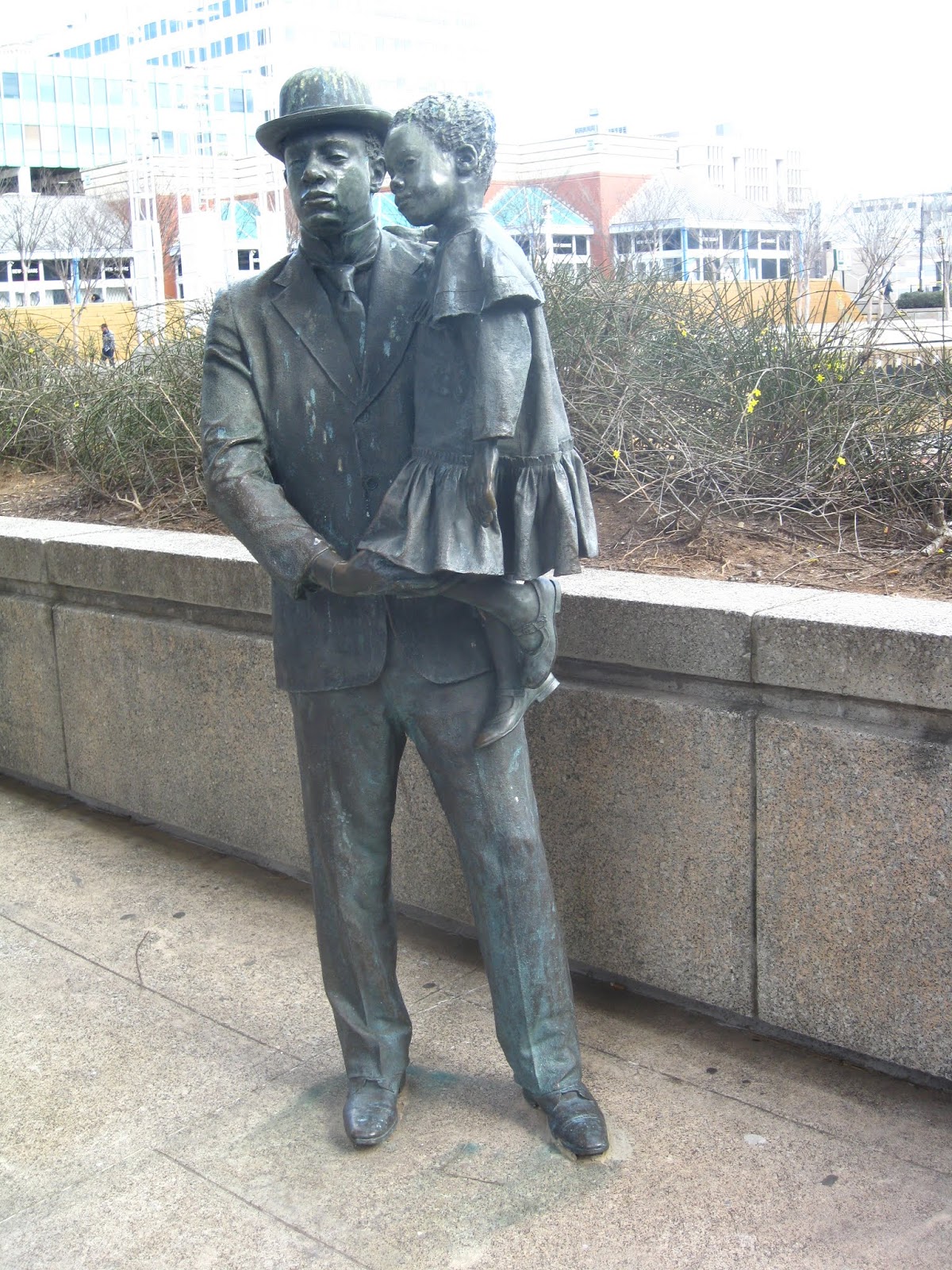
The only bronze I could find this time is on the upper level, a man holding a child.


We met Maryellen and Ken, my sister-in-law and brother-in-law, at a terrific Italian restaurant called Baraonda. Mare, Ken, and I had eaten there once before when I was in town. 

As I recall, we had been walking on Peachtree Street a block north of the Fox Theatre and found the place by accident.

It ranks with the best Italian-fare restaurants I know.

Joanna had the ravioli, which is outstanding. Mare ordered it on our first visit and gave me a sample. Joanna’s was equally good.

My dinner was Garganelli ragu. The sauce was made with ground beef instead of the beef chunks that fall apart, which is the way I think of ragu. But it was very tasty—savory with no sugar (or very little) added—and I believe it contained plenty of wine. I’d definitely ask for this one again sometime.

The Montepulciano d’Abruzzo was also very good. 

On the way home, I stopped at Terrific Package Store a mile or so from the hotel.

It was pretty terrific in its way. Sitting right next to the Naughty Lady Lingerie shop, it had iron bars on the windows and doors. The clerk worked behind bullet-proof glass.

The place was so heavily armored, it felt like I was coming to bail out a prisoner instead of a bottle of wine.

Joanna came in with me. She didn’t want to sit in the car in this neighborhood. 

It was fun for a short visit, but I was glad that our hotel was in a less ominous part of Druid Hills.

I bought a cheap bottle of California Pinot Noir. It was OK, but certainly wasn’t Montepulciano d’Abruzzo.

Wednesday had a forecast of rain, so we went to the Georgia Aquarium in the afternoon. 

We got there just in time to see the dolphin show. Each animal works with its trainer. They perform in a pool with a plexiglass wall so you can see below the water.


They dance, and they wave. They stand on their front flippers. Sometimes they come up to the edge of the pool and rest their front flippers on the edge, much like a kid at the side of swimming pool. 

The dolphin show was over the top. You’re warned repeatedly before the show starts that the first ten rows are in the “soak zone.”

Everything starts with leaping and spinning dolphins, and yeah, that puts up a splash. Before it’s over, though, a half dozen animals are at the edge of the pool using their tails to scoop water into the audience.

The dolphins pull their trainers through the water. One stunt doesn’t look humanly possible. A trainer stands up on one foot, which—try to picture this—rests on the tip of the dolphin’s snout as it races across the pool.

I can’t imagine how anyone could stand with both feet maybe on two dolphins' noses for better balance, not even if they stayed stock still.


The biggest attraction in the aquarium, though, isn’t a show at all. The area called Ocean Voyager is a salt-water tank filled with rays, sharks, schools of colorful fish and dull fish.

You look through windows into the tank. You walk through a tunnel that surrounds you with the fish without getting wet. 

Then you come to a small theater with carpeted steps where you can sit and watch the entire tank through a window about the size of a movie screen in your local multiplex.

The aquarium has two whale sharks. It is the largest species of fish in the world and when you see them from underneath, they indeed look like whales with their wide bodies and blunt heads.


It’s fascinating just to sit and watch. As one of the aquarium people put it, “You can sit here and clean your mind.”

A section devoted to river life includes a small tank of piranhas. They swim very calmly looking like they wouldn’t bite a fly. 

A monitor on the wall shows them at feeding time. A dead fish is dropped into the water on a line. They clean it in seconds.

The Georgia Aquarium, its name notwithstanding, isn’t a state organization. It is a non-profit. The various exhibits have corporate sponsors. For instance, Sun Trust supports the sea lions, AT&T the dolphins, and Southern Co. the river exhibits.


It was outside the aquarium that we ran into the second disappointment of our sojourn in Atlanta.

One of the additional sources of fun at the aquarium was that Legal Sea Food was right across the street. This is a restaurant chain that claims “our fish is so fresh that an entree once took a bite out of the appetizer.” 

Wow, just like the piranhas.

We had planned to go there for dinner, but the restaurant has, alas, closed. Maybe fish isn’t popular in Atlanta. Or maybe people got nervous eating fish close to their toothy cousins.

We started driving back to the hotel, expecting to find a promising place on the way. And we didn’t have to go far. 

A couple of blocks away, near the Olympic Park, we saw a sign for Ted’s Montana Grill. We had been of those restaurants in Bozeman. 

This one was in the Ted Turner Building on Ted Turner Blvd. You can see the CNN building nearby. 

Ted’s Montana bills its fare as “authentic American dining.”

Even the wines are American. We had two very good ones from California. 

Since we were sitting at the bar in front of a mounted buffalo head, Joanna’s wine was very appropriate—a smooth Merlot labeled Bison Ridge. I had a spicy Pinot Noir from MacMurray Ranch on the Central Coast.

Dinner for Joanna was half a roast chicken. I chose a bison filet. I don’t think it was taken from the animal on the wall. It came planted with a small paper American flag on a toothpick.

Both choices were excellent, the chicken savory, the bison actually tender.

Bison has a slightly gamy edge that distinguishes it from beef. It’s not to everyone’s taste. Joanna isn’t crazy about it, for instance. But I love it. 

I come from a long line of deer hunters and poachers. I was raised on venison, not all of it taken in season. So farm-bred buffalo is a treat.

Here’s hoping for treats all around.

Good night, gang. And if you ever sleep with the fishes, be sure they’re not piranhas.

Harry


Wednesday, April 10, 2019

Midday in the Garden of Good and Evil


Jan. 17-19

The drive from Hilton Head to Savannah is supposed to take about an hour, maybe less.

I managed to get lost, so it took us a little longer than that.

Bob gave me a shorter route than Google had laid out for us.

We passed through the old town of Bluffton again and found South Carolina Highway 46. That led us to SC-170 West and then U.S. 17 South.


The route took us past the Savannah National Wildlife Refuge. I pulled into the driveway to find the gate down. It’s a national refuge, duh. It’s closed by the political flap over money for the border wall.

A short time later, we were crossing some marsh country when a high curving bridge came into view on the horizon. It crossed both the Little Black River, which marks the state line, and the much broader Savannah River.

Up to this point, we were doing fine. 

But we had to go back to the original Google directions at the bridge.


The bridge took us to Interstate 516, Georgia Highway 21, and a couple of other numbers too, all on the same road.

That matched Google. So far, so good.

I was supposed to follow GA-21 to Lynes Parkway and then DeRenne Ave. No problem with that until the highway divided and all signs for GA-21 disappeared. Nothing about an exit for Lynes or DeRenne either.

I’ll confirm what you already know: With a 50 percent chance of guessing right, I took the wrong tine of the fork.

We were soon outside Savannah and heading farther away, but thanks to the miracle of suburban sprawl, we came to a CVS pharmacy, where there was hope of getting proper directions.

The lady behind the counter offered to help me find my way. What are you looking for?

The Hilton Garden Inn.

I know where it is.

It seems that I-516 melts away and becomes Lynes Parkway and later changes its name to DeRenne. When it finally does that, you’re close to home.

But wouldn’t you have to be a local to know that? It’s a bit much to put on a highway sign, but maybe Google could have spelled it out.

Maybe it’s another instance of the reason you have to question Google. You ask it for directions and it assumes you know the territory.


The Hilton Garden is a roomy new hotel with a logo that resembles the Hong Kong flag, a white flower on a red ground, but the resemblance is probably coincidence.

We checked in early and then took the No. 14 bus up Abercorn Road to the Cathedral of St. John the Baptist.

It’s in the old town and was one of the few landmarks in the city that I could name for directions.


This was nothing like Hong Kong. The No. 14 bus was several minutes late and took about half an hour to go less than four miles. It was small and crowded.

The church is at Lafayette Square. Abercorn is interrupted by several squares—delightfully shady parks—on the way to its end at Bay Street, about a block from the river. 

We arrived at the cathedral a bit after four, about 10 minutes before closing time. We were coming in just under the wire again, like the Discovery Museum in Bluffton.


According to the cathedral’s website (Savannahcathedral.org), Savannah’s Roman Catholic parish was begun in the late 1700s by French refugees from the revolutions in Haiti and France. 

Savannah became a Roman Catholic diocese in the 1830s.

The present cathedral was built in the 1870s. A fire in 1898 spared only the outside walls and the twin spires. The church was able to reopen a year later, although redecoration of the interior wasn’t finished till 1912. 

So it has that early 20th century feel—old but not too old. 

We explored a nearby commercial strip, Liberty Street, but couldn’t find a place where we wanted to have dinner. We went back to the hotel and did a search for interesting places, all of which were a few miles away. 

We didn’t feel like going far, so we settled on the Bonefish Grill across the road. it was all right. 

Joanna enjoyed her grilled trout. My grilled tuna steak was OK, but I wouldn’t cross the road again for that.

Their house white was La Torre Chardonnay, the same kind that I was drinking the other night in Santee. It’s pretty entertaining for a white wine.

We got out late on Friday after I sent my last dispatch, recounting our stay in Hilton Head.

This time I drove and we parked on Bay Street, near the port.


It’s an interesting setup at that end of town. Savannah sits on a bluff overlooking the river. There’s a strip closer to the waterline at the foot of the bluff.

The strip is much smaller than Quebec’s Lower Town. It largely consists of River Street and some embankments. 

What at one time were warehouses have now become bars, restaurants, boutiques, and hotels.

The buildings stand about four or five stories high. On one side, the ground floors open onto River Street. 

On the other side, at the top of the bluff, bridges connect to the buildings at the third story, which is ground floor up there.


We stopped for a snack at a French style cafe. Roast red pepper bisque for Joanna, which she loved, and a quiche Lorraine for me, which I also enjoyed.

We descended the historic stairs (so called on the caution sign) and explored River Street. We tasted honeycomb at Savannah Bee, dropped a dollar to an a capella blues singer, read several menus, and finally decided to try Barracuda Bob’s, one of the restaurants that we had considered the night before.


We had already had the soup and quiche course and were ready for the main event.

Joanna opted for grilled salmon and I took the Low Country boil. Both were disappointing. 


Joanna found the salmon and everything else too oily. She wondered if the fish was in fact grilled or maybe it was deep fried instead. 


The boil came with shrimp in the shell. A lot of work, but OK. 

The menu said there was smoked sausage in the mix. What I got was like an oversize, very fatty hot dog. The corn on the cob was the best part of the boil.

The absolutely best part of the meal was Hop’lin IPA from Southern Brewing Co. in Savannah. It was fragrant and appropriately sharp.


Saturday we got to do what I came here for. We went to the Bonaventure Cemetery on the east side of the city.

We have already been introduced to the moody Low Country with its spreading trees and Spanish moss. Now we get to see it with Victorian tombstones under the trees and moss.


We saw Johnny Mercer’s grave and Conrad Aiken’s. We parked the car under a live oak near a particularly poignant monument.

It is the grave of six-year-old Grace Watson, who died of pneumonia in 1899. Her father commissioned a local sculptor, John Walz, who used a photograph as a model to carve a statue of the girl, now known as “Little Gracie,” which sits surrounded by an iron fence.

According to a lady at the visitor center, the fence is not original to the site. It was put there to protect the gravesite, which has become a popular stop for sightseers.  


The Bird Girl, the statue made famous by the book cover of “Midnight in the Garden of Good and Evil,” and then made more so by the film, has been removed from the cemetery, also to protect it. It is now in the Telfair Museum in Savannah.

We had some Jim Crow moments too. Several graves have rusty old metal markers for the Confederate States of America. They look like Maltese crosses with the stars and bars in the center.

Many of the roads through the cemetery have names. Most of them are the names of prominent families who are buried there.

One of the roads, though, is called Confederate Way. And there are several Confederates buried by and near it.


There is a general named Anderson and a few other officers. Hugh Mercer, a Confederate general who may be a forebear of Johnny, has a modest headstone not far away.


We went back to River Street for dinner. This time we were at the other end of the road, at a bar and restaurant called River House.

We shared an appetizer, escargot in a creamy sauce with sun-dried tomato and scallion. It was different, and also terrific and tasty, as snails always are.

 Joanna had a house specialty, called Savannah paella. It mixed chicken, shrimp, clams, crab, and grouper in yellow rice. You can’t go wrong with that.

I had more of that Southbound Hop’lin with dinner.

Good night, all. And don’t let the moss grow in your shadow.

Harry