Tuesday, June 12, 2012

The Great White North


Marathon Run
May 25, 2012

Hello, all.

I've made it to Marathon, N.Y., and the Three Bear Inn, where I have a slow WiFi connection.

This is a very appropriate place name for this weekend.

I was originally planning to go to Ottawa. U.S. Memorial Day, so go to Canada, right? Wrong. This is the big foot race weekend up there. All the rooms are booked a year in advance. They expect about 40,000 people to show up for a marathon, half marathon, 10K, 5K, etc.

I don't want to go anywhere when 40,000 extra people are going to show up. I'm going to take some scenic routes along the St. Lawrence and Ottawa Rivers, but stay well away from Ottawa.

But the first order of business is to walk across the parking lot now to get something to eat and lots to drink. Driving is over for the day so the beer drinking will commence.

Bless everybody.

Renfrew of the Mounties
May 25-26, 2012

Ontario beckoned and I answered. Arnprior, the place on the Ottawa River where I had hoped to land a room was booked solid. The proprietor of the Quality Inn there made a few calls. The other places in town were full, but he put me in touch with a Best Western about 30 kilometers away.

That’s why I’m writing this from the Renfrew Inn, a Best Western hotel and conference center franchise in Renfrew, Ontario. It’s my kind of place. They have beer. Right now, I’m drinking Mill Street Brewery’s Tankhouse ale. It is bitter and wonderful.

But let me recount chronologically.

Diesel, the guy who was in his cups the last time I was at the Three Bear Inn and who wanted everybody, or at least the old volunteer fireman, to go to the strip club in Syracuse, wasn’t at the bar last night. Neither was the old fireman.

Maybe they were at the strip club in Syracuse.

There was, however, an interesting fellow who was drinking Absolut and orange juice (I guess for the vitamin C) and told me how he sent his mother to Ireland with some friends. The bus driver, the guy said, at first refused to let his mother off the bus in a certain part of Northern Ireland because he said it was dangerous. But her cousins or nephews and nieces were lined up to greet her—so she insisted, got off the bus along with her friends, and they didn’t blow up.  At least, that’s the gist of the story.

He was talking to Gina, the bartender and daughter to the owner of the place, about her boyfriend. I gather she has been dating someone for a short time. I think she said a month and a half.

A couple of times he was saying, ”I apologize for everything I just said.”

I bought him a drink because he is the sort of company I go to bars to meet. 

He ran afoul of Gina, though. One of the customers was a particular friend of hers and was having words with her significant other. The old guy at the bar kept butting in to their argument with silly comments.

I tried to explain to him that when the bartender says, “Watch your fucking mouth or I will fucking throw you out of my bar,” the bartender may be serious.

But he couldn’t stop needling Gina’s pal. She threw him out. I asked her: Is he a regular? She had never seen him before.

No wonder he has to apologize for everything he just said.

The WiFi connection was very slow. When Larry called by Skype from Thailand, we had just enough bandwidth for voice only. When the link breaks down, it is usually because of the service in the lobby of Larry’s hotel in Koh Samui. He found it a pleasant novelty that this time the breakdown was on my end.

I haven’t been to Koh Samui yet. I wonder if it’s a bit like Marathon, but without the stuffed bears.


May 26

I walked past the three stuffed bears to get breakfast this morning and then headed out a little after nine.

About an hour and a half up Interstate 81, I was in new territory. I passed through the Onondaga nation and Syracuse, but I was on the highway and didn’t see the strip club, or Diesel or the fireman.

It’s mountain country, those round old eastern mountains that have aged and become  beautiful and covered with trees—except where the trees have been cut down to make fields. I’m not sure, but they may be the western Adirondacks.

I was doing fine up I-81 and holding as well as I could to my 10-mile-an-hour rule. Sometimes it would get away from me and I found myself doing 80 in a 65 zone, but I backed off and brought the needle under 75.

Traveler’s tip: If you come this way, remember that just before you get to the first of the Thousand Islands Bridges, the speed limit drops to 55. This I learned from the state police officer. I zipped by her doing 77. She followed me to the toll booth, and after I paid my fee, the collector said, “She wants to pull you over.”

As I started to go, the roof lights came on. It was almost balletic in its precision. There was even a convenient place on the side where we could park.

I was embarrassed because I hadn’t been paying proper attention. Had I been alert, I would have been going under 65—less than 10 miles an hour over the limit and the officer probably wouldn’t have bothered to stop me.

The upside is that I got to be an outlaw again. I was even wearing sunglasses and one of my gangster hats.

[Editor’s note: Harry was further thrilled when he learned that he could pay the fine through a service called GovPayNet, which seemed to him a kind of PayPal for malefactors.)

A few minutes after that, I was in Canada. If I hadn’t been planning to return to the States, I might have made a run for the border and escaped a ticket.

I had to take off my sunglasses at the passport check. Last time I crossed into Canada, last July, the border guard ran my passport into a computer and then asked me (calling me by my passport name), ‘Harold, why were you fingerprinted?” Say what?

I told him the truth: I was fingerprinted when I was 16 years old in order to get a special license to work underage in a liquor store in New Jersey. At the time of my interview with the border guard, my most serious offenses were two speeding tickets. (Of course, I claim three now.) So why are my fingerprints still floating around the ether in a government file? And what’s worse, my government gave them to a foreigner.

No questions this time, though, about fingerprints, only the routine stuff about imports and weapons. And I had none of that. Well, a folding knife, but that isn’t a weapon because I usually open letters and cut apples with it.

The first thing to do in Canada is to take a one-hour cruise among a few dozen of the 1,800 Thousand Islands. These are tiny, rocky bits of ground (according to one sign, the remnants of mountains that have worn down) with cabins, bungalows, and mansions on them. They are accessible only by boat.

The big landmark is Boldt castle, built by the owner of the Waldorf-Astoria. It was built as a gift to Boldt’s wife, but I’m not sure she ever went there. 


There is another island nearby that had a summer mansion for Boldt’s daughter. The photo for the day is of a house and island called “Just Room Enough.” 


According to the trip narration on the boat, Boldt built it for his mother-in-law, “who could not swim.” Supposedly he dropped her off in the spring and picked her up in the fall.

There are also two islands very close together that are one property. One is in Canada and the other in the U.S. They are connected by a bridge 10 meters long. According to the narration on the boat, it is the world’s shortest international bridge.


I took a two-lane blacktop highway that followed the St. Lawrence River. It was to take me to Brockville, where I was to make a left onto the highway that would get me to Arnprior.  But the way was blocked by a street fair. Can’t pass that up.

Street fairs are the same everywhere. This one was distinguished by one hell of a blues band, fronted by a woman who did vocals and drums.

The coolest thing was a coincidence. It always is, and that’s why I take road trips.

I saw a group in dark robes at the top of the hill. Is it a high school graduation? I need exercise, so I climb. Closer inspection reveals plumed hats. It’s the Knight of Columbus.

But first there are statues and plaques. The town is named for a Major General Brock. A plaque shows a monument to him that stands in St. Paul’s Cathedral in London. I saw that two weeks ago. I remember it because it shows him stricken with his mortal wound and an Indian is looking on.


He died in 1812 defending Queenstown from an attack by the enemy. I especially remembered it because my ancestors were the enemy on that one.

I went into the Brockville Courthouse, which was right there and had a sign outside saying “doors open.” Turns out, Doors Open is a local project to conduct tours through public buildings—the courthouse, churches, even a local club.

I joined a tour led by a court reporter who works in the building. The old jail from the 19th century is still used to hold prisoners overnight before their bail hearings. 

The building has been remodeled. One wall of the old jail overlooks the new waiting room where the accused meet counsel. There are barred windows in an old stone wall and the waiting room wall is all clear glass or plastic. One room in the courthouse, known as the Heritage Courtroom, has been carefully restored.

A retired judge who worked there for 25 years does the Heritage Courtroom. He is a very cool guy. We talked about Brock, how thrilled I was to be called the enemy, and he said he was one of the people instrumental in getting the plaque put up that had talked about Brock’s monument in St. Paul’s.

If you look out that courtroom’s windows, you can see the St. Lawrence and the northern shore of the States. A long time ago, this was a nervous place because they were on constant red alert for fear of the U.S. The judge mentioned invasions from both sides of the river.

I hoped to investigate that later.

I had chicken curry and an Alexander Keith India pale ale at the Georgian Dragon in Brockville. A new brand to me, it was mild for an IPA, but flavorful and it might even be good in the bottle.

I know I’m on a trip because I got lost two or three times today and had to backtrack.  At one point, thinking I was on the northbound route, I came back to a highway I had seen before.

I stopped at a convenience store to buy a better map and also ask for advice. I was told to go around the Tim Horton’s and make a left and then a right.

That was extraordinarily appropriate. Tim Horton’s is one of Ontario’s great success stories. It is the Krispy Kreme and Dunkin’ Donuts of Canada. 

There is a Tim Horton’s in Penn Station in New York, and one just about everywhere in Ontario. I went through one town today and there was a Tim Horton’s on the right, another on the left a few hundred yards down the road, and a little while later a convenience store that advertised Tim Horton’s doughnuts for sale.

Right now, I have a Thermos bottle of Tim Horton’s coffee waiting for tomorrow morning and a few doughnuts. It wouldn’t be right at all to pass through Ontario without visiting Tim Horton’s place.

On the way to Arnprior, I found a five-arched stone bridge across the Mississippi River. No, not that one, but another with the same name that runs through Ontario.


According to the sign, it is "the only stone bridge of its kind in North America," but the sign doesn't say why. Could it be the only stone arched bridge. I don't think so. Maybe because it has five arches? Not much of a distinction. If you come this way—up Route 15 above Smiths Falls, you may want to bring a civil engineer to clarify the issue.


There is little access to the shoreline of the Ottawa River on the Ontario side. I traveled the River Road for several miles above Arnprior, and the bank is lined with private homes. Like the National Lakeshore in Michigan. There was one public dock, where a family was fishing and I was able to stand and look.

The river is wide and was a blur in the sunshine. The Quebec bank appears to be much wilder. The forest comes down to the water and there are very few houses in sight. It may have looked almost like that when the Iroquois lived here.

As I said, the Renfrew Inn is my kind of place. It has a restaurant with a bar. When I got there around nine or so, things were winding down. But then the lady behind the bar gave me the news that they were having trouble with the taps. The beer was too warm, she said.

Wait, wait. I was in London two weeks ago helping a lot of pubs stay in business. So I ordered a Molson Canadian and a Rickard’s Red. They were little below room temp and damned near perfect. Good beer tastes better when it is cool, but not refrigerated.

The only problem was that they were coming out of the tap with too much foam. The girl would spoon out some of the head and draw some more beer. A guy came out of the kitchen to warn me about the warm beer, and we had a pleasant conversation about preferences in beer temperatures. The girl had worked hard enough, so I had three-quarters of a pint of each brew. At 12 dollars and change (Canadian) for the pair, they were the most expensive drinks I’ve had since I left New Jersey.

The glasses of Genesee ale draught at the Three Bear, for instance, were a buck each. That means if you drink enough beer, you can cover the cost of the gas you burn in getting there. I may have done that, by the way, but I lost count. I also played Quick Draw, the video lottery, and won 15 dollars on a 12 dollar bet.

All right. The beer is kicking in now, so I’ll wrap this up. I thank Art at the Quality Inn in Arnprior. He is the reason that I am not sleeping on the backseat of the Taurus tonight. I thank the gods who watch over me that I can be privileged to engage in this kind of nonsense. I thank all my friends for their goodwill.

God. I must be drunk.


I can't recall where in Ontario the shoe 
tree was, but it's too funny to leave out.


The Long Trek Home
May 27

Before I set out from Renfrew, I had seen on a map a reference to the Battle of the Windmill. OK, I’ll bite.

I headed for Prescott, Ontario, a ways east of Brockville on the St. Lawrence. Fort Wellington is there. It is a reconstruction of a fort that was built during the War of 1812 to defend the place against U.S. invasion. The fort is full of reenactors in period uniforms.


One was the cook. He offered me a piece of pastry he had made in an iron oven over an open fire. It was delicious. I mentioned my experience talking about mutual invasion with the judge, and he knew the judge, Paul Cosgrove, because his parents were both “law enforcement officers.” They may have been policemen, but he didn’t specify. I was still a malefactor, being careful to drive not too far over the speed limit, so I didn’t ask.


If you’re ever in Prescott, Fort Wellington is worth a visit. Named of course for the Iron Duke (whose effigy I also saw in St. Paul’s), the fort also figured in what the Canadians call the Rebellions. A college professor named MacKenzie led a revolt in the early 1800s against an entrenched cronyism that had taken hold of the Canadian government. I don’t have all the details, but the brief rundowns I was reading suggested that a sort of aristocracy without titles was controlling everything and keeping it in the family.

The rebellion failed, and a lot of the rebels headed south. They found a lot of sympathy in the U.S. and so they and a hundred or so pals from the States invaded Prescott in the expectation that the locals would back them up. But not so.

They wound up stuck in a windmill. There were cannons, reinforcements, gunboats on the river—all the exciting stuff you read about in rebellions and invasions. They held out for several days before they ran out of food, water, and bullets and had to quit. Not a well-thought-out plan, I guess. But then, they were looking for a welcome from the locals.

Anyhow, after a trial in Toronto, the Canadians hanged a few, sent a bunch to Australia, and deported the rest to the United States.


The windmill was later repurposed as a lighthouse. there is a narrow trail with stairs you can follow down to a picnic bench right on the river bank, on the edge of Canada.


Prescott is also home of the former Poke-a-Lot Tattoo Studio (alas, now closed) where “Tattoos are not a business, but an addiction.”

I crossed back into New York near Ogdensburg and made my way back through the Adirondack Park, a large area of the forest that contains highways and towns but is largely protected, I guess.

The woods consist largely of evergreens, possibly some type of fir. It has its share of unusual things. I made a video of the trees, and then crossed the road to find a cluster of butterflies on the ground. 


I don’t know what they were after, perhaps something tasty that was spilled or growing in the grass.


There were also two mismatched lakes. There likely was a dam out of sight, but out of sight made the differing water levels very funny looking indeed.

I was planning to stay somewhere out there, but decided to push through and got home sometime past midnight.

No beer that night.


Wednesday, June 6, 2012

London in 12, part 3


St. Paul’s and St. John
Thursday May 17

Among the street performers are a number who dress in Halloween costumes and ask for cash in return for having their photos taken with visitors. One that we saw on Southwark Bridge on Sunday and again on Millennium Bridge today is supposed to look like the Queen. But I don’t know. The mask has a long nose and beady eyes. I think it’s Richard Nixon in drag.


Today we got into St. Paul’s. This is another of those places crammed with illustrious dead. Nelson and the Duke of Wellington are in neighboring chambers in the crypt. The walls throughout the building are lined with plaques and statues naming distinguished officers.

I came away with the impression that most of the monuments are to high-ranking officers who died in combat. There are plaques and statues commemorating generals who fought in America and died in India and other places of colonial oppression.

A particularly smug-looking Cornwallis faces a monument to Nelson in the nave. Cornwallis died in Benares on the way to take command of an army in India.

The crypt holds a chapel dedicated to the Order of the British Empire.

The apse of the church contains a shrine behind the altar dedicated to the American dead of World War II. Their names are listed in a huge roll book. 

I learned that there were two British generals, Edward Pakenham and Samuel Gibbs, “who fell gloriously on the eighth of January, 1815, while leading the troops to attack the enemy’s works in front of New Orleans.”

Or as they say in the States, “We fired our guns and the British kept a’comin’. There wasn’t nigh as many as there was a while ago.”

Photography is prohibited in the cathedral, as it is in Westminster Abbey, so I can’t show you how glorious the mosaic ceilings are. They probably wouldn’t have come across in photos anyway—at least not in mine. The colors are deep and highlighted by metallic bits that catch the light.

We climbed up to the Whispering Gallery. It is rumored that if one person whispers, another can hear the sound on the other side. That is not true because the place is filled with chattering school kids. I saw people whispering and all I heard was my tinnitus.

A guide leading a group past John Donne’s effigy identified him as an English-language poet and added that when he was thirty, he married a girl of 13. Joanna said it was a 16th century Lolita.

After imbibing all this history, we headed for the sybaritic part of town, Covent Garden, where there are more bars per block than in Hoboken. We watched a juggler ride an eight-foot-high unicycle and toss three prop machetes. He later stood on a table and juggled a tennis ball, a fake machete, and a very real chainsaw. Kids, don’t do this at home.

We stopped at the Nag’s Head owned by a brewery called McMullen. McMullen bitter and A K (I asked but nobody knew what the letters stand for) were quite good. Mouth-filling and nutty flavored.

We had dinner at Henry’s Cafe in Covent Garden. Joanna ordered fish and chips and I had beef cheek, which tasted like the best pot roast I ever ate. The draft beer selection was limited, and I had two familiar ones, Brains SA and Guinness stout. The Gran Espiral Rioja from Spain had a dry, acidic flavor that went well with the cheesecake we had for dessert.

Another good day on the road.

                                   This is an ad over a urinal
                                   in one of the pubs. I forget
                                   which one. You'll have to 
                                   visit them all to find it.


Mummies day
Friday May 18

We left the hotel a little past nine and crossed Russell Square to the British Museum. I wanted to see the Lindow Man. Not nearly as old as the Ice Man, the Stone Age man found frozen in the Alps, this is a natural mummy dug from a peat bog about 30 years ago. His upper half and a leg are preserved in a case way off in a discreet corner of the Early Britain Room. I must have walked past it two or three times among the bones and swords without seeing it. The sides of the case that face the room are solid panels and are unmarked. I had to ask a museum guard where it was. He had to walk me to it.

It’s behind glass and has been preserved by drying and being soaked in a polymer that has replaced the remaining moisture and will keep new damp from getting in. He has holes in his head were he was bludgeoned. He may have been stabbed in the neck. (No one is sure about that.) His neck was broken, and researchers believe that’s what killed him.  So just like the Ice Man, he is the victim of violence, and just like the Ice Man, no one knows if he was set on by muggers or if he was getting his just deserts.

The museum points out that Lindow Man died sometime in the first two centuries A.D. Human sacrifice was outlawed by that time because the Romans were in charge. But I remember Leo McKern in “Help.” Some habits are heard to break. 

Actually, Joanna and I got to the museum early. The lobby and rotunda were open, but when we went to the stairs, there was a rope across them. We were looking for a way around when a guy in uniform across the lobby started hollering something, but all I could hear was echo. So I went to see him. How do I get up to the good stuff?

By those stairs, when the museum opens. When does it open? Like I said, at ten.

Oh, so that’s what he said.

So we sat in the rotunda, where the reading room used to be and photographed a lion that came from a tomb built in 250 B.C.


The reading room, by the way, is where the philosophers and scholars used to study and write.  The journalists worked in the saloons. Like today. The British Library next to St. Pancras Station a few blocks away has all the books and manuscripts now. That’s where we went to see the Magna Carta.

The Egyptian rooms at the British Museum are where Boris Karloff’s mummy drank the tana leaves. The Brits dug up all kinds of people in Egypt and brought them home in the old days.

                            Joanna meets the mummies.

Early Egyptian burials, especially of regular (as in not royal) people, were in baskets and wooden crates.  You can see a few, and they are just bones. Like the burials of the Beaker People back near Lindow Man. (The Beaker People are called that because nobody has a clue who the hell they were, but they buried their dead with a ceramic pot or vase.)

There was an Egyptian who apparently had been left in the sand and was naturally mummified. Then you get into the professional work—salt and bandages and glittering sarcophagi. You’re deep in Universal Pictures territory now.

Having had our fill of mummies and old swords, we made our way to the nearest pub, the Museum Tavern, directly across Great Russell Street from the museum. This is where Karl Marx used to come to unwind after a hard day of bashing capitalism in the British Museum.

We had the pork snack platter—pieces of roast pork, pork sausage, and cracklings with apple sauce and chili sauce on the side—along with some fruit drinks. Joanna had a mix of citrus fruit and I had some Magners hard cider.

We had an hour to kill at the National Gallery, where we were able to take in some Rubens and Rembrandts, a Vermeer, Titians, and assorted Spanish and Italian Renaissance works.

There is a special exhibit built around Titian’s “Flight Into Egypt,” with examples of paintings, etchings, and drawings, including pieces by Durer, that may have had an influence on Titian at the time. No, no. It’s not this boring. It was really fun.

We made it to the airport with plenty of time for beer. This was a matter of research. We compared Murphy’s Irish stout to Guinness. Both are creamy and much drier than the English stouts that I also enjoy and often drink. Bombardier English bitter is lighter than stout but stronger in flavor than Stella Artois. And I know all this from research at that one bar.

Bitter always ends with a nutty flavor in my mouth. The Stella has that Belgian herbal touch. It can’t compare with Chimay, but then it’s not five bucks a bottle or nine for a pint on draft.

This entry was written on the airplane over the Atlantic. The gang at British Airways, being appropriately British, were handing out drinks of all kinds, including the can of Fuller’s London Pride that’s waiting for me in the seat pocket.

Bye for now.

Harry


Thursday, May 31, 2012

London in 12, part 2


Cool Old Stuff
Tuesday, May 15

As Americans in London, we have to stay true to our disobedient—dare I say?—revolutionary roots. It’s OK that a statue of George Washington, almost as large as life and looking better than a dollar bill, stands in front of the National Gallery overlooking Trafalgar Square.

But today Joanna and I were going for even more fundamental stuff, the Magna Carta. Damn, it’s so important that it’s in Latin. In the old days it was at the British Museum, but now it is housed in the British Library, a few blocks away from Russell Square and next to the St. Pancras railroad station. The over-the-top Victoriana of St. Pancras is worth the walk by itself.


The top of St. Pancras station behind the British library.


In addition to the Magna Carta, there are all kinds of wonders in the Treasures of the British Library room. Early editions of Chaucer, manuscripts of Beatles songs, books in which authors have made notes for a second edition—you get the idea.

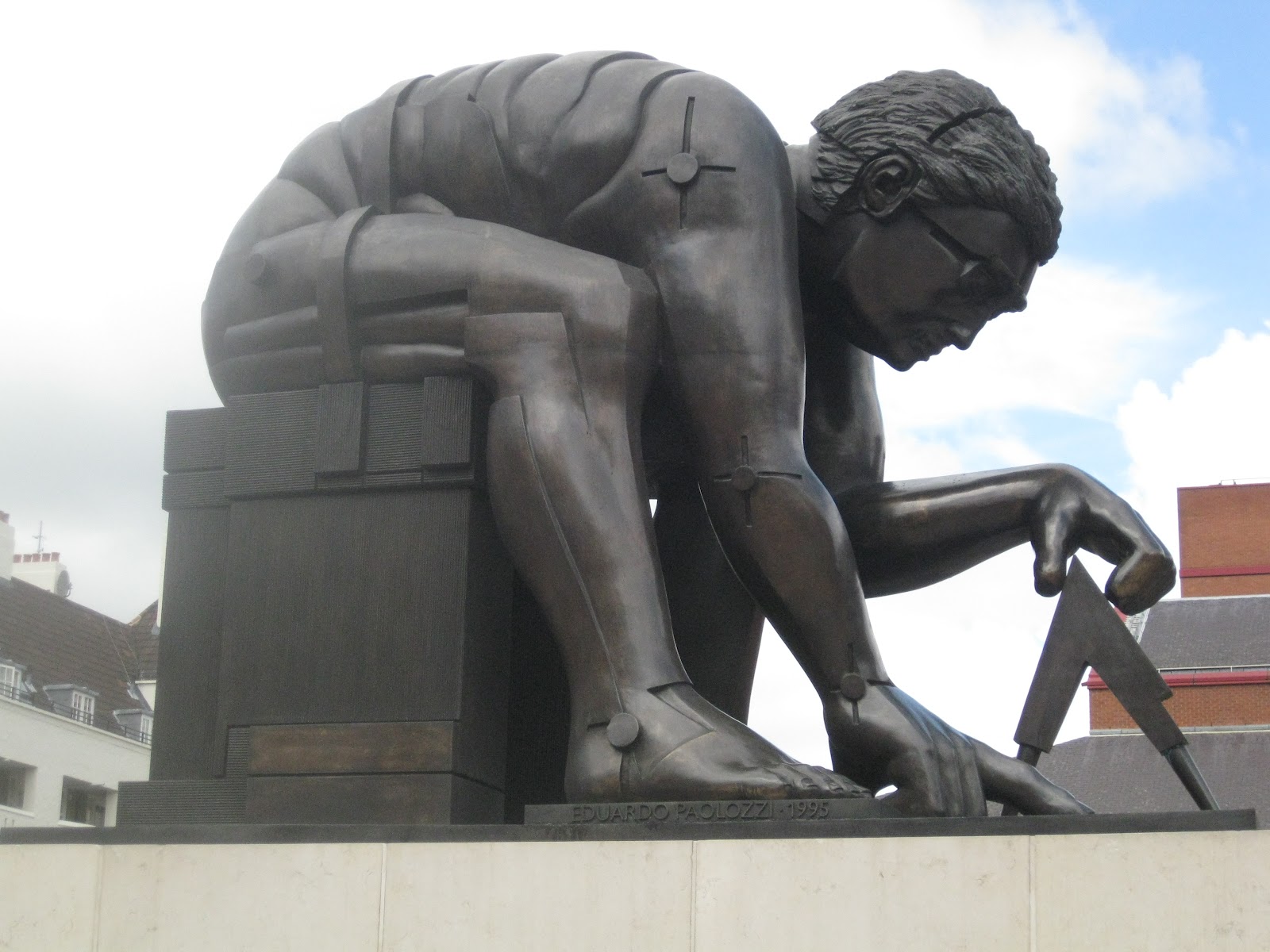
Outside the library is a monumental statue dedicated to Isaac Newton. The figure is based on a print by William Blake that depicts “The Great Artificer,” God making the world. This, then, is Newton figuring it out.


St. Bartholomew the Great is a spectacular place. We were there in the afternoon because it is near Smithfield market, and Smithfield market is close to the place where I had made dinner reservations a week earlier, when I was still in the States. We were going to St. John, which is so popular I couldn’t get near the place last year, and at the time I was trying to get a table two weeks in advance. But that’s another story, and you can read about that in the series of blog entries I called “London’s 11.”


St. Bartholomew’s, for you Ben Jonson fans, is connected with St. Bartholomew’s Fair. There is a St. Bartholomew’s Hospital in this neighborhood, too, and as I understand it, they were both founded by a member of Henry I’s court. Henry I didn’t get a Shakespeare play or kill Thomas a Beckett, so I don’t know a whole lot about him.

The courtier’s name was Rahere, and the story at the church is that he had malaria (didn’t know the Europeans had it back then) and was cured by the intercession of St. Bartholomew. He was, or became, a priest and founded the hospital and the church, which had a priory, which I learned is a monastery of priests, rather than brothers. There is a rumor, often denied by parishioners at St. Bartholomew’s, that Rahere, whose tomb is near the church altar, had been a jester at Henry’s court. It would be very cool indeed if that were true. but then, I’m an American, and therefore a revolutionary.

I had visited St. Bartholomew’s briefly on my first visit to London 16 years ago. But I had forgotten the details. It was wonderful to walk around inside while the thunder, lightning, and rain echoed outside. The weather had been threatening on and off all day, but this was the only serious rain. We were in a church, so God kept us dry.


We were told that the original church was much bigger, but when Henry VIII disbanded the priory, the original nave was torn down and the space was used as a burying ground. The current church consists of the quire, the place beyond the nave where the congregation of the priory used to worship.

One of the many entertaining things about St. Bartholomew the Great is that it has been used for a number of movies, including one of my favorites, “Shakespeare in Love.” There is a scene where Joseph Fiennes is on his knees in church, In the background there is a colorful tomb with an effigy, but you can only see the very bottom of it. From the first time I saw the film, I thought it was Southwark Cathedral and Gower’s tomb. In fact, the church is St. Bartholomew’s and the tomb is Rahere’s.

[Editor’s note: When Joanna and Harry returned to the States, the first movie they watched was “Shakespeare in Love.” Harry is reported to have laughed out loud when he recognized Rahere’s elbow at the top edge of the frame.]

We passed through a drizzle to Smithfield market. I had an idea of where to go but thought to stop and have a glass of wine first, giving me time to kind of mull and ponder. Great wine bar in Smithfield right across the street from the market.

I asked directions to St. John’s Lane and advice on using the public phone—the change I’d need, anything I’d need to know. The bartender told me exactly where the St. John restaurant was, about 50 yards on the other side of the market, and gave me his cell phone so I could call. There are three St. John’s in London and I wanted to be sure I was headed for the right one.

St. John Smithfield is fantastic. The restaurants serve food to go with the wine—Joanna had braised rabbit; I had venison—with Chateau Lascaux Coteaux de Languedoc, Le Clos Domaine Boudau Roussillon, La Chaussee Rouge la Grange aux Belles Anjou. Don’t ask me to describe them. Don’t ask me to pronounce them. They were overwhelmingly beautiful.


High Rent Districts
Wednesday, May 16

We got into Westminster Abbey this time. It seems the royal wedding fever has burned off. There were only two dozen or so people in line this morning.

It’s a great place. It is very old and very strange, right from the start and it keeps going.

One of the tombs near the entrance is for the loyal Duke of Newcastle and his second wife, “by whom he had no issue.” She was the Duke of Colchester’s daughter and of a good family, we are assured, because “all the sons were valiant and all the sisters virtuous.” Now, how did they really know that? She was witty and learned, and the epitaph makes reference to her books, but it isn’t clear if she wrote or merely owned them.

She was with her husband during his banishment and miseries. Say what? Turns out, he was with King Charles II in France when Cromwell ran England.

The abbey has another tomb of a knight who was involved in one of the plots against Henry IV that Shakespeare wrote about. The epitaph calmly reports that he had his head cut off at the Tower. But he still got a spot in the abbey with the generals and the dukes. I noticed that it seemed to be a short tomb.

Then there is this one: “Beneath this stone was buried the body of the blind scholar Ambrose Fisher, 1617, author of ‘A Defence of the Liturgy.’ “

The public restrooms in Westminster Abbey are appropriately sited just outside Poets’ Corner. When you get out there, you find more good stuff. A flying buttress, for instance. There is also a plaque on the wall that says “1476. Near this place William Caxton set up the first printing press in England.”

Pissoirs, poets, and printing. There’s something very appropriate about associating all that. And not only because they all start with “P.” It’s great how nature finds a way to have things fall into place.

The royal tombs are fun, too. There is the shrine of Edward the Confessor, the sainted king who founded the abbey in the middle of the 11th century. The original building, now long gone, was finished a few days before he died in 1065. You can’t go into the shrine now because it is considered a “delicate area.”

The sarcophagi of several kings are arranged around him and they are close enough to the aisle that you can see them. The kings include Henry VII. Henry IV got rid of Richard II and had himself buried at Canterbury near St. Thomas a Beckett, just to be safe. Henry VII knocked off Richard III and had himself put near St. Edward the Confessor for the same reason. Henry V of “once more into the breach, dear friends,” is also there.

Elizabeth I is around the back in another room, and near her is Mary Queen of Scots, whom Elizabeth beheaded. Mary’s is also short tomb.


So after all this funereal jollity, Joanna and I decided to head for the blue-blood country. We walked up Horse Guards Road and made our way to Piccadilly. It was mid-afternoon, and breakfast was in the remote past, so we went to the 1707 wine bar at Fortnum & Mason for a few appetizers and a selection of Italian wines. There was a light-hearted red called Dolcetto d’Alba that was mild but nice, another red called Terre de Talarato that was earthier and a little sharper, and white Bolettano Lugano that was spicy with a touch of sweet and made me think of another Italian white called Soave.

The store still sells the hampers of wine and delicacies that the gentlemen explorers were supposed have taken with them for sustenance in the heart of Africa.

Half a block from Fortnum & Mason is St. James’s Street. You turn left and there’s St. James’s Palace. Around the corner from there is the Mall, which leads to Buckingham Palace and is partly closed to traffic right now.

Everything here is under construction, as it was last year. Not only are the Olympics coming in July, but this is Queen Elizabeth’s diamond jubilee year. She has been queen for 60 years. Crews are working on cleaning the Queen Victoria Memorial outside Buckingham Palace. Others are putting up bleachers and light stands across from the palace. I guess there’s going to be one hell of a ceremony here in the first week of June.

There is a sign behind the palace fence about the changing of the guard. They do it every day from spring to autumn, but in the cold weather they change the guard every other day. Maybe that’s because they don’t sweat as much, but do they make those guys stand outside for 48 hours at a stretch in the winter?

I will fortunately miss the jubilee. Just as I missed the royal wedding (although not some of its fallout) last year. I am a lucky traveler,

The water fowl in the lake at St. James’s Park include storks.

Another travel tip: Gordon’s Wine Bar is worth a visit, but it can be tricky to find. It’s on Villiers Street, which is clearly marked, but you will miss it if you are looking at Charing Cross station instead.

So if you do go too far, and the Strand ends, remember that you are in the Temple, where all the lawyers are. You go up to any clutch of people in black outside a pub and tell them you want to go to Gordon’s. They’ll get you right there.

Gordon’s is very crowded, but we squeezed into one of the main attractions. The bar is in the cellar of an 18th century building that used to be a warehouse. There is a cellar hand-carved from the living rock that used to be a storage space. Now it is a dining room about 5 feet high. It is crammed with tables and there is no electricity, just candles on the tables. The atmosphere gets a little close with all the people and no ventilation.

Joanna and I shared a red Cotes du Rhone out in the alley, where they have more tables and fresh air.

Grabbed a quick bit of pie and a cab home.

That was a lot of walking, so I’m getting tired.

Good night, everyone.

Harry