Thursday, June 14, 2018

Boone Companions


April 12-13

The ride to Boonesborough would finish a trip that I made a few years ago. I had found that Interstate Highways 78 and 81 roughly follow the route that the Boone family took when they moved from Reading, Pa., to somewhere in North Carolina.

The western end of U.S. 58 in Virginia follows a section of the Wilderness Road, which began in North Carolina, crossed southern Virginia and then passed briefly into Tennessee to reach the Cumberland Gap.

The gap was as far I got into Daniel Boone country on that first trip. I wound up heading into Davy Crockett territory and discovered the weird magic of Pigeon Forge and the Smoky Mountains. But that’s another story.

Daniel Boone crossed the gap many times to hunt game in land that the British government had reserved to the Indians. 

Boone had run-ins with Indians from time to time, but nothing too violent.

Then he was hired by the Transylvania Company to widen the trail that runs through the gap into Kentucky. That was the origin of the Wilderness Road. 

Boone led a group of settlers through Cumberland Gap in 1775 and they eventually stopped at a spot beside the Kentucky River, possibly on April Fool’s Day.

I had heard so many fascinating lies about this place and about Boone when I was a kid that it has permanently damaged my mind. When I was about 11, I learned that one of my father’s distant ancestors was a distant relative of Daniel Boone.

Wow, the shock to the system must have lasted a month or more. I walked around referring to Boone as “Uncle Daniel.”

So when I found that there is actually a Fort Boonesborough Park in Kentucky, that determined the direction I’d take on this trip. Once I left Morgantown it was all new territory to me.

Stonewall Jackson Lake, the Kentucky Folk Art Museum at Morehead State University, craft beer—they were all icing. The cake, at least on the first half of the ride, was Boonesborough. Uncle Daniel, I was coming to visit.

When I got to the park, I was almost disappointed. I had seen photos that showed people in a log stockade and period costumes. But I didn’t see any sign of that.

The visitor center was closed so there was no help there. 


What I did see was a stone wall surrounding a coffin-shaped monument. It marked the site of the original fort. 

Nearby is an obelisk with plaques honoring “that gallant band of axemen, pioneers, and Indian fighters who at the risk and loss of life opened the doors of destiny to the white race in Kentucky and the West.” That was put up in 1934.


Not far away is a largely dismantled miniature golf course that still includes a cigar store Indian.

Across the road from the white race monument is a sign marking “Sycamore Hollow.” Sycamores still grow there.


When Boone’s party arrived there they began to build log shelters on the lowest part of the river bank.

Boone was a hunter who camped in this territory all winter long every year and survived. Maybe he had a touch of April Fool Fever when he got here. Who can say? 

He should have known better than to build a permanent camp on what had every appearance of a flood plain.

Col. Richard Henderson, who had organized the venture and had hired Boone, showed up three weeks later on the 20th and insisted the settlement should be built on higher ground a hundred yards or so away.

That’s where the monuments are.

Beyond the Sycamore Hollow today is a campground (on higher ground) that was loaded with trailers and RVs. The store there was open. A lady at the counter explained that the replica fort was up the hill and had a separate entrance. I needed to go back to the highway and turn left.

It was late in the day, but I got to spend an hour there.


It’s a high log stockade with blockhouses at each corner. There are cabins representing homes and displaying tools and crafts. In one blockhouse, a woman in a bonnet was making corn husk dolls. 

In one of the cabins, I startled a lady who had been making candles and had begun her end-of-day cleanup. 

A man who had been with the doll-making lady joined me in another of the blockhouses which was filled with Daniel Boone memorabilia. 

We chatted about that.

Some of the books I had read were there. So were lunchboxes, comic books, records, posters, VHS tapes, and pen knives. Much of it familiar.


Another cabin has historical artifacts. Still another cabin has iron tools. The man briefly demonstrated the use of the wood vise and a treadle lathe.

Both use foot power. Pressing a pedal brings the vise down to hold a workpiece. Pumping the treadle of the lathe pulls a rope that turns the piece being carved. A spring overhead (in this case a flexible length of wood) brings the rope and the treadle up again.

Then he asked if I’d like to toss a tomahawk. God, I’m going to play Daniel Day-Lewis in “Last of the Mohicans.” Sure, I’ll sign a waiver or anything if it lets me throw a tomahawk.

He showed me how to do it: Stand with your right foot forward, bring your right forearm forward to about 10 o’clock, and just open your hand.

He must have shown me well, because the first tomahawk hit the target and stuck. It was laugh-out-loud time.

He taught me well, but I wasn’t as good at remembering. My next three tries were all misses. One hit the axe that was in the target, another didn’t hit the target, and the last hit backwards and bounced off. 

I dunno. Maybe that’s a promising start for somebody from New Jersey.

The fort is about a half hour from Richmond, Ky., where I checked into a La Quinta Inn.  

I had dinner at a local craft beer bar called Madison Garden. The selection was all right but none of it was on draft. 

Well, there was a vanilla porter from a Kentucky outfit, but that’s like a dessert, not a beer. The other taps were mainstream commercial lagers and lights.

I had a few bottles over the course of a couple of hours. Two were from the West 6th brewery in Lexington: an OK amber a little on the light side, and a much better IPA that was nice and bitter with a bit of fragrance.

I had to try one brew because of the name. The bartender, a lady in tattoos, told me it’s a big seller for that reason. The brewer is Country Boy, also in Lexington, and it’s a blond ale called Cougar Bait. It wasn’t too sweet, and that was good, but it was way too light to follow an IPA. 

Truth, a red or amber IPA from Rhinegeist in Cincinnati, had a bit of perfume and a complex flavor. Red IPAs in general are among the most interesting beers that I’ve had.

I checked into the hotel for two nights. I was getting tired of having to pack up every morning and be out by 11 or noon.

It gave me a chance to plan the rest of the trip. I reserved tickets online for two tours at Mammoth Cave. I sorted out my notes and recollections of the previous couple of days, and sent a report on part of them.

Richmond isn’t a big town and I was running short of bars to hop. I wound up for dinner the second night at an Irish bar called the Paddy Wagon. 

I hadn’t eaten all day, so I took the bartender’s suggestion and had the bangers and mash. I needed it. The gravy may have come from a jar for all I know, but it was dark brown and savory.

Go-withs included a stout from West 6th that was good and unexpectedly dry, almost like an Irish stout. 

So that’s how I spent my Friday the 13th. 

Good luck, all.

Harry


Thursday, June 7, 2018

Between a Devil and a Stone Wall


April 10-12

No shortage of colorful characters and good beer on this run.

I’ve developed a fondness, for instance, for an IPA named Devil Anse. 

It happened this way.

I walked from the Clarion Morgan to the Apothecary Ale House & Cafe. I hadn’t eaten since breakfast around 8 in the morning and this was nearly 7 p.m. 

The cafe part of the business must be an afterthought, because all the menu offered were a few sandwiches, and the bartender told me the place had run out of most of them.


So after an OK pale ale called Ready Steady Go made by a West Virginia brewer called Short Story, I headed to High Street, past the Don Knotts statue and went back to Gibbie’s. I had stopped there on my last visit to Morgantown a couple of years ago.

Devil Anse was on tap, and I asked the bartender about the name. I couldn’t make sense of it. It’s a person, she said, and wrote it down for me: Devil Anse Hatfield.

Surprise, surprise. I had actually seen that name before, years ago. I had heard it in movies, too. It’s the nickname of William Anderson Hatfield, who led his family in the blood feud against the McCoys. 

Why, it’s one of the most famous families in America. They fought a war for almost 40 years.

The IPA is made by a West Virginia brewery called Greenbrier Valley Brewing.

I’m writing this in Kentucky and am keeping my eyes open for a local McCoy ale. There are a couple of brews called Real McCoy, but they’re not from Kentucky and not related to the feud, as far as I can tell.

I had a lot of other ales, too, at Gibbie’s. Among the best were Stumptown Ales’ Lefty Lucy amber, very malty, but even so not too sweet, close but not quite an English bitter; and Greenbrier’s black IPA, which tastes like a heavily hopped stout with a burnt-chocolate flavor at the end that was a lot of fun.

Devil Anse wins, though. It’s fragrant, bitter, and sharp. 

I left Morgantown in the morning to cross West Virginia to Huntington. I got another big surprise about 60 or 70 miles on my way. There was a road sign telling me to take the next exit if I wanted to go to the Stonewall Jackson Lake State Park.


I suppressed my excitement and followed directions. Before you get to the park, though, you pass through the Stonewall Jackson Wildlife Management Area. There’s a Stonewall Jackson Dam, too. 


I couldn’t believe it. West Virginia was created because it didn’t want to side with Stonewall Jackson and his associates. What does Jack T call it? West By God Virginia. This isn’t Rebel Virginia.


Turns out, Gen. Jackson was born in a town called Clarksburg, in the present state of West Virginia, which didn’t exist when he was born. Charleston, the capital, has a Middle School named for him too.

The park contains an entire golf course, a marina, campground, resort, conference center, and who knows what all.


I was checked into the Pullman Plaza Hotel in Huntington by 3 in the afternoon. I had gotten out of bed too late to have breakfast and hadn’t had anything to eat all day.


The hotel is right next to a mall called Pullman Square. It looks like a repurposed transportation terminal. It’s a few hundred yards from the Ohio River. Maybe it was originally a boat landing and a rail station.


I wound up at a place called Black Sheep. I had a huge burrito with a fiery sauce and a few beers for breakfast. The brews were all from an outfit called Bad Shepherd. 

One was called Drowning the Dearg. “Dearg” means “red” in Irish, and this was a fine Irish-style red ale. The Loud was an IPA. Butcher’s Knob was a wild ale, slightly sour, so I had it for dessert.

Later, in the evening, I walked to the Huntington Ale House. Since I wasn’t driving, I had a couple of ales. Mountain State Brewing’s Almost Heaven amber, like the Bob Denver song, was a little sweet, but OK.

The bar had another Greenbrier Valley Brewing number on tap, Wild Trail American pale ale. As the name suggested, it had a touch of sour, which went well with the bitter of the hops.

Next day, the 12th, I took off for Kentucky. I was headed for a place that has been a goal since childhood: to visit the site of Boonesborough.

But on the way, I couldn’t pass up the Museum of Kentucky Folk Art at the Morehead University Campus. 


It’s a small gallery showing art by untrained sculptors, painters, and furniture makers. Lots of fanciful animals in wild colors, and many realistic ones too.


Favorite subjects seemed to be genre pieces—carvings, paintings, collages, etc.—depicting Adam and Eve with the serpent, visions of heaven and hell (more often hell), and Noah’s ark.


The collection of canes is spectacular, bright, shining, with lots of snakes.

There’s more, and I’ll send that later. I’m running out of steam and I’m enjoying a buzz.

Everybody be well. Love to  all.

Harry


Thursday, May 31, 2018

On the Road Again


April 9-10

I may be in the Midwest. I’m not sure.

Right now, I’m stopping for the night at the Clarion Hotel Morgan in Morgantown, W.Va.

This is the second night out on my first road trip in a long time.

Indeed, it has been a long time since I’ve had any travel to brag about.

After we got back from Thailand last fall, we joined Joanna’s family in Phoenix for Thanksgiving. We had a great dinner with my cousin Bill and his wife, Dee, and also sampled some of the local Mexican fare. The mole was terrific. (That’s “mo-lay.” I’ve yet to eat one of those things that undermines the back yard. Some day maybe)

I took a brief trip to the Carolinas to flee the cold at the turn of the year, but spent most of my time in the car and so had little to report. I revisited the Cowpens Battlefield, which I had seen once before, and this time I was better prepared and so found the Swamp Fox’s grave, which I had tried to find last May.

Joanna and I went to New York for a couple of days last week. The Friends of Mozart held the last concert of their season on April 4 at Christ and St. Stephen’s Church on West 69th Street. 

Four vocal students from Juilliard performed works by Mozart and Schubert. They were accompanied by a fifth Juilliard student at the piano. The duet “Pa, Pa, Pa,” from the Magic Flute, alone was worth the trip. It’s a comical back and forth between Papageno and Papagena.

We went to Boite en Bois on 68th for some very good and probably overpriced French food and wine.

We stayed at La Quinta on 71st street, a half block from Central Park.

We went to the Metropolitan Museum of Art and wandered for a few hours among the Egyptian and medieval exhibits. We had pasta at Polpette on 71st Street.

The following Monday I left for parts not fully known.


I drove as far as Danville, Pa., where I stayed in a Super 8 next to I-80. It’s about two miles from downtown Danville, which is one of those charming 19th century towns made of wooden row houses and stone mansions.

Some of the stonework is phenomenal. Walls are are made of light and dark stones that create an unusual texture. 


The local library has pink marble details by the door. 

One house on a street corner is made entirely of green stone. I’d never seen anything quite like that before and so went up to get a closer look. There was no evidence of paint on it and I don’t think it could be dyed. But what do I know?


One of the stone houses belonged to William Montgomery, a Revolutionary War veteran and all-around leading citizen who set up a trading post in the neighborhood.

The town is named for William’s son, Daniel, who surveyed the area where the town was built. Like Fort Casper in Wyoming, the town is called by someone’s first, instead of last, name.


The next time you’re in Danville, be sure to visit the Old Forge Brewing Co. brewpub on Mill Street. For a small operation it has a broad variety of brews. 

There’s even a proprietary cask ale, which is one of the best I have tasted. That list includes all those drawn for me on my last trip to London.

Cask ales are carbonated in the barrel. Sometimes they can seem a little on the flat side. This one was dead-on perfect.

The bar also has a red ale, which I had with a rare sirloin. According to the Old Forge menu, the beef is raised locally and fed with spent grain from the brewery.

It was tougher than I’d expect of grain-fed beef, but surprisingly tasty.


I brought home a six pack for Old Forge Overbite IPA. I was drinking and watching Netflix on the computer when I fell asleep in the desk chair.

I woke and transferred to the bed around four and made it to breakfast at 8:30. They turned out the dining room lights on me at 9. I was on my second cup of coffee, and the lady said I didn’t have to leave. Even so, I took a refill back to the room.

When I left around 11, it had started to snow. Nothing serious, though: There was little of it and it was melting wherever it landed.

About 40 or 50 miles west on I-80, in the higher hills, some of it was sticking to evergreen branches, but only to evergreens, and to small patches of grass. It looked so strange to see it there, maybe because I didn’t expect it.

The route included I-99, U.S. 22, and U.S. 119, which took me right to the hotel. 

It’s a beautiful ride through mountain gaps, over the rivers and through the woods, (whether your grandmother lives there or not), and past small towns. Yeah, you pass an occasional stretch of strip malls, but mostly though, it’s open country, and very picturesque.


On U.S.119, I passed a sign for Historic Hanna’s Town. So I turned around and went back to take the cut-off. There’s a small reconstruction of log houses and a stockade.


The town started in 1773 and had the first English courthouse west of the Allegheny Mountains. A force British soldiers and Indians attacked the place and burned it in 1782.

According to a web site, Pa-Roots.com, under a heading titled “The Destruction of Hannastown,” the town’s residents kept the attackers at bay from the stockade.


One young woman, Margaret Shaw, was killed.  She was struck by a bullet when she was rescuing a toddler who had wandered into harm’s way.

The town was burned and looted, and never fully recovered. The county seat was moved elsewhere in 1786.

I had an encouraging travel experience shortly after leaving Hanna’s Town. I got lost. 

I must have missed a turn to stay on Route 119 and wound up on U.S. 30. Not bad, but not what I wanted.

I stopped to look at the map in a town called Jeannette. I didn’t have to go all the way back to the missed intersection. A spur of the Pennsylvania Turnpike took me right back to 119 South.

I crossed the Mason-Dixon Line at 4 p.m. to enter West Virginia and checked into the hotel 20 minutes later.

So far, so good.

Love to all.

Harry


Tuesday, January 30, 2018

From Farang to Gwei Lo


Oct. 29-Nov. 1

The last few days of our sojourn in Bangkok were OK. They were fun enough, but Bangkok just isn’t as interesting or as inviting as Chiang Mai or even Chiang Rai.

Traffic is loud, dirty, pretty brutal in fact. Sometimes it’s much easier (and safer) to climb the equivalent of three flights of stairs to use an overpass to avoid the crosswalks of a major intersection.

But there is still plenty to see on the street: Shops, restaurants, massage parlors of all kinds, shopping malls, and hotels.

The highlight of the end of the trip, though, was a 16-hour stay in Hong Kong. 

On Sunday, the 29th, we took a late morning walk that brought us to Soi 8. This street is familiar to us from our last stay in the area. We stopped for breakfast at a place that may be called Viva. 

It’s a bar with a vast deck around it, where you can sit to watch the activity on the soi.

The utility company was working on power lines. Men on bamboo ladders were working on wires in the tangle above the street. How they could tell one from the other wasn’t clear to me. 

At one end of the block the man on the ladder was pulling wire out and handing it to a colleague on the ground. At the other end, the ladder man was installing new wire.

We decided to go for health food. I had a waffle with jam and whipped cream. It also came with some fruit and honey, which made it healthy.

Joanna had a similar plate, Hers had two small pancakes and even more whipped cream. More fruit too, so it was balanced.

Later we went to dinner at a place we knew from a year and a half ago. Larry introduced it to us.

It’s called Cabbages & Condoms. It is run by the Population and Community Development Association, which began as an advocate for the use of condoms for birth control. In Thailand, as in many countries with high birth rates, families are often so large that they lose all chance of emerging from poverty.

More recently, though, the group’s message has focused on disease prevention.

Part of the message is to overcome stigma. The gift shop includes rolled condoms on sticks meant to be used as artificial flowers. 

At the entrance to the dining room, mannequins made up to look like superheros wear clothes made completely of condoms.

The name of the restaurant, I once read, is intended to suggest that condoms should be as comfortable a subject to discuss as vegetables.

The food in the place is excellent. We split a grilled fish and some stir-fried vegetables. 

I hope the fish in the pool next to our table didn’t mind that we were eating their cousin.


When you get the check, instead of after-dinner mints, you get complimentary condoms.

Monday, our last full day in Thailand, we took it easy. 

We had a date to meet Larry and Noi at a restaurant called the Fat Cow, about a half-hour metro ride from the hotel.

Joanna was thinking about adding a Thai-themed charm to her Pandora bracelet. We found a department store called Emporium, one stop east of the hotel on the SkyTrain, that had Pandora merchandise.

We left for Emporium in mid-afternoon. It was easy enough to get to. The Asok stop for the train is around the corner. We take that one stop to a station called Phrom Phong. You can walk right from the station into the store.

Joanna wanted an elephant. It’s the national symbol of Thailand, and done right it could be quite interesting.

Well, Pandora just didn’t get it. The store had an elephant charm, which looked like a fugitive from a Walt Disney cartoon. For some reason, the store had nothing else relating to Thailand.

The Fat Cow, on the other hand, was a winner. Larry told me it’s Noi’s favorite place.

The place is run by an ex-pat. I think his accent is British.

The menu has various options, but the emphasis is clearly on hamburgers. 

Like most of the beef we’ve seen in Thailand, it is grass-fed and imported from Australia. It is delicious.

I had mine medium rare. I know we’re not supposed to do that, but hey, I love beef when it’s red inside.

We had a big platter of fries to share and, when that was gone, ordered more. 

It was perfect bar food to go with another of the emerging collections of interesting beer. The bar had no taps, but otherwise it was like drinking beer at some of the better places back home.

There were brands I didn’t know. I had an interesting IPA called Showdown from Outlaw, which may may have been developed by a Thai company but for legal reasons is brewed in Laos. 

The big brewers in the country have backed laws penalizing the manufacture, sale, and possession of craft beer. 

There was an American style pale that reminded me of a milder Sierra Nevada. Joanna liked that one, and finished it for me while I went on to another.

We had to get up early on Tuesday, even though our flight wasn’t to leave till 3:15.

The early rising was my fault. 

When you enter Thailand, you fill out two forms. One the immigration officer keeps; the other you keep to surrender on your way out.

I lost mine, and had no idea what kind of line I’d have to stand in to get a replacement. 

When we went to check in, before noon, I asked the lady at the counter what I should do. 

Just fill out a new card, she said.

Where do I get one? 

Oh, I can give you one.

Problem solved.

As a result, the wait at the airport was longer than the flight. We were in the air for about two and a half hours. As Gregory put it when we met him in Bangkok, long enough for one movie and a TV show.

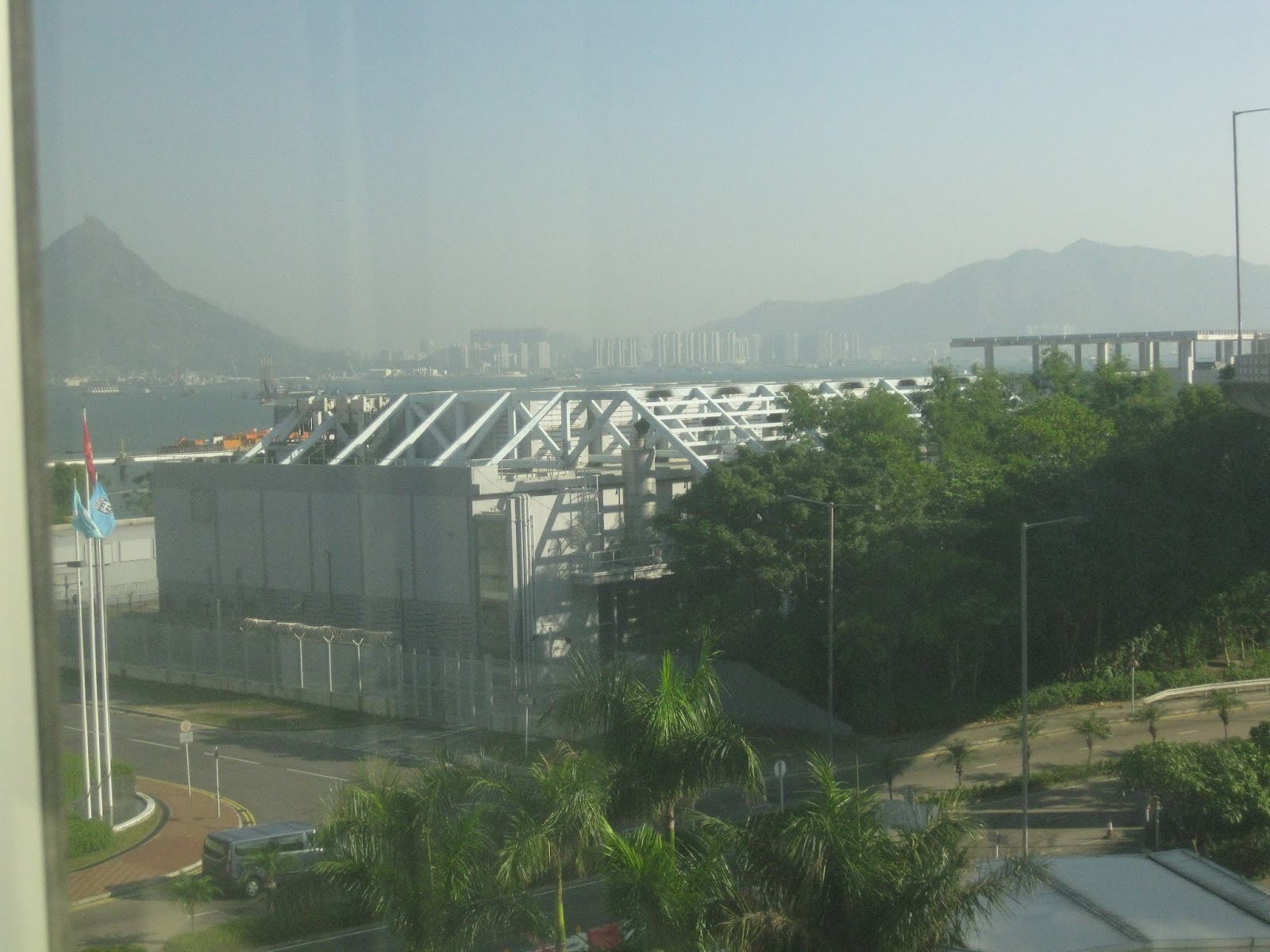
Hong Kong International on Lantau Island is one of the better airports of the world.
It’s efficient; service is great. It’s well marked.

We had a 16-hour layover. All the United flights leaving Bangkok on the afternoon of the 31st had layovers in Hong Kong. 

Most were four or five hours. The longest, 16 hours, would let us rest for the night between flights. It would also put us into the Regal Airport Hotel.

We had stayed there for a night at the end of our trip to Hong Kong in 2012. We loved the place.


After we entered the terminal at Suvarnabhumi in Bangkok, we didn’t go outside until we had cleared Customs at Newark. The Regal is connected to the terminal in Hong Kong by a corridor.

We followed a half dozen monks who were apparently also rooming at the hotel.

Hong Kong time is an hour later than Bangkok. That put us at the gate a little before 6. Less than two hours later, we had cleared immigration, checked in, and were in the restaurant sampling a local craft brew. 

There is a Hong Kong craft brewery called Gwei Lo, a Cantonese term of contempt for Europeans. As far as I can tell, that translates as “Ghost Guy.” But it is usually rendered in English as “Foreign Devil,” which conveys a better idea of the connotation.

If I see anything called “gwei lo,” I have to try it. 

The bar had two ales, a pale ale and an India pale ale, from Gwei Lo. 

I had the pale first. It was good. Not a strong mouth-filling flavor, but a good bitter edge and some perfume. 

I could have enjoyed more than one of them, but moved on to the IPA, which was more to my liking. The flavor and fragrance were not very different from the first, but were more intense.

Joanna liked the pale ale better. She liked it so much that she actually ordered a bottle for herself. That’s unheard of. 

I thought she was reordering for me. But no, she was ordering one of her own—and she finished it. She had never done that before.

She brought the bottle home as a souvenir.

We had gotten used to the smaller portions served in Thailand, so we ordered too much food.

Had we known how much was going to be on each plate, we would have asked for one and divided it, the way we do at most American restaurants.

I managed to get through half of the bangers and mash on my plate. They were tasty enough, and I probably ate more than I needed, but even so I had to waste too much.

Our flight out the next morning was scheduled for 11:15 with a 2:45 p.m. arrival in Newark. The plane was late getting to the gate, and the doors didn’t close till almost noon. 

We landed in Newark around 3 and were back at Joanna’s house around 5. 

Gwei Lo beer in Hong Kong. Who knows? Maybe by the time we get back to Thailand there will be craft beer called Farang.

I’m sending this on November 2, the Day of the Dead. Think well of the ghosts, gang.

Harry