Friday, January 4, 2019

A Night at the Opera


Nov. 24-25

In our wanderings Friday night we had crossed a large paved plaza connected to a palatial building. Over the door were three Han characters—in Cantonese “chung” (central), “san” (mountain), and a third that Joanna translated for me as “hall.”

Later she learned that its Mandarin name is Zhongshen Hall, sometime transliterated Zhongzheng, and is named for Sun Yat Sen, the father of the Republic of China. 

The hall has rooms for meetings and exhibitions, and also a dining room where the three sisters used to have tea. The sisters, named Soong, were wives of the leading heavy-hitters of the republic. 

One married Sun Yat Sen. Another married Chiang Kai Shek, and the other married the head of the Bank of China.


The hall is about two blocks from the hotel, so we had to go there, if only to acknowledge the three sisters.

We had some tasty stir-fry and green vegetables in a pleasant, old-style room on the second floor. We could look out the windows at the park. 

There is a glorious white piano among the tables. I believe it provides the music for high tea in the afternoon. Given the building’s connections to politics and intrigue, maybe it’s there so Humphrey Bogart can hide stolen travel documents. 


The hall and our hotel are in a district named Zhengshen in honor of Dr. Sun. The plaza is surrounded by government buildings, including the national police headquarters. 


A Zen Buddhist organization, Dharma Drum Mountain, also occupies a high-rise at one end of the park.

We stopped in the library there, and also peeked into a meditation room with a Buddha on an altar, a wooden drum, bronze bell, and a gong. And just about nothing else but a highly polished wooden floor.


The colors were muted earth tones for the most part.

It’s quite a contrast to the Kwun Yam and Tin Hau temples we have seen here and in Hong Kong. Their palette is dominated by red and accented with blue, green, yellow, and black. 

The air is thick with incense and the space filled with ritual objects, effigies, and offerings. 

This was Saturday. We got near Ximending, but didn’t go in. The streets were jammed shoulder-to-shoulder with people. 

Besides, we had enough excitement in store. We had reserved tickets to the opera at a venue called TaipeiEYE, which is dedicated to teaching modern audiences about traditional Chinese entertainment.

We got there before the box office opened and had dinner across the street: Pea shoots, beef with Chinese broccoli, roast chicken, and a surprisingly good local lager, Taiwan Gold Medal.

When we picked up the tickets, Joanna asked if we could see the actors putting on their makeup for the performance. 


What neither of us realized is that watching the actors prep is part of the standard preshow activities, which are on the second floor. When we got off the elevator, we found three actors already sharing a table and dishes of paint. 


At the end of the room a lady in the final stages of makeup was being fitted with her wig and headdress. She later posed for photos with visitors. 

There was also a lady playing a Chinese lute called a pipa. She was playing traditional Chinese folk melodies. At least I think that’s what I heard.


Every once in a while a bar would sound almost familiar. I was reminded how folk art, including music, has similar echoes around the world.

I do admit, though, that I laughed out loud when she struck up the "Ode to Joy." It’s the happiest piece of music Beethoven ever wrote. It crops up in the funniest places.

It plays a hilarious part in the film “Copying Beethoven.” It’s a great movie all the way through. How do you top Ed Harris as a curmudgeon wearing a fright wig and an ear horn? 

Well, you do it by dramatizing the debut of the Ninth Symphony’s choral movement. The instant the choir breaks loose is by itself worth the price of admission. 

I can’t hear the piece, though, without thinking of Ringo and the tiger in “Help.” 

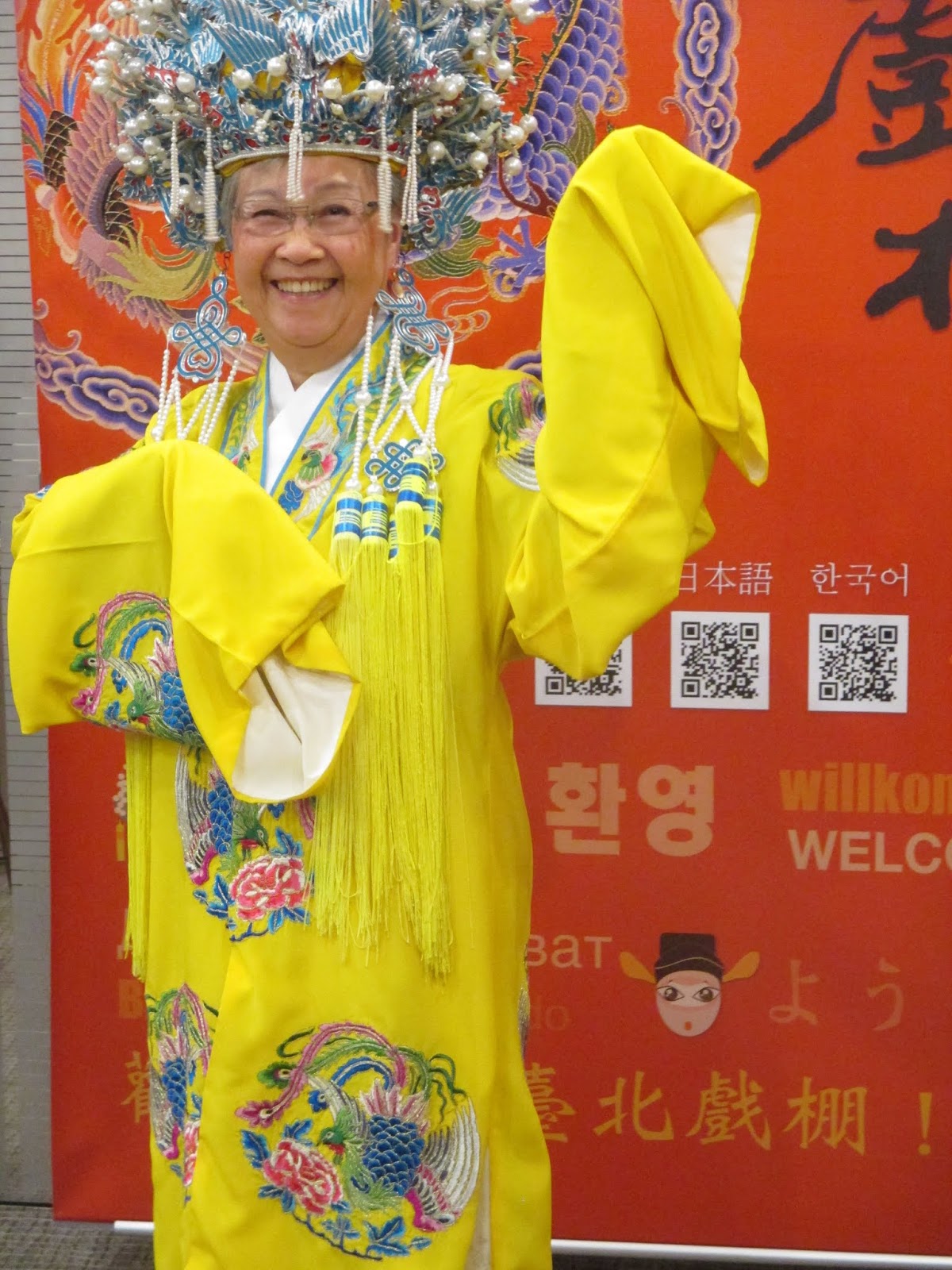
Another feature of the preshow entertainment gave me the photo of the day. Visitors get to dress up and pose for photos in front of an opera screen. 

That’s not the Dowager Empress. It’s Joanna in imperial yellow.

The first half of the show featured acrobats and illusions. A dancer backed by a chorus of young women would pass a fan over his face for an instant and just that quick his mask had changed. 

After he had gone through maybe a dozen masks, he danced for a while without a mask. He had glitter on his eyelids that flashed. Then he gave his head a flick, and yet another mask appeared in a blink from somewhere as we watched.

A juggler got 12 dishes spinning on top of quivering rods. 

A young lady (one of the masked man’s backup dancers, perhaps) climbed onto a table and balanced on a board with a free-rolling cylinder under it. 

She juggled bowling pins and then put a metal bowl on her head. She was able to catapult other bowls from the end of the board and catch them in the one on her head.

I could have lived without the man who kept stacking chairs in an ever-more-precarious tower and doing handstands on it. 

I kept thinking of the Wallendas, a family of aerial daredevils who do stunts like building human pyramids supported by parallel high wires. 

They work without a net. Every generation there’s a news story about half a dozen of them getting killed in a fall.

I was glad when he climbed down in one piece.

I had some concern because these acts were all backed by recorded music. Was this going to be karaoke opera?


During intermission singers in costume took turns performing with a six-piece traditional band. The man on the chairs had survived. My last misgiving was settled.

The second half was “White Bone Spirit,” an opera based on an episode from a Chinese classic, “Journey to the West.” Three characters accompany a monk, who is on a quest to India where he will receive sacred Buddhist texts to take back to China. 

White Bone Spirit is a demon who wants to attain immortality by eating the monk.


One of his retainers, a trickster character called the Monkey King, is not fooled by the tricks the demon uses to try to lure the monk. 

The conventions of classical Chinese music are unusual to a Western ear. The singing is generally high-pitched. The monk sang in falsetto. The Monkey King was maybe a baritone.

The women’s parts are all very high. 

When you hear recordings played through inadequate media—like television, for example—the voices sound shrill and often grating.


It was four years ago on Temple Street in Kowloon that my interest in Chinese opera woke up.

Singers performed duets to the accompaniment of musicians. It was the first time I heard the music in person.

What an ear opener. I couldn’t understand a syllable, but everything was punctuated by special effects from the instruments—birds and crickets and wind—and the pathos of the characters came through their voices.


TaipeiEYE does Mandarin opera, which uses acrobatic dancing and juggling as well as music.

Characters were turning somersaults in the air. Someone threw a spear at the demon, who returned it accurately with a kick behind her back. 

This was laugh-out-loud hilarious. It ended too soon to suit me.

Joanna said it reminded her of the theater that her father owned in China before the family had to leave.

This was indeed a traditional show, jugglers, magicians, acrobats, and all.


Sunday we set out for a walk in a new direction.  

We stopped at a calligraphy shop around the corner from the CityInn. The lady there showed us a sheet for practicing brushwork. It needs no ink. Dip the brush in water and the strokes show up as black, like ink.

They stay with you for a couple of minutes and then begin to fade as they dry.  

That was on Yanping South Road, the cross street by the hotel. A right onto Hengyang Road brought us to Cha for Tea. 

They have a store selling tea and treats, many made with tea, on the first floor. Upstairs is a restaurant where just about everything on the menu is made with tea.


We had a set meal: beef stew with oolong. a shot of royal tea with lemon and vinegar that tasted like a cocktail, tea tofu, and tea-flavored wonton soup. All very unusual and wonderful.

We had an herbal Jell-Oish dessert called Oriental beauty jelly. It reminded me of a pleasant herbal concoction we had in Singapore a few years ago.

At the end of HengYang Road we came to the 228 Peace Park. Signs in the park gave us as much of the story as it was safe to print. The number refers to February 28, 1947.


After the Japanese surrendered, the city celebrated, but by ’47 had fallen into disorder. Officials in charge were either unable or unwilling (the history was unclear on this point) to curb lawless elements. 

There was a reference to the sale of “illegal tobacco” and to an instance where someone attacked a woman. Crowds turned out to protest on Feb. 28, and shots were fired.

Sometime during all this Chiang Kai Shek had moved troops into Taipei. The story doesn’t say who fired the shots or how many were fired.

Over the next several months thousands of people, mostly educated professionals, were killed or disappeared.

When Joanna was reading this, she asked for the meaning of a term. Someone said “The government.” 

Which government? “We don’t know,” a kid said.

Later an old lady came up, “You think about. There’s no need to point it out.” 

There has been an independence movement for a long time in Taiwan. Maybe they want independence from more than just the Reds.


On the way back we stopped at a brew pub called Jolly. They were serving three ales—a Scotch, a pale, and a Belgian IPA. 

The Scotch was not too sweet, which is good, because some Scotch ales are downright cloying, and although the flavor wasn’t strong, it was satisfying. 

The pale was OK, but but there are dozens I’d take before this one.

I don’t know if the Belgians make IPA. I think it’s a craft-brew innovation to copy a Belgian ale and hop it like IPA, which is a traditional English brew, originally created for shipment to the colonial market in India. 

The combination makes an interesting drink. This one was a respectable entry in the category.

Sweet dreams, everyone. But if you’re drinking ale, not too sweet.

And good night.

Harry


Wednesday, January 2, 2019

Taipei Day


Nov. 22-23

Thursday we moved to Taiwan.

We had a 6:30 flight that left us time to kill when we checked out of the Best Western Grand. So we walked toward the tip of the peninsula. We veered east from Nathan Road into the pub and food area. 

In our explorations, we found the original Hair of the Dog. The other day we had found II and III. There may be others too, but this so far is the only one not numbered. I haven’t been inside any one of them. 

Despite the name, they are closed early in the day.


Maybe we’ll get to one when we come back in a week. It’s on Hart Avenue, if you want to venture there some day.

Another highlight of the walk was Mody Square. This is a shopping mecca with a giant plaza and fountain and busloads of people standing more or less at attention behind people carrying pennants. Most of them seem to be waiting to get into restaurants booked by tour companies.

The experience has a condensed flavor of Hong Kong, or more specifically, Kowloon.


The airport was efficient enough. We checked our big bags and then Joanna asked one of the gate guards about the food available on the other side of the security check. Unlike Newark, Hong Kong’s main restaurants are outside the barrier.

We opted for Maxim’s Jade Garden. This is the same Maxim that owns Maxim’s Cakes, where we met Greg and Eugie on Wednesday night. It also owns a dozen or more other food brands with operations spread all over Hong Kong.

Passport control was the only glitch. They have an automated system, very quick when it works, that scans a passport and lets Joanna go through just fine.

I tried two scanners and neither could read my passport. So I was sent to the conventional line. And wound up in the slowest by far of four.

I finally got through and joined Joanna to follow signs for our gate. It was getting close to boarding time, but we were almost there. Or so we thought.

This was one of those annoying airport designs where you walk forever to the end of the terminal and then have to take a bus to another building. The bus always leaves from the far edge of the terminal to an island among planes.

We found the gate in plenty of time, though, and it was a short flight, only bumpy in spots, when they had to suspend cabin service.

Immigration in Taipei is as slow as it is in Newark. We killed the best part of an hour standing in line.


After that it was smooth going the rest of the way. We took a cab to the hotel, the CityInn on Baoqing Road. The room is small, but compared to the Best Western, seems like a suite. 

When I went to the convenience store on the corner for beer, I ran into my first real language barrier of this trip. Thinking about the morning, I asked for yogurt. The kid at the counter brought out a bottle opener.

Things were busy on Friday. It was the day before the elections.


When we walked out for breakfast, we passed the Falun Gong setting up a demonstration in the plaza by the big H&M. The banners, similar to those we saw in San Francisco, attested to the goodness of Falun Dafa, the organization’s teachings.

We saw similar-looking banners in Hong Kong about Falun Gong, but they carried quite a different argument, which followed the party line. The message in HK was that Falun Gong demonstrates on the streets to interfere with traffic and commerce and to contribute to “public disorder.” 

Bad Falun Gong. Good Red Chinese.

We asked at the desk for places to have breakfast. The lady directed us down Cheng Du Street to Fong Da, a luncheonette. I had a Taiwan coffee that was satisfyingly strong and a sandwich of ham and egg on white toast.


It seems the only bread here is white. This was conventional western bread. There are indigenous breads in Taiwan, but they are steamed, not baked.

I took one bite of the sandwich and found a surprising sweetness. Mayo. Not as bad on ham and egg as it is on stir-fry, but still a mystery. How did the Chinese develop a taste for mayonnaise?

Joanna doesn’t drink coffee, so instead had a hot soup full of lotus seeds, which are soft and mild-flavored beans. The soup stock was light and fantastic. 


Across the street is a temple devoted to Tin Hau, the patroness of sea people. This is the same Buddhist saint of the temple on Temple Street in Kowloon.


Like many temples we have seen in Hong Kong, it is an ancient structure covered with color and elaborate carvings wedged between newer structures.

The temple’s roof and eaves are covered in bright motifs of dragons and phoenixes.


The temple also has an ATM. I never used an ATM in church before, so I tried it. Apparently it only gives cash on credit cards, so my debit card didn’t work. 

Just because of the name, we walked into an alley labeled Hong Kong Street. 


That was the beginning of Ximending. This is a party area of a dozen or more blocks defined by streets and narrow lanes. There are motorbikes everywhere, and it seems almost everyone goes there to eat. 

We saw all the expected names, KFC, 7-Eleven, H&M, Uni-Qlo, Starbucks. There are also plenty of local joints. One particularly popular attraction had people lining up and others standing around in the street eating rice-flour noodles from paper cups.

We came to an intersection that opened into a large plaza. it was blocked off at the time for public works, so we had to follow the arcade around it.

Most of the commercial streets we have seen in Taipei have a feature that we saw in Singapore and in Bern, Switzerland. The buildings have arcades over the sidewalk so you can walk protected from sun or rain as you shop in the commercial properties on the ground floor.

Stores use some of the arcade space for displaying merchandise that lends itself to impulse purchase.


The local supermarket for the neighborhood is Carrefour, a French company. We stopped for fruit and yogurt. It’s open 24 hours a day, so if we get a craving in the middle of the night for ready-to-eat chicken feet, we’re all set.

Somewhere (not sure exactly at which point in our wanderings) we heard loudspeakers on the move. About a block away a caravan of trucks and motorcycles was turning a corner. They carried banners promoting a referendum for independence. 


I checked online and there were several referendum questions on the ballot this year, but not one on independence. 

This wasn’t the first indication of independence activism. Banners over the big intersection near the hotel (the same area where the Falun Gong was setting up) proclaimed the right of people to vote for their independence. 

Dinner was lot calmer than politics, and more enjoyable. Eugenia had told Joanna not to miss the beef noodles in Taipei. A top-rated spot to have them lies just around corner from the CityInn.
The place is in an alley off a side street. We knew it had to be the place because half a dozen people were waiting in line outside. 

It was a quick turnover. We waited maybe 10 minutes. 

The shop serves only beef noodles, with a choice of spicy or not. And pig’s feet. Nothing else, not even beer.

Imagine the best-tasting pot roast ever, swimming in a broth covered with wonderful fat. Add noodles to soak up the flavor.

After that, we walked up and down more narrow lanes, before we stuck onto commercial streets in search of a bar. 

I wanted a beer. But it’s like cops, ATMs, taxis, and sometimes 7-Elevens. You can’t find one when you need one.

We went into a hotel that advertised the Unwind Bar. It was only offering bottled beer. I had a Taiwan Gold Medal and Joanna had a Heineken. 

We had wandered so far that we were back on the edge of Ximending. With the lights and the crowds and the noise, it was like the Wildwood boardwalk on steroids. So we had to go in there.

That’s where we got really lost.

The plaza intersection, our landmark of the morning, it seems, is far from unique. I lost count of how many we crossed. 

We finally got to a place where we could read the street names, the corner of Xi Ning and Emei. We had to go south one block to Cheng Du Road, and then we were almost home.

We turned onto Cheng Du, and walked to the next big intersection. The streets are busy with shops and signs all the time. At night, everything lights up, even parts of  the sidewalk with flashing warning lights.

I couldn’t tell if we had been here before or not.

Then we came to a street that, on the map at least, is in the opposite direction of the one we wanted to take.

That’s when Joanna asked for help from a couple of kids with smartphones.

Yes, Cheng Du was the right street. We had just walked in the wrong direction. 

When we had not gone far, Joanna saw the sign for Fong Da, where we ate breakfast, and then we passed the Tin Hau Temple.

I bought a few cans of beer at 7-Eleven and settled in for the night at CityInn.

Here’s hoping everything stays bright and shining for you, too.

Good night, all.

Harry


Tuesday, January 1, 2019

Kwun Yam and the Old Han Tomb


Nov. 19-21

Before I left New Jersey, I made a mental note to order a couple of replacement things at Sam’s. The summer jacket was one. The other is a dark vest with chalk stripe that makes me feel like Orlando, the hero in “As You Like It.”

I don’t wrestle as well as he does, but I do have his clothes. 

On my first visit to the New Globe in London, I saw one of the happiest, funniest, most energetic renditions of the play that I have found so far. It was the Globe’s touring company version. 

The set was a cargo container, and one actor with salt-and-pepper whiskers played Duke Senior, his usurping brother duke, and Audrey, the country girl. Sometimes in the same scene. 

The play was in retro dress—early 20th century, that is.

Orlando came out in a brown tweed jacket, charcoal trousers, the chalk-stripe vest, and a pair of dark cordovan shoes. I took one look. I have all those clothes.

I put them together when I got home (still had a home then) and have put them on as a suit ever since.

The vest is the oldest part of the get-up, and it’s going fast. Joanna has applied her artistry to give it more time, but there’s only so much that even a talent like Joanna’s can do to stretch the life of a failing garment. 

I can’t find anything like it in stores, but I knew I was headed to Sam’s. Then I got distracted by the low-contrast black-gray herringbone and forgot to order the chalk stripe on Friday.

So I added that to the list when I went for my fitting Monday.


The jacket will be nice and boxy. You can’t buy things like that in stores right now because they are out of fashion.

The herringbone vest ditto. It will have a belt in back for adjustments according to beer consumption.


During the fitting Joanna snapped a couple of photos. Then Sam, the owner, stepped in for a couple of shots.

The store has photos posted on the walls of all kinds of celebrities. Many are standard handouts of people ranging from Prince Charles and Angela Merkel to Barry Manilow and John Boehner. There’s one of Roger Moore being fitted by Sam himself.

Joanna joined us. Here we were, having the photo of the day taken with Sam.


It won’t go up on Sam’s wall or anything, but even so, wow, we were in Roger Moore territory.

Later Joanna and I took a short ride on the No. 6 bus to a district called Hung Hom to see a temple dedicated to the Kwun Yam, the Buddhist Virgin Mary.


I had seen a reference to the temple during a Google Maps search for the Kowloon Walled City Park. 

Kwun Yam is a Cantonese transliteration. In Mandarin the name is Kuan Yin. The Cantonese pronunciation, which I learned from Joanna, sounds almost like Goon Yum.

I think she watches over me so it’s not polite to pass up a chance to visit one of her shrines.

It is a small, traditional temple in an area that sort of resembles a commercial district almost anywhere in the world. Imagine North Newark or Passaic, when somebody has hit the “translate this page” button for Chinese.

The temple, however, is one story high and has carvings. They run along the rooftop. They and the gold-on-red traceries of the walls will confirm that the temple is the real thing.


We went inside and added to the smoke already wafting from coils and sticks of incense large and small. A priest in an embroidered robe was chanting next to a civilian in one corner.

I lit three sticks of incense at each of 12 altars. A lady speaking Cantonese to Joanna led me through the ritual.

Later Joanna told me she was asking why I would do this if I didn’t know how. 

Another surprise was the effigy of Kwun Yam. The face is dark brown. Was it made that way? Is it the result of years of sitting in a fog of incense smoke? 

The parallels between Kwun Yam and the Virgin Mary are many. Kwun Yam is sometimes shown holding a small child, for instance. Both are sources of mercy.

So there is also a black Kwun Yam, echoing the black Madonnas of Europe and South America.

We stayed for a few minutes, tapped the drum, rang the bell, each three times, just as the priest had done before us.

When we had crossed the street and were heading down Kun Yam (still another variant transliteration) Street back toward the bus stop, a man from the temple ran up behind us and handed us two red envelopes. He said they held prayers of good wishes from Kwun Yam. 

We strolled up and then back down the main street before we stopped for a beer at a hotel bar called Moreish Malt. After all, I had been to a church so it was time for a beer.

They had a decent beer lineup for a Hong Kong bar. I was about to order a Stella on draft when I saw they also had craft beers in bottles. 

There were a few from Brewdog, a craft brewer in Scotland. One, Punk IPA, I had enjoyed in London a couple of years ago. I opted this time for one I hadn’t tried, called Indie Pale Ale.

“Indie” as in “independent,” apparently, not as in “Jones.”  I think it was very good. Or maybe it was just me at the time.

I was so thirsty that my glass of water tasted good. But no, I think Brewdog’s Indie would hold up under any circumstance.

Dinner was the first miss so far.

The place is brand new. The contractors were still working on it when we checked into the hotel. 

Lack of experience may account for some of the problem.

We ordered beef sauteed with mustard greens. Apparently they had run out of mustard greens and subbed them with string beans. Not my favorite, but still OK.

It’s the mayo they didn’t warn us about. Stir-fry with mayonnaise? Where did this idea come from? Indiana, maybe?

The sickly sweet smell damned near killed my appetite. They couldn’t take it away soon enough to suit me.

We wound up having beef in black bean sauce. The other dish came as advertised, clams in black bean sauce. Both were OK, but I don’t think we’ll go back there again.

Tuesday took us in pursuit of another chance find, a 2,000-year-old brick tomb in a district called Lei Cheung Uk.

The area is named for two fishing villages that originally stood there. Years of landfill have removed it considerably from the waterside.

The district became a refugee haven, first in the 1930s and early ’40s, during the Japanese occupation, and then later as people fled the Red Chinese takeover. 

Huge squatter settlements developed. They were firetraps.

A fire in 1953 displaced thousands of residents. A photo on the wall of the museum shows the settlement in flames. The memory was vivid for Joanna because she witnessed that fire. Her family lived there.


After the disaster, the hazards of the squatter settlements were clear to everybody. So the Hong Kong government began building resettlement blocks to provide better housing for thousands of people. 

Workers were preparing ground for construction when they came across the tomb. It contained grave goods, but no human remains.

You can stand on a platform and peer inside through a glass seal over the entry. Temperature and humidity in the interior are controlled and periodically checked.

The tomb has a domed central chamber surrounded by four vaulted chambers in a cruciform pattern. 


It is made of bricks, most of which are decorated with geometric and stylized animal images. A few inscriptions, which have helped set a period for construction, refer to Panyu, the county administration that governed the area for the first 200 years A.D., during the Eastern Han Period.


The museum next to the tomb devotes as much space and time to the resettlement project and its culture as it does to the tomb itself. 

I have read some of Joanna’s memoirs of her life in China. She describes the night of the fire and also talks about the culture of mutual support that grew up in the refugee community.

Museum exhibits and films explore both of those topics. It was all fascinating, and even more so was the privilege of watching Joanna take all this in.

It was a deeply moving experience for her. What started as a bus ride to see an ancient and curious artifact turned out, maybe because of that blessing from Kwun Yam, to be something much more important.


We also visited a small park built around the tomb site, where we got to stroll among long-tailed birds and enjoy the contrast between the more traditional park architecture and the packed high-rises across the road.


Wednesday’s first objective was to head for the ATM. We’ve been using HSBC in Cameron Road, about a block below Sam’s.

That put us near the foot of Nathan Road and a warren of small streets that we had only superficially explored. We came to Cameron Road and Cameron Place (where we had bought the opera tickets) and then to Humphreys Avenue.

We were walking along when Joanna pointed to a sign across the street. The place was offering very traditional Hong Kong dishes. Couldn’t miss that.

We had onion stir-fried with lamb. There was also a variant of that dish called “fried onion with cow fat,” but Joanna wanted to be more conservative than that and opted for lamb. 

We had it with a side of tong sum choi sauteed in shrimp sauce.

I always try to eat my vegetables. And since we got here I have been enjoying them more than usual. This was another terrific plate of greens, much like the water spinach called morning glories in Thailand. 

The lamb and onion combination was also great.

Joanna gave me long slice of something out of the sauce and asked how I liked it.

I chewed on it for about half an hour, and wondered if it was really supposed to be food. What is it? Leek.

I should have known. That’s why I hate leek. It’s about as tender and savory as straw. Actually, I hate leek except for the tender inside bits. So some of the leek that I had later was OK.

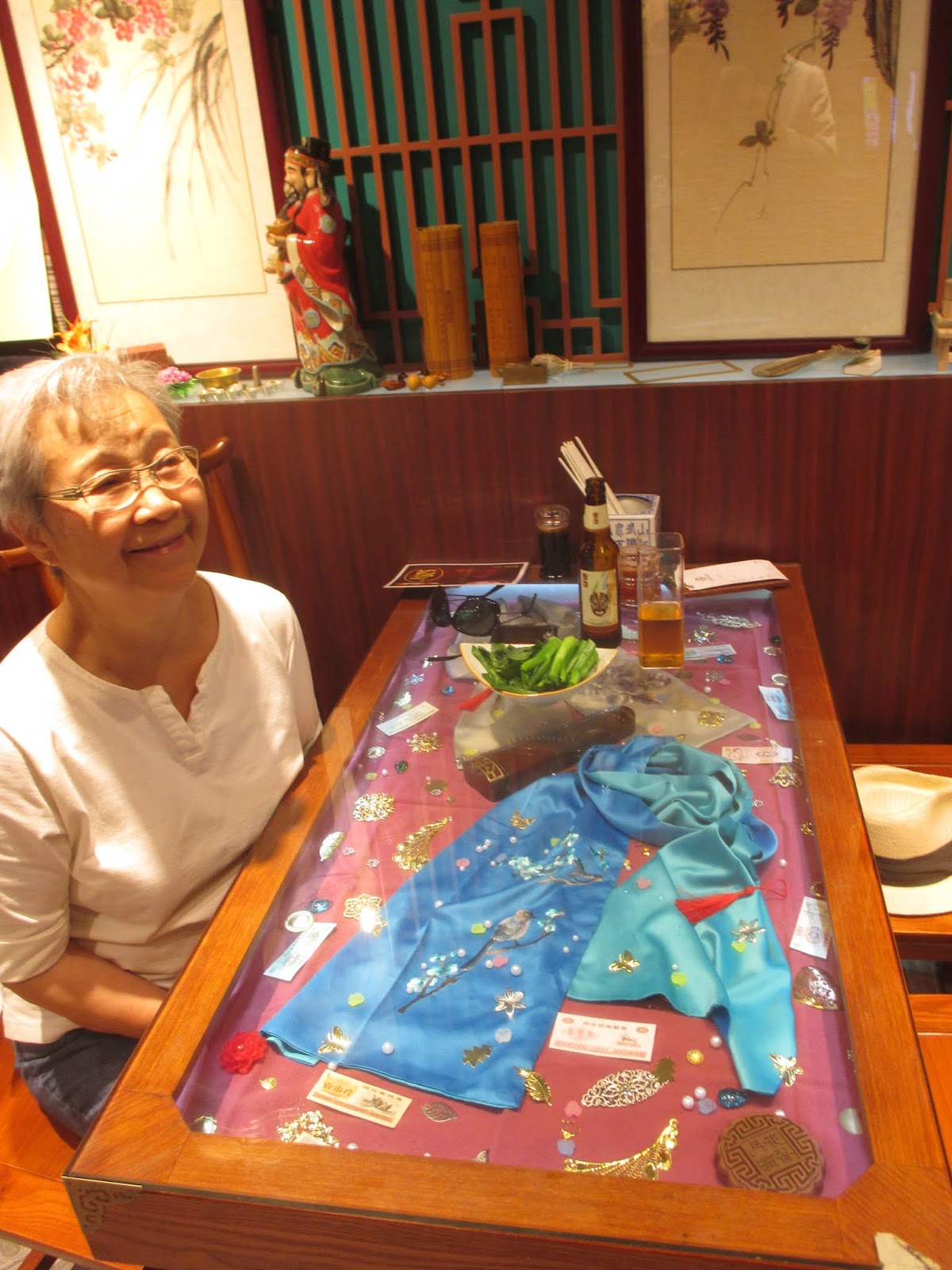
The restaurant had a Chinese lager with a colorful mask on the label. The name in Chinese translates as “snow flower.” It wasn’t bad, for a lager.

The tables were interesting in themselves. They were glass-top cabinets holding artful displays of Chinese tchotchkes and ephemera. 


There was tiny currency that looked like a translation of Monopoly money. Joanna told me they were ration tickets. 

We took a break at the hotel for the afternoon before we went out for a family dinner.

Gregory and Eugenia, Joanna’s son and daughter-in-law, are in Hong Kong. Eugenia is a citizen of Hong Kong, so they have homes here and in New York.

We met them in front of Maxim’s Cakes near Exit G of the Central MTR station. They led us to the restaurant, where Eugenia’s parents were waiting for us. 

Joanna and Helen, Eugenia’s mom, keep in touch by telephone. So they had plenty to talk about. Most of the conversation was in Cantonese. Every now and then Eugenia or Joanna would give me a quick recap. 

Sometimes someone would apologize for speaking Chinese. I don’t know why. It was fascinating.

The Peking duck was superb. The char shu was surprisingly tasty. The pork and vegetable soup was mild and soothing. (It’s believed to have medicinal properties, so I must be better off for it.)

We had an interesting dish in which minced crab was sauteed with vegetables and then baked in the shell. 

When the Peking duck comes out, the server carves small slices of meat and crisp skin, which you wrap in thin pancakes with some dressing. The meat left after that serving was removed, chopped small, and cooked with a few more ingredients.

Toward the end of the meal it came to the table. We ate it wrapped in leaves of iceberg lettuce. Its a tossup which I liked better, the first or second serving of the duck.

We got back to the hotel before 10. I was feeling wiped out. I hadn’t had a beer since the Snow Flower at lunch and didn’t even want to go to the Flame Bar for another. I just wanted to sleep.

So I did.

Sleep well, everyone.

Harry