Thursday, November 3, 2022

From Topiary to Train Wrecks


June 4-5


Driving and the heat had wiped us out, so we stayed in place and hid out at the Comfort Suites in Sumter, S.C.


That’s when I wrote the last report. I may have taken a nap, too. Who can remember what happened on a lazy day like that?


We learned of a place not far from us, the Simply Southern Bistro, where we had dinner.


Joanna had grilled salmon. It was supposed to come with a dill sauce, but she passed on that. 


I had shrimp and grits, very creamy with slices of sausage and bits of sweet pepper.


We both had collard greens, a bit spicy, as they often are in the South. Joanna got through maybe half of hers before she had to call it quits. 


Next day we set out for a county seat called Bennettsville. It’s a short run, maybe two hours if we drove straight through. 


I wanted to give us plenty of time to stop on the way, though, because we were going to pass something that I had just learned about—the Pearl Fryar Topiary Garden in Bishopsville.


Bishopsville about a half hour drive from Sumter. The garden is on Broad Acres Road, just off U.S. 15. 


When I first saw the name it suggested a rich lady who gave money to a public works project. But no, it’s better than that. Pearl Fryar is a man who lives in a ranch-style house with a large yard, just outside Bishopsville.


He has created a fanciful acre of wonders—arches and cones and layer cakes shaped from boxwood and conifers. It’s punctuated with something he calls “junk art,” structures of scrap metal welded into shrine-like standing structures, mostly about four or five feet high.


It looks like something out of Dr. Seuss, one of my favorite writers.


According to the bio on Wikipedia, Pearl Fryar is the son of sharecroppers. He served in Korea and worked for a Coca-Cola bottling plant in New York. When he retired he wanted to move into Bishopsville, but was denied entry. 


The white population of the town said he might not be able to keep his property up to local values.


So he settled just south of town and decided to prove them wrong. 


He picked up plants discarded by local nurseries and tended them in his yard. 


Some people have written about visits in which they have met Fryar. We weren’t so lucky. I’m sure he can’t come out to meet everybody who stops here. 


To get an idea of the effect he has had, you only need to ask Google to look up “Pearl Fryar,”


My favorite bit is the double arch that looks like two horns coming together. If you view it from one side, though, you see the carving of a dinosaur.


Now Fryar has plenty of neighbors and they appear to have picked up his spirit. Yard after yard down this cul-de-sac has hedges like mushrooms or hats or fountains. You can get the street view on Google Maps.


We spent the best part of an hour walking around this man’s yard and snapping photos. Some things, like the hedge of carved trees, for instance, just didn’t translate into two dimensions.


Scenery is like that. You need a pro to get it right.


We reached Bennettsville a little after one. Much to our surprise, the Quality Inn had a room ready. 


It seems a school graduation had drawn a lot of visitors to the area, and they had been booked up the day before. The cleanup crew was in the lobby taking lunch and told the lady at the desk that there was a room ready on the first floor.


We drove downtown to take a walk. It was Saturday and almost everything was closed.


There were few people on the street and few cars. 


Apparently most businesses in the old town are supported by the people who work for the county government.


The anchor of the neighborhood is an impressive courthouse, which is always a black hole that draws a galaxy of lawyers and bail bondsmen. 


We found a small park with a couple of historic buildings, both of which had been moved from their original sites and preserved here. 


One was a clapboard one-room schoolhouse called the Old Female Academy. The name seems ambiguous: the academy for old women? Or the old academy for girls?


The other building was much larger. It was the house of a local doctor and had been used by Sherman as his headquarters when his troops occupied the town in 1865.


Most restaurants that weren’t fast-food brands were closed. We had dinner later at Fiesta Tapatia, which I believe is local. 


Joanna wanted to try a margarita. The menu listed a range of fruit drinks available as margaritas and daiquiris. The waiter explained that the drink was a margarita if it was made with tequila and a daiquiri if it was with rum.


Joanna got a mango margarita. It was very sweet and not too strong. I had a couple of glasses of a house red listed on the menu as “Burgundi.”


We shared an order of chicken and beef fajitas. I hadn’t had fajitas in long while and enjoyed the tangy flavor of the marinade. Joanna thought they were a little dry. I had some wrapped in a tortilla, but mostly mixed them with my refried beans and rice.


When the bill arrived, I saw one entry, “FyA.” What? Like a dummy, it took me a few seconds to remember “frijoles y arroz.”


Next day was mostly on the road. We decided to make one long drive to Appomattox, about four to five hours, and stay two nights there, rather than make a string of one-night stays.


It worked fine. We even got lost around Greensboro. 


We were supposed to pick up U.S. 29 north from I-85, but didn’t see any connection. We stopped well east of where we were supposed to be and consulted the paper map. We found some alternative routes that would get us to U.S. 29 at a town called Reidsville.


We wound up taking three North Carolina routes: 61 to Osceola, 150 to Williamsburg, and 87 to Reidsville. Maybe 20 miles in all, and a lot more fun than the Interstate.


This time, when we crossed the state line into Virginia, Joanna got the whole message on the sign.


We stopped at a welcome center at Danville and learned that this indeed is the place where Old 97 was wrecked. According to Lester Flatt and Earl Scruggs, "It's a mighty rough road from Lynchburg to Danville and a line on a three-mile grade. It’s on that grade that he lost his airbrakes. You see what a jump he made.”


I know the song because my father used to sing it when I was a kid.


There were also displays devoted to one of the area’s leading industries—a case, for instance, of extinct brands of cigarettes.


We got to the Appomattox around five. Just about everything was closed there, too. One place was supposed to be open, the Rail Yard Restaurant, not far from the Appomattox Inn, where we are staying.


We got there to find the door locked and a sign in the window explaining that they were closing early because of a shortage of help.


We met a local man in the parking lot and asked where in town we could find a place to have dinner. He directed us to a large mall on the principal highway, U.S. 460. 


We found a Chinese restaurant, and next to it, Pino’s, a local pizzeria. Probably because it was one of maybe a half dozen or so places in town still open on Sunday, it was buzzing.


People were coming in groups of six and eight sometimes, but there were still tables open, so we got to sit right away. 


I had a personal size pizza with sausage and olives. It was pretty good. It wasn’t the D.O.P. Margherita from Woodstack, but it was all right. It didn’t cost $20 either.


I had it with a generic Chianti. Like the last one I had on this trip, this one tasted a little lighter than Chiantis I know. It may have been an American copy using Sangiovese grapes. Joanna took a sip and found even this one still too strong to enjoy.


Joanna ordered eggplant Parmagiana, but without the Parm. She’s cutting back on cheese in her diet. The sauce was made with crushed tomatoes, so it had a pleasant consistency. 


It was a bit on the sweet side, and I would have wanted a bit more salt and oregano, but that’s a matter of taste and not quality, so I’d have to rate Joanna’s dinner as passable, too.


A lot of places are closed here on Monday, too, so we may well wind up back at Pino’s again.


We’re going to the courthouse tomorrow. I’m not worried, though. I think they’ll let me off easy.


Everybody stay well and happy.


Best wishes.


Harry and Joanna


Tuesday, November 1, 2022

Welcome to nia and Points South


May 30-June 3


We haven’t been to the Carolinas in a while. We bypassed them on our trip west last winter. We were following I-81 then, and it goes directly from Virginia into Tennessee.


I had told Joanna about the swans and irises in Sumter, South Carolina, so we decided to go there.


It’s getting late in the Iris season. Many of the irises in Joanna’s backyard have already bloomed and faded. So we wanted to get to Sumter fast.


We took Interstate 95 South. Unless there’s a pressing emergency that forbids it, that means the first stop is North East, Md.


It’s a couple of hours and change from Montclair and has two great restaurants, Steak and Main, and Woody’s Crab House. We usually opt for Steak and Main, which was introduced to me by my sister Jamy and her husband, Bob, when they lived in Havre de Grace.


This time, though, we went to Woody’s, just for the change.


Joanna went Maryland all the way and opted for the house crab cake. 


That’s always a gamble. There’s no telling about crab cakes. Too many places cheat by using a nasty glop of finely ground crab meat with an overload of binder. It lets them skimp on the meat. 


I tried a sample from Joanna’s plate. Oh, this was the real thing, now, with big lumps of crab meat and nothing mealy about it.


I had oysters for dinner — seven on the half shell and five stuffed. That is, topped with crab and broiled. They went well with the two great ales on tap.


One was unfamiliar to me, Big Oyster Hammerhead IPA, which was mildly fragrant, adequately bitter with lots of flavor. 


The other was an old standby, Dogfish Head 60 Minute IPA, one of the best. 


Both ales are made in the same neighborhood: Big Oyster in Lewes, Del., and the Dogfish Head a few miles from there in Milton. 


Next morning we had about a hundred miles of Maryland left. We crossed into Virginia on the drawbridge that skirts the District of Columbia.


Joanna likes to catch photos of the state welcome signs. It can be difficult on the interstate highways. I guess you could pull over to the shoulder and get out to shoot a picture, but it can’t be a recommended practice. Besides, there’s really no shoulder on the bridge.


This time, Joanna only caught the “nia” on the welcome sign.


We hit some backups here and there, but for the most part it was clear sailing.


I did notice one thing that had changed since my last run through Virginia.


It’s a good thing that I’ve been this way a few times before, because it gave me the opportunity to visit the Stonewall Jackson Shrine. I wrote about this before. I’ve always been fascinated by the Jim Crow propaganda glorifying the Rebels. 


Stonewall Jackson, it seems, was elevated to a sanctity rating roughly on a par with the Virgin Mary. 


There used to be a white-on-brown sign on I-95 telling you that the exit for "the Stonewall Jackson Shrine" was coming up next. 


Not anymore. Now all you get to visit is “the Stonewall Jackson death site.”


There’s still a U.S. Army post called Fort A.P. Hill, named for a Rebel general killed at Petersburg. But the way things are going, though, I’m going to run out of Jim Crow propaganda to make fun of.


I couldn’t find my North Carolina road map when we left. It may be stuck in the trunk under the box with my shirts and ties. 


In any event, I needed to visit the North Carolina welcome center after we crossed the state line.


It came up sooner than expected so I missed the turnoff. Had to try again: Next exit we turned around and Joanna got another shot at catching the Welcome to Virginia sign. 


Again, I couldn’t stop or even slow down too much because of traffic. I did let up on the accelerator for a few seconds. Joanna got “Virg” this time.


We made it to Petersburg in about four and a half hours. We didn’t go into town, but stayed in a Comfort Inn just off the highway.


We had dinner at a Mexican restaurant called Arriero, which was theoretically within walking distance of the hotel. “Theoretically” because there was no crosswalk, no light, no sidewalks.


We could see the place across the road, but there was no way we were going to try hoofing it across that four-lane country road where nobody expects anyone on foot.


This wasn’t the only time when we’ve had to take the car to cross the street.


I had a margarita and a dish made with pork and chicken, mainly because it came with refried beans and rice. We had considered a couple of places but once we decided on Mexican I started to develop an overwhelming appetite for refried pinto beans. The margarita was on the weak side, but the food was great. I wasn’t disappointed.


Neither was Joanna, who had grilled tilapia, rice and a mix of vegetables. Give her fish, rice, and choi, and Joanna’s doing fine. 


Next day it was another five hours to Sumter.


On the way we stopped at the North Carolina welcome center, mainly to stretch. We picked up a couple of brochures about attractions that look interesting. 


One is the Vollis Simpson Whirligig Park & Museum. There was a sample whirligig next to the welcome center’s parking lot.


The other is The Museum of the Southeast American Indian, which is part of the University of North Carolina. 


We didn’t have time on this trip to visit either one, so we’ll catch them next time.


The hotel, Comfort Suites, is a hundred yards or so from an Outback Steakhouse. This time we could walk.


Outback is OK, but not great. They season the beef too much. Joanna can’t eat it at all, so she was still on a seafood diet, with a broiled salmon steak with no dressing.


I had a small sirloin. That’s a tasty cut, but the seasoning overshadowed the flavor of the beef.


The main draw for us in Sumter is the Swan Lake Iris Gardens, a public park comprising two private gardens that were donated to the city years ago by the families that owned them.


Irises grow in plots along the lake shore. Cypresses stand in the lake water and on the banks. 


The temperature was in the 90s so we had to take it easy. We listened to a few of the talking trees in the arboretum. You press a button on a little kiosk and get to hear the bald cypress, the southern magnolia, and the sweet gum talk about themselves.


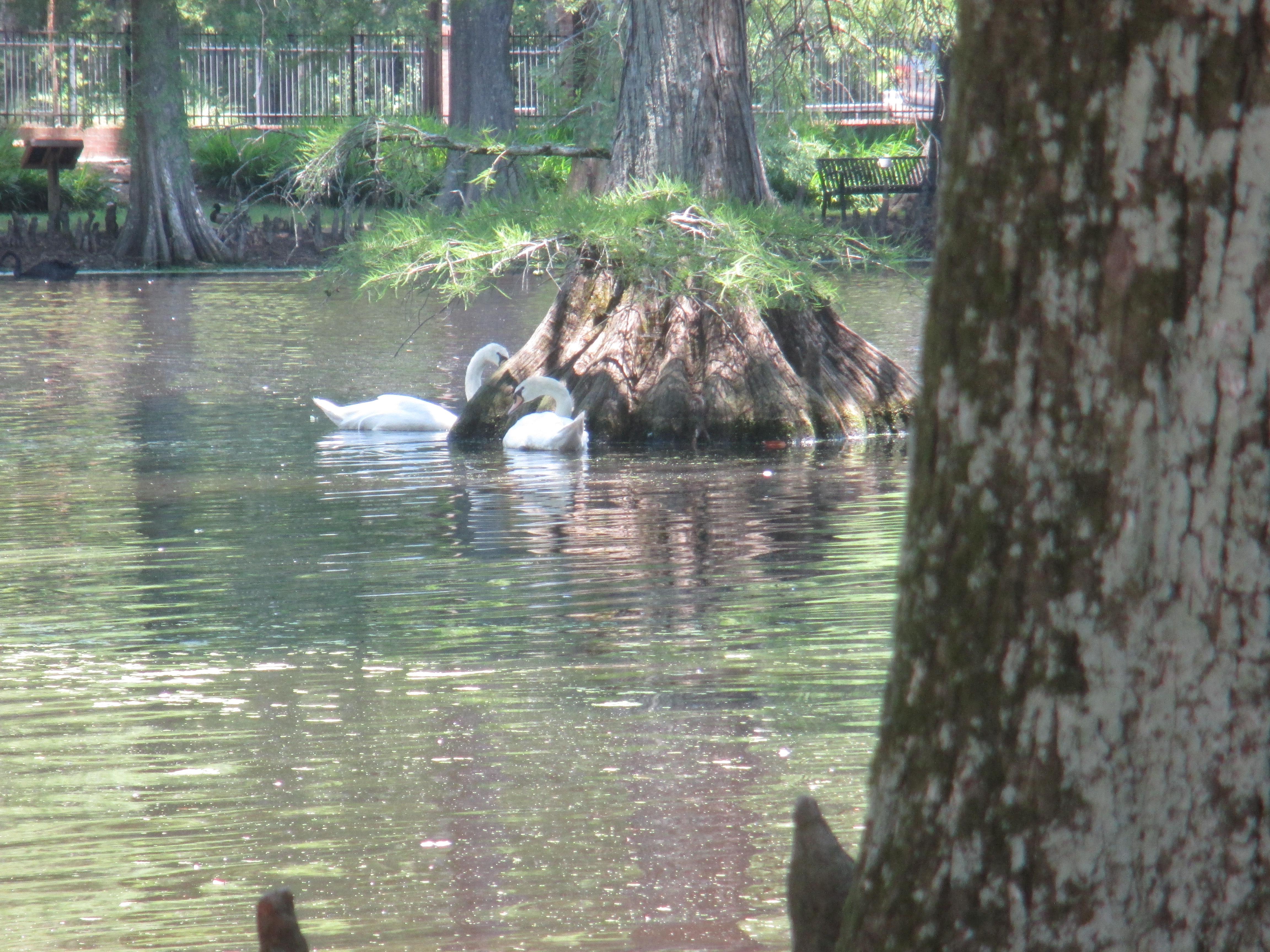
The park has representatives of the seven known species of swans. I don’t know all the names, but they include trumpeters, whistling swans, black swans, black-necked swans and mutes.


We sat on a bench in the shade for a while to listen to the trumpeter swans out on the water. At one point, a pair swam side by side playing a fanfare for two trumpets.


Another that I think is a mute swan—black mask, black fleshy bump between the eyes—paddled in our direction. Maybe it was posing for Joanna’s camera. It surely looked like it.


It came this way, that way, sat on the water, turned to show its best side.


At one point it came up onto the bank to preen. It shook its wings in a spectacular fashion and stayed in place till Joanna could get close and start shooting pictures again.


Sumter is near Shaw Air Force Base. When one of the jets flew low over the park, the roar was unmistakably military. They can’t sacrifice power by muffling the engines on a fighter.


The air shook. There were black swans, Canada geese, and what all in the air heading for cover or distance.


Joanna’s photo model, though, didn’t lift a feather. Even if it’s deaf as well as mute, it had to feel the vibration. If so, it didn’t trouble that creature one bit.


We passed a section of the park that was a butterfly garden, full of plants that draw them, and yes, there were butterflies in residence.


There is also braille garden. A lady, probably a volunteer, greeted us as we came to it. 


She was working in the garden with a colleague. She took time out to explain that the garden got its start as an Eagle Scout project in 1964. It was the creation of an 18-year-old student at the local high school. His mother was blind, and his goal was to create a garden that she could enjoy.


Plants are chosen for their fragrance and texture. Some plants are thriving in boxes, but after almost 60 years the boxes are showing signs of age. So they are being replaced.  


There are also plans to add more plants that will bloom to yield fragrance the year around.


There was more to see, but we were wiped out by the heat. We called it quits after the braille garden.


On our way to the park, we had passed Sambino’s Bistro, an Italian restaurant. We checked reviews when we got back to the room. They were mostly very good, so we gave it a try.


Joanna had spaghetti with sweet sausage. I went for the chicken Marsala. I didn’t sample Joanna’s dinner, but she said the sausage had lots of fennel, and to me that’s a good thing. 


I’ve had better Marsala. The sauce was very thick and made me wonder if it was made in the kitchen or taken out of a jar. Probably the jar. There were lots of mushrooms, and considering that we’re a long way from New Jersey, I rate it as not great, not bad. 


The Chianti was all right, but a little mild. It may have been an American-made copy. That doesn’t bother me, mind. My top drink at one time was Opici Chianti, which is made in New York State. I used to cook with it, drink it with meals, and get loaded on it.


We’re still at the Comfort Suites in Sumter. I booked us an extra day so we could do nothing—no driving, no touring. Just catching up and relaxing.


Which is exactly what we are doing.


Here’s hoping you take it easy, gang.


Love to all.


Harry and Joanna